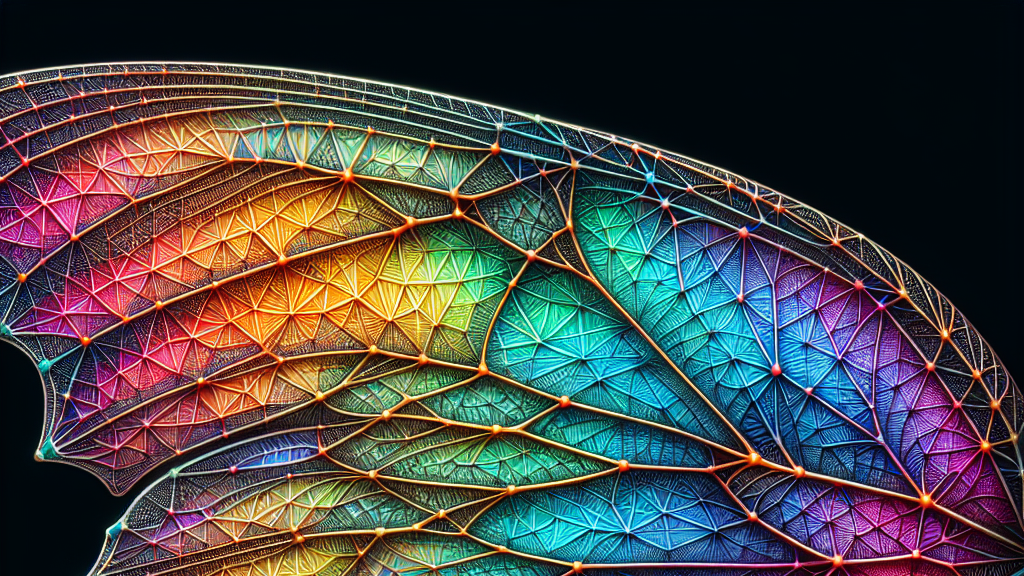
Ever wondered how butterfly wings get that mesmerizing shine and vivid color? Scientists have discovered that these beautiful wing colors originate from a special kind of structure called a gyroid. This intricate design isn’t just for show; it’s like nature’s way of building something as dazzling as it is complex, using nothing but the tiniest building blocks called nanomaterials.
The gyroid looks like a delicate, floating pattern, yet it has a strong, deeply interwoven structure. This study reveals that instead of being a simple, smooth structure, the gyroid in the wings of the Emerald-patched Cattleheart butterfly is a woven, helical pattern of fibers. You can imagine it like a spiderweb weaving itself into a 3D network, creating those vibrant colors that change as you move. The twist? These fibers aren’t crystalline, meaning they’re flexible and without fixed order, yet they structurally mimic a crystal’s ability to play with light.
But why should we care? Well, this fascinating discovery could be the key to creating new materials for everyday products. Imagine paints and fabrics that never fade or gadgets with screens that naturally provide a full range of colors without extra energy. By understanding these natural designs, we could unlock innovations in sustainable and more visually stunning technologies, all inspired by the humble butterfly.
Butterfly wings use microscopic structures, not pigments, to create vibrant colors!
FAQs
What are butterfly wing nanostructures?
Butterfly wing nanostructures are minute, intricate designs on the surface of butterfly wings that manipulate light to create vibrant colors, not unlike how a prism works to split light into a rainbow.
How do gyroid structures in butterfly wings form?
In butterfly wings, gyroid structures form via a woven pattern of fibers, rather than the previously assumed smooth formation, creating a network that intricately manipulates light to produce vivid colors.
Why is studying gyroid structures in butterflies important?
Studying gyroid structures in butterflies is crucial as it offers insights into nature’s engineering, allowing us to bio-mimic and develop new materials for technology, textiles, and other fields.
What is the difference between crystalline and non-crystalline structures in butterfly wings?
Crystalline structures have an ordered pattern, while non-crystalline ones, like those found in butterfly gyroids, lack fixed order, offering unique flexibility and light-manipulating properties without a rigid structure.
How might butterfly-inspired designs be used in the future?
Butterfly-inspired designs could lead to innovations in sustainable materials, creating items such as non-fading paints or energy-efficient vibrant displays, by mimicking the natural processes found in butterfly wings.
Background
Butterfly wings often display iridescent colors due to their microscopic surface structures called photonic crystals. These structures manipulate light through their specific shapes and arrangements, like tiny, elaborate mirrors reflecting and refracting light in particular ways. The gyroid structure found in some butterfly wings is a prime example of such a photonic crystal, showcasing nature’s ability to handle complex design and function at a nanoscale level.
History
The study of photonic crystals in butterfly wings has fascinated scientists for decades. In the past, they believed these structures followed simple, smooth designs to create colors. This recent study, however, reveals the presence of a more intricate, woven fiber nature, challenging old assumptions and adding a new dimension to our understanding of how natural nanostructures are formed.
Based on “Hierarchical woven fibrillar structures in developing single gyroids in butterflies” by Anna-Lee Jessop, Peta L. Clode, Martin Saunders, Myfanwy E. Evans, Stephen T. Hyde, James N. McPherson, Kasper S. Pederson, Jacob J. K. Kirkensgaard, Nipam H. Patel, K. A. DeMarr, W. Owen McMillan, Bodo D. Wilts, Gerd E. Schroeder-Turk, available on arXiv (arxiv.org/abs/2504.03459), used under CC BY 4.0 (creativecommons.org/licenses/by/4.0/).