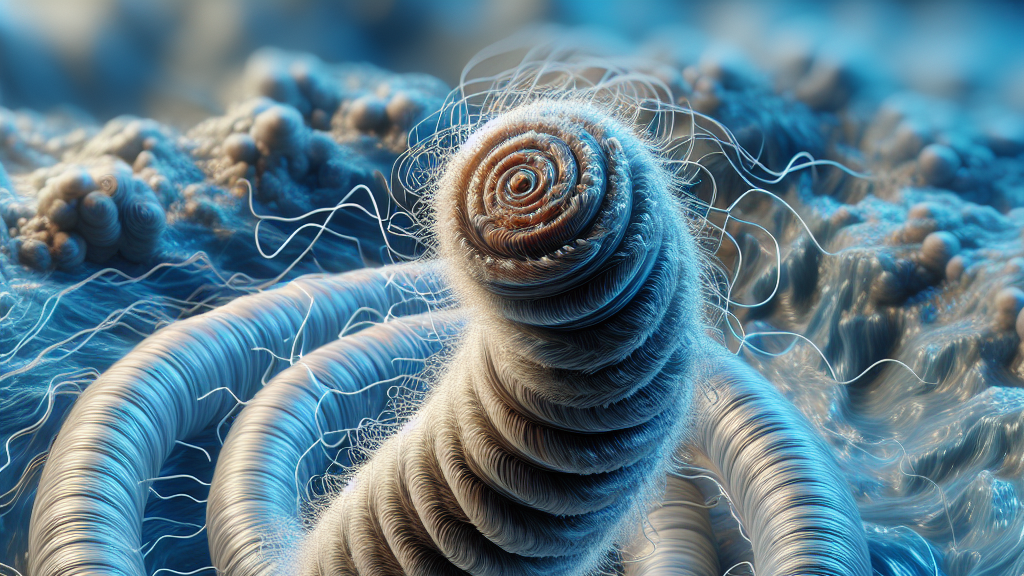
Did you know bacteria are like tiny Olympic swimmers, even in the chaotic soup of life? They face something called thermal noise, like a watery static that makes it hard to move straight. But these little swimmers have a secret weapon: their flagellum, a helical, spiral-shaped tail that not only propels them forward but stabilizes their direction.
In an exciting study, researchers used a simpler model to analyze how these bacterial tails work. This model treats the flagellum as a chiral (spiral-like) body, which helps scientists understand how bacteria overcome their chaotic surroundings. By looking at the different forces and movements involved, the researchers validated their model by comparing it with actual bacterial motion, focusing on how the flagellum affects thrust and direction.
Imagine if you could add a spiral tail that would help you walk straight in a strong wind. That’s what scientists hope to achieve—creating technology or medicine that can mimic these natural swimmers. By understanding more about bacterial movement, we could inspire innovations in fields like healthcare, where tiny machines might one day swim through the bloodstream to deliver treatments directly to where they’re needed most.
Bacteria’s spiraled flagella allow them to move perfectly straight, even in a chaotic environment!
FAQs
How does bacterial swimming relate to everyday life?
Bacterial swimming is essential for their survival and impacts areas like health and disease prevention. Understanding their motion could lead to innovations like tiny robots that deliver medicine directly within the human body.
What role does thermal noise play in bacterial motion?
Thermal noise is like background static that can affect how bacteria move. It’s a random motion due to temperature, and bacteria must overcome it to move in a straight line effectively.
Why is the flagellum important for bacterial motion?
The flagellum acts like a propeller, pushing bacteria forward. It stabilizes their movement and helps them maintain a straight path in chaotic environments, making it essential for their navigation.
What is a chiral two-body model, and why is it used?
This model simplifies the complex structure of bacteria and their flagella into a more understandable form. It helps scientists analyze bacterial movement and understand how these microorganisms navigate their surroundings.
Can the findings on bacterial motion help in other fields?
Yes! The study of bacterial motion can inspire technological advancements in medicine, such as the development of tiny robots that navigate through the human body to deliver targeted treatments.
Background
Bacteria are fascinating microorganisms that swim using tiny, spiral-shaped tails called flagella. Their environment is chaotic due to thermal noise, which is the jostling that comes from temperature-driven energy, pushing and pulling them randomly. However, they manage to move in a straight path by effectively using their flagella as stabilizers. Scientists study these movements to understand how bacteria navigate and survive, which has intriguing implications for technology and medicine.
History
For years, scientists have been interested in how bacteria swim through their liquid environments. Earlier studies focused on simple models of bacterial motion, but they lacked depth in explaining how bacteria maintain stable, linear paths. This research builds upon those foundations by introducing a chiral two-body model that better captures the complexity of bacterial movement, providing new insights into the stabilizing role of the flagellum.
Based on “Morphological Effects on Bacterial Brownian Motion: Validation of a Chiral Two-Body Model” by Baopi Liu, Bowen Jin, Lu Chen, Ning Liu, available on arXiv (arxiv.org/abs/2504.05053), used under CC BY 4.0 (creativecommons.org/licenses/by/4.0/).