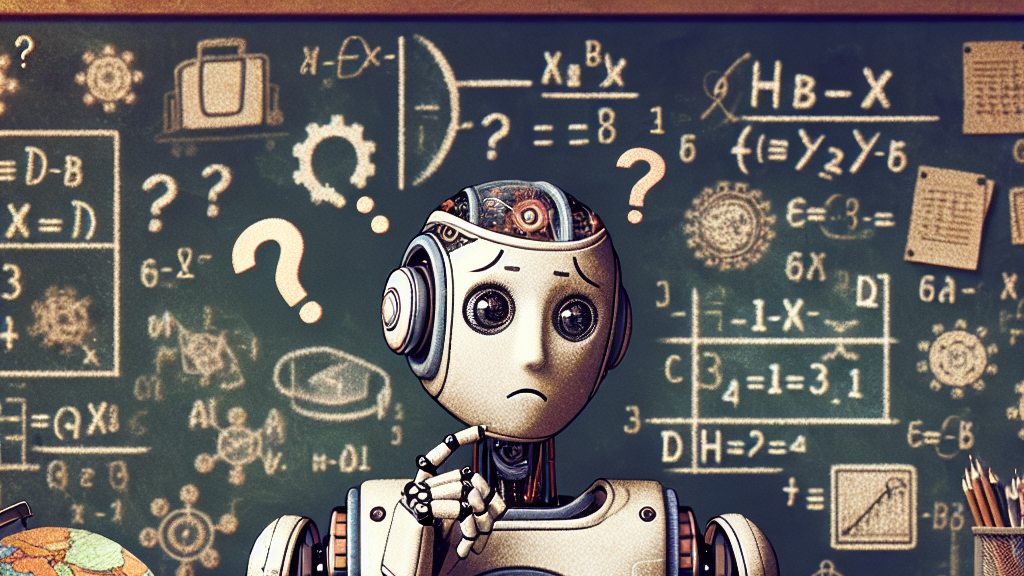
Imagine a world where robots and AI can pretend to be just like us—even having a hard time in math class. That’s what some of the smartest AI language models are trying to do: mimic students who aren’t doing so well in school. Sounds simple, right? But it turns out, even these state-of-the-art models get tripped up when asked to simulate what’s called ‘reversed performance’—essentially pretending they’re not that great at something on purpose.
Researchers designed a special test for these AI models to see if they could convincingly act as struggling students, especially in math scenarios. But surprisingly, none of these top-notch AI models could do it well, including some really famous ones from top tech companies. This flaw might not sound like a big deal, but it actually limits how we can use these models in virtual learning environments. Being able to simulate struggling students could be key to tailoring educational experiences and helping real students improve their skills.
Think about how we learn from role-playing games or simulations to practice for real-life situations. If AI can’t act like a struggling student, we miss out on creating more realistic educational tools. Imagine a classroom where AI ‘students’ help teachers spot weaknesses and adapt lessons for better teaching. This research pushes us to think about how we can advance AI systems to be even more like us, ready to handle every scenario, including the challenging ones.
Did you know that AI models can simulate different personas, but they struggle to act like they are not performing well on purpose?
FAQs
Why can’t AI models simulate struggling students effectively?
AI models have difficulty simulating personas with ‘reversed performance’ because they are designed to optimize for success rather than intentionally perform poorly, which is a concept known as counterfactual instruction following.
What are counterfactual instructions in AI?
Counterfactual instructions involve asking AI to perform tasks contrary to their design, such as simulating poor performance, to understand diverse scenarios better.
How does this research impact education?
This research highlights a limitation in AI’s ability to simulate non-optimal behaviors, which can restrict the development of realistic educational simulations used to tailor learning experiences.
What is the significance of using AI in educational simulations?
AI can help tailor educational experiences by simulating different student types, offering insights into students’ struggles and potential areas for improvement.
What does it mean for AI models to have ‘reversed performance’?
Reversed performance means AI models are asked to act like they are not performing well, which is challenging for AI that typically aims to optimize outcomes.
Background
Large Language Models (LLMs) are a type of artificial intelligence that can understand and generate human-like text based on the instructions they are given. These models are used in various applications, including simulating personas—or characters—in virtual environments. However, while simulating competence or success is relatively straightforward for these AI models, deliberately mimicking a lack of proficiency or poor performance, termed ‘reversed performance,’ is challenging. This study investigates these models’ ability to follow counterfactual instructions, which means intentionally underperforming to simulate realistic scenarios where skills are lacking.
History
The field of AI and large language models has been evolving rapidly, particularly with breakthroughs that allow these systems to simulate human-like interactions and perform complex tasks. Initially, these models were celebrated for their ability to replicate human-like conversation and provide accurate information. However, their limitation becomes evident when tasked with simulating failures or struggles, which are just as crucial for creating realistic virtual environments. This study is the first to propose a benchmark for evaluating how well these models can handle these reversed performance tasks, building on past research that focused on optimizing AI for success.
Based on “Can LLMs Simulate Personas with Reversed Performance? A Benchmark for Counterfactual Instruction Following” by Sai Adith Senthil Kumar, Hao Yan, Saipavan Perepa, Murong Yue, Ziyu Yao, available on arXiv (arxiv.org/abs/2504.06460), used under CC BY 4.0 (creativecommons.org/licenses/by/4.0/).