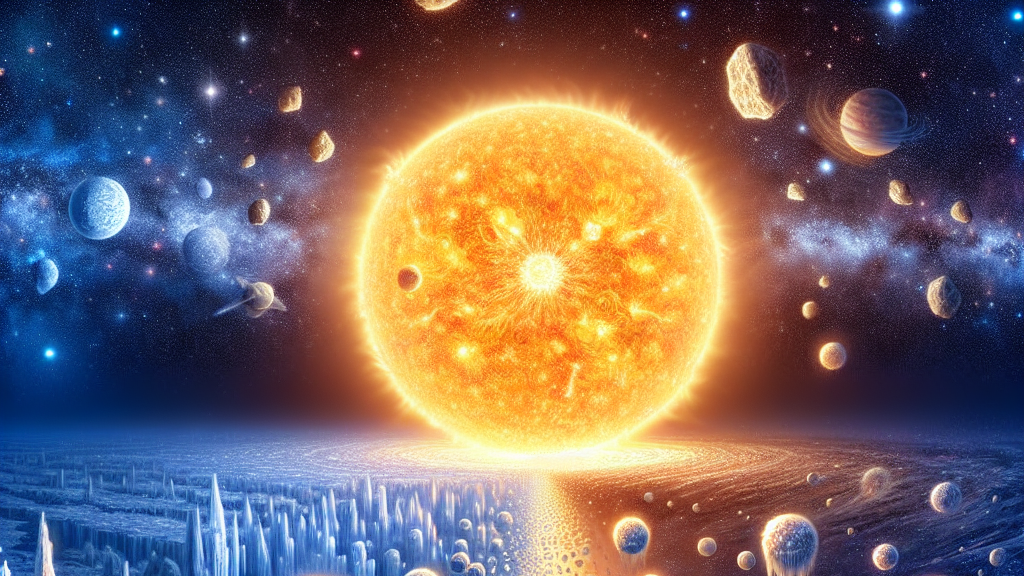
Have you ever thought of the Sun as something other than a blazing round ball in the sky? Surprisingly, it’s not a perfect sphere! Scientists have found that its slightly odd shape might hold the key to a mysterious cosmic secret—a hidden ring or disk that we can’t see with the naked eye.
Here’s how they cracked this mystery: When astronomers measure the Sun’s shape and how it affects Mercury’s orbit, they notice some peculiar differences. They suspect that there might be a faint ring of non-luminous material, like cosmic dust, playing games between the Sun’s shine and Mercury’s dance. This extra mass could potentially sway the gravitational balance, similar to how a hidden hand affects the motion of a spinning top.
Why should you care? Imagine if we discover a hidden halo of dark matter right in our cosmic backyard! This would not only solve the Sun’s peculiar shape puzzle but could also revolutionize our understanding of what’s really out there in space. Like a treasure map, future discoveries could guide our quest to unlock the Sun’s hidden mysteries and perhaps even change our picture of the universe.
The Sun’s not-spherical shape might hint at a hidden cosmic ring right next door!
FAQs
Why is the Sun not a perfect sphere?
The Sun’s shape is slightly flattened due to its rotation, which creates an effect known as oblateness. This can reveal details about its internal structure and rotation speed.
How does the Sun’s shape affect Mercury’s orbit?
The Sun’s gravitational pull, affected by its shape, creates variations in Mercury’s orbit. This helps scientists infer the mass distribution around the Sun.
What is the significance of finding a circumsolar dust ring?
Discovering a dust ring around the Sun could explain the discrepancies in measurements of the Sun’s oblateness and offer insights into dark matter’s role in our solar neighborhood.
Could a hidden ring affect Earth or other planets?
While the immediate effects might be minor, uncovering a hidden mass like a ring could enhance our understanding of gravitational forces in the inner solar system.
What future studies could help explore this mystery?
Future space missions focusing on the inner solar system and advanced telescopes could refine our understanding of the Sun’s mass distribution and uncover more about potential hidden structures.
Background
The Sun looks circular from our perspective, but, like a spinning top, it flattens slightly due to rotation—a phenomenon called oblateness. Measuring this shape can give clues about the Sun’s inner workings and how it affects nearby planets, like Mercury, through gravitational forces.
History
For decades, scientists have analyzed the Sun’s shape and gravitational influence to understand its composition. The introduction of space missions like STEREO has provided more data, suggesting the intriguing possibility of a circumsolar dust ring or dark matter, building on the foundations of physical astronomy and celestial mechanics.
Based on “Does the Sun have a Dark Disk?” by Gustavo F. S. Alves, Susan Gardner, Pedro Machado, Mohammadreza Zakeri, available on arXiv (arxiv.org/abs/2406.03607), used under CC BY 4.0 (creativecommons.org/licenses/by/4.0/).