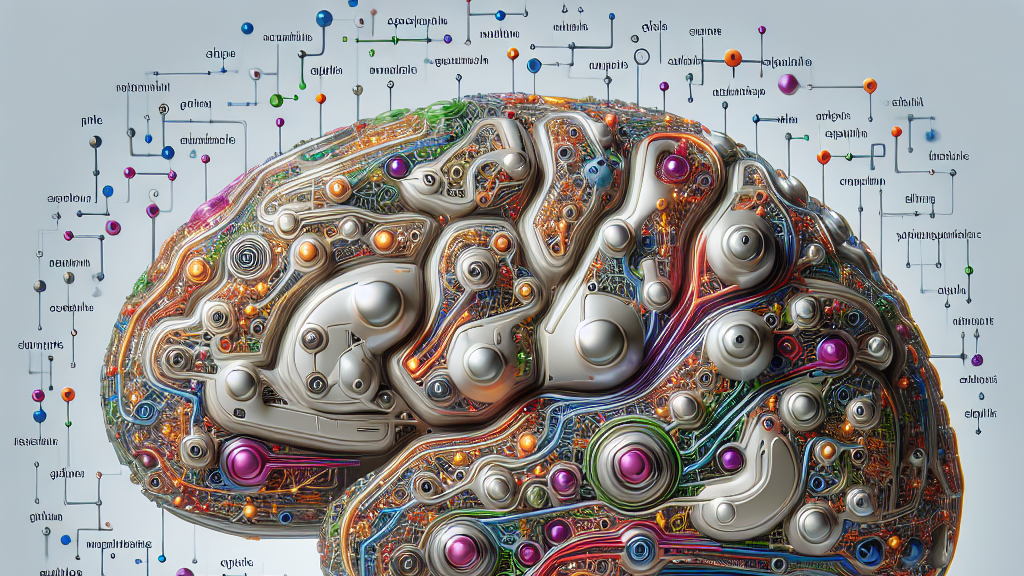
Think of large language models (LLMs) as advanced A.I. brains that blow our minds with what they can do, yet leave us scratching our heads about how exactly they achieve such feats. Researchers have embarked on a journey to unravel the mystery behind these A.I. models by comparing their learning process to how our brain might work, aiming to demystify behaviors like hallucinations and how they scale up with data and size.
Imagine these language models as super-efficient data sponges that store and recall information by using a method inspired by natural laws, like Heap’s and Zipf’s. By understanding these methods through a mathematical lens, researchers have developed a simplified model to simulate how these A.I. systems might compress and store information, making them smarter with each piece of data they encounter. This approach highlights a brain-like efficiency in acquiring and cataloging new knowledge.
The real kicker? Our improved understanding of these models could revolutionize how we design A.I. in the future, making them capable of dazzling new feats that mimic human learning even more closely. Picture language models that can predict outcomes with uncanny accuracy or store vast amounts of information in a way that mirrors the human memory, opening up incredible possibilities for education, tech, and beyond.
Did you know that some A.I. models can hallucinate, producing information not present in their data training? It’s like dreaming up facts they’ve never learned!
FAQs
How do large language models resemble human brains in learning?
The research explores how language models might store and process information in a way similar to human brains, using principles like Kolmogorov complexity and Shannon information theory to compress and predict data efficiently.
What are hallucinations in language models?
Hallucinations occur when models generate information not included in their training data. This research provides insights into why this happens using a simulated data model.
Why is understanding AI learning important for the future?
By decoding how A.I. learns, we enhance its capabilities, paving the way for innovative uses in technology and potentially developing A.I. that can learn and adapt as we do.
Background
Kolmogorov complexity is about finding the shortest possible description of an object, and Shannon information theory deals with optimizing data transmission. These principles help explain how A.I. models compress data for efficient storage and retrieval, similar to how our brain simplifies vast amounts of information.
History
The study of A.I. learning draws on fundamental principles developed over decades, such as compression algorithms and probabilistic models. These theories have evolved to help us understand not just A.I. but also human cognition, providing a basis for current models that simulate brain-like learning in machines.
Based on “Understanding LLM Behaviors via Compression: Data Generation, Knowledge Acquisition and Scaling Laws” by Zhixuan Pan, Shaowen Wang, Jian Li, available on arXiv (arxiv.org/abs/2504.09597), used under CC BY 4.0 (creativecommons.org/licenses/by/4.0/).