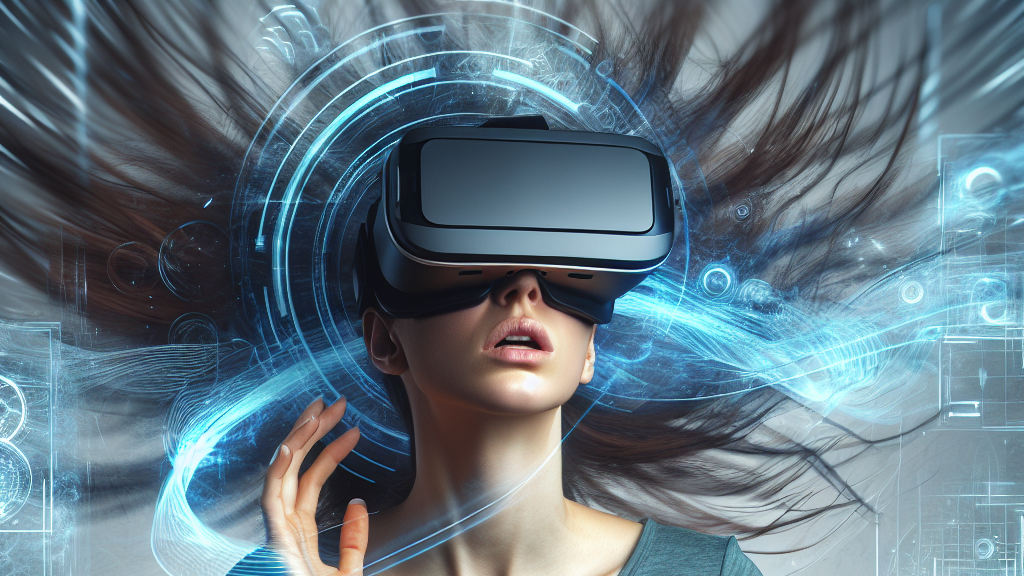
Imagine a world where the strangest concepts of quantum mechanics start to make sense. Quantum Intuition XR is breaking barriers by turning mind-boggling ideas into an engaging experience. With virtual reality, you’re not just reading about qubits and entanglement; you’re seeing them, manipulating them, and feeling a part of that mysterious world. It’s like watching a high-stakes science fiction adventure unfold right before your eyes.
The core of this innovation is a Mixed Reality headset that lets you interact with the very building blocks of quantum computing. You’ll see qubits float in mid-air, change their states, and even get entangled, all because of your interactions. This isn’t just a visual spectacle—it’s a scientifically accurate representation of quantum states. Think about it as playing a game with the universe’s most fundamental rules and truly understanding them for the first time.
Why does this matter to you? Picture a future where anyone, regardless of their science background, can grasp the basics of quantum mechanics, paving the way for breakthroughs in technology, communication, and beyond. Imagine students learning these concepts in a classroom, preparing them for careers in cutting-edge fields that are currently hard to comprehend. This research could soon make understanding the universe’s most elusive secrets as straightforward as a VR game.
A single qubit can exist in multiple states at once, unlike a classical bit, which can only be 0 or 1.
FAQs
What is Quantum Intuition XR?
Quantum Intuition XR is an interactive, extended reality experience that makes complex quantum mechanics concepts like qubits and entanglement tangible and easier to understand using virtual reality technology.
How does this interactive experience help with learning quantum mechanics?
By allowing users to see and manipulate quantum states in a virtual environment, Quantum Intuition XR turns abstract concepts into visual and interactive experiences, making them more intuitive and easier to understand for non-experts.
Why is it important to understand quantum mechanics?
Understanding quantum mechanics is essential for the advancement of future technologies, particularly in areas like computing, cryptography, and nanotechnology. Making these concepts accessible can hasten innovation and education in these fields.
Can anyone use the Quantum Intuition XR system?
Yes, the system is designed to be intuitive and accessible for non-experts as well as quantum specialists, allowing a broad audience to deepen their understanding of quantum phenomena.
What future developments are planned for Quantum Intuition XR?
Future developments focus on expanding multi-user interactions and refining the visual fidelity of quantum state representations to enhance the experience.
Background
Quantum mechanics is notorious for how it defies our everyday understanding of the world. Key concepts like superposition allow particles to exist in multiple states simultaneously, while entanglement reveals instant connections over distances. These phenomena underpin revolutionary ideas in quantum computing, using qubits as the fundamental unit, as opposed to classical computing’s binary bits. By making these ideas visually and interactively accessible, Quantum Intuition XR shifts the learning experience from theoretical to tangible.
History
The journey to understanding quantum mechanics has been long and complex. The field began in the early 20th century with pioneers like Albert Einstein and Niels Bohr. Over the decades, while quantum theory provided explanations for phenomena at atomic levels, its principles remained largely theoretical and abstract for non-experts. Recent advances in VR and AR technology, however, have opened new opportunities to bridge this gap by making the unseen, seen. Quantum Intuition XR is part of this evolution, offering a novel approach to visualize and interact with quantum systems in real-time.
Based on “Quantum Intuition XR: Tangible Quantum Mechanics using Interactive XR Experience” by Jamie Ngoc Dinh, Marven Wong, Matthew Brooks, Charles Tahan, Myungin Lee, available on arXiv (arxiv.org/abs/2504.08984), used under CC BY 4.0 (creativecommons.org/licenses/by/4.0/).