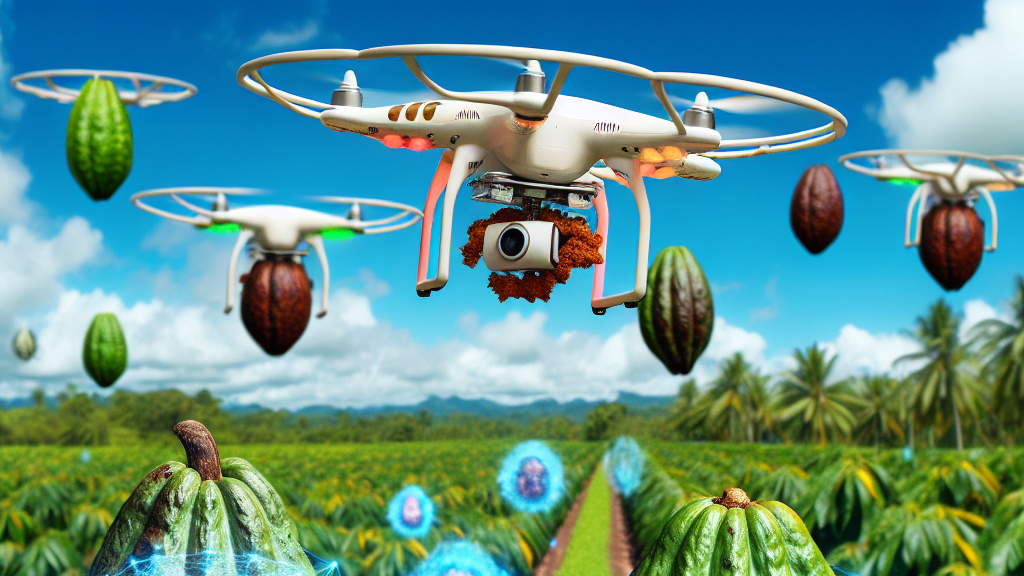
Imagine you’re about to unwrap your favorite chocolate bar, but just before you do, consider this: without the advancement of AI, there might be fewer chocolate bars to savor. How? Cocoa pods, the source of chocolate, are often attacked by diseases that can ruin crops. But thanks to cutting-edge research, we now have AI to help protect these precious plants.
Researchers have figured out that by using something called ensemble-based AI learning, computers can now identify diseases in cocoa pods with astonishing precision. They used a bunch of different AI technologies, like transfer learning and ensemble strategies (which are just ways to teach machines to spot patterns more accurately). By training these machines with thousands of images of cocoa pods, they’ve equipped them to distinguish between healthy pods and those affected by diseases like Black Pod Rot and Pod Borer.
In practical terms, this means that with AI, farmers might soon have an incredibly accurate tool to detect and act on early signs of disease, saving crops and ensuring that there’s plenty of chocolate to go around. Imagine drones or robots scanning fields, diagnosing plants in real-time, and helping farmers make decisions to boost production and minimize loss. It’s a sweet future indeed!
Cocoa pods can suffer from diseases that threaten up to 40% of global chocolate production!
FAQs
How can AI help with cocoa pod disease classification?
AI can analyze thousands of cocoa pod images to identify signs of diseases like Black Pod Rot and Pod Borer, distinguishing them from healthy pods with high accuracy.
What is ensemble learning and how does it improve disease detection?
Ensemble learning combines multiple AI models to increase accuracy and robustness, allowing for better disease detection by using various approaches to interpret data.
Why is transfer learning used in cocoa pod disease classification?
Transfer learning leverages pre-trained models to quickly adapt to new tasks, like cocoa pod disease classification, reducing the time and resources needed for training from scratch.
How accurate is the AI in classifying cocoa pod diseases?
The AI achieved a flawless 100% accuracy with a method called Bagging, outperforming other techniques like Boosting and Stacking, which also had high accuracy.
What impact could AI have on chocolate production?
By accurately identifying and helping manage cocoa pod diseases, AI can greatly reduce crop losses, leading to increased chocolate production and sustainability in agriculture.
Background
The study utilizes a powerful computational technique known as ‘ensemble learning,’ which combines several machine learning models to boost performance. This is paired with ‘transfer learning’, where a model developed for one task is reused as the starting point for another task, helping speed up and improve the learning process for new, but related, problems. The researchers used several pre-trained models to fine-tune them for recognizing specific cocoa pod diseases.
History
The use of convolutional neural networks (CNNs) for image classification has been around for a while, gaining prominence with models like VGG and ResNet. This study takes these models further by integrating them with ensemble strategies, which has been a growing trend in AI for achieving more reliable predictions. This research builds on longstanding efforts to use AI in agriculture, pushing boundaries by focusing on a critical cash crop like cocoa.
Based on “Enhancing Cocoa Pod Disease Classification via Transfer Learning and Ensemble Methods: Toward Robust Predictive Modeling” by Devina Anduyan, Nyza Cabillo, Navy Gultiano, Mark Phil Pacot, available on arXiv (arxiv.org/abs/2504.12992), used under CC BY 4.0 (creativecommons.org/licenses/by/4.0/).