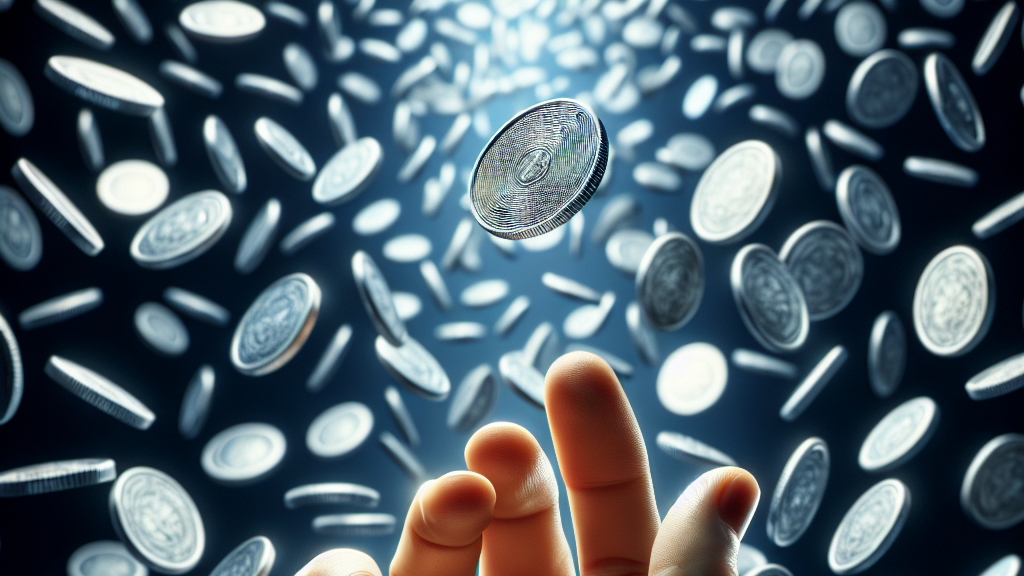
Have you ever flipped a coin and thought it was a perfect 50/50 chance whether it would land on heads or tails? Turns out, it’s not so straightforward! Recent research on over 350,000 coin flips has revealed that coins have a slight tendency to land on the same side they started on. This isn’t magic or luck; it’s physics in action! This subtle bias is rooted in the mechanics of how we flip coins—most people inadvertently flip in a way that slightly favors the starting side.
The study, inspired by a physics model from researchers Diaconis, Holmes, and Montgomery, found that a coin lands on the initial side about 51% of the time. That’s only a little more likely than random chance, but with enough flips, it becomes a noticeable trend. Even more interesting, this tendency varies from person to person, suggesting that our personal flipping style influences the outcome.
So, why should you care about this tiny bias? Well, imagine the implications in games, decisions, and even life events decided by a simple coin toss. This research suggests that with practice, we could even learn to control coin flips better or use this knowledge to our advantage. Understanding these little quirks in everyday randomness can make life just a little more predictable—and fun!
Did you know? A coin is slightly more likely to land on the side it started on, defying the idea of a perfect 50/50 chance!
FAQs
Why is a coin more likely to land on the side it started?
When a person flips a coin, the initial force and angle often result in the coin landing on the same side, as discovered in the study of over 350,000 flips.
How does this research affect the fairness of coin tosses?
While the bias is small, it suggests that not all coin flips are perfectly fair, especially when factors like flipping technique come into play.
Can people train to control coin flips better?
Yes, the study found that with practice, the bias decreases, indicating that flipping technique can improve with experience.
What does this mean for games decided by coin tosses?
Though the bias is slight, it could influence outcomes in games, potentially making coin tosses less random than we believe.
Does the type of coin affect the outcome?
No, the research showed that this same-side tendency does not vary across different coins.
Background
The concept of randomness often fascinates people, and coin flipping is a classic example of understanding probability. It is generally assumed that a fair coin has a 50/50 chance of landing heads or tails. However, factors like spin, flip speed, and the angle of the throw can slightly influence the outcome. This research explores these nuances and reveals a slight bias toward the starting side.
History
The idea of a biased coin flip has been explored for many years, with a notable model developed by researchers Diaconis, Holmes, and Montgomery in 2007. Their work suggested a slight bias when people flipped coins, but until now, extensive experimental data was lacking. This new study builds directly on their model, providing robust evidence from a massive dataset of coin flips.
Based on “Fair coins tend to land on the same side they started: Evidence from 350,757 flips” by František Bartoš, Alexandra Sarafoglou, Henrik R. Godmann, Amir Sahrani, David Klein Leunk, Pierre Y. Gui, David Voss, Kaleem Ullah, Malte J. Zoubek, Franziska Nippold, Frederik Aust, Felipe F. Vieira, Chris-Gabriel Islam, Anton J. Zoubek, Sara Shabani, Jonas Petter, Ingeborg B. Roos, Adam Finnemann, Aaron B. Lob, Madlen F. Hoffstadt, Jason Nak, Jill de Ron, Koen Derks, Karoline Huth, Sjoerd Terpstra, Thomas Bastelica, Magda Matetovici, Vincent L. Ott, Andreea S. Zetea, Katharina Karnbach, Michelle C. Donzallaz, Arne John, Roy M. Moore, Franziska Assion, Riet van Bork, Theresa E. Leidinger, Xiaochang Zhao, Adrian Karami Motaghi, Ting Pan, Hannah Armstrong, Tianqi Peng, Mara Bialas, Joyce Y. -C. Pang, Bohan Fu, Shujun Yang, Xiaoyi Lin, Dana Sleiffer, Miklos Bognar, Balazs Aczel, Eric-Jan Wagenmakers, available on arXiv (arxiv.org/abs/2310.04153), used under CC BY 4.0 (creativecommons.org/licenses/by/4.0/).