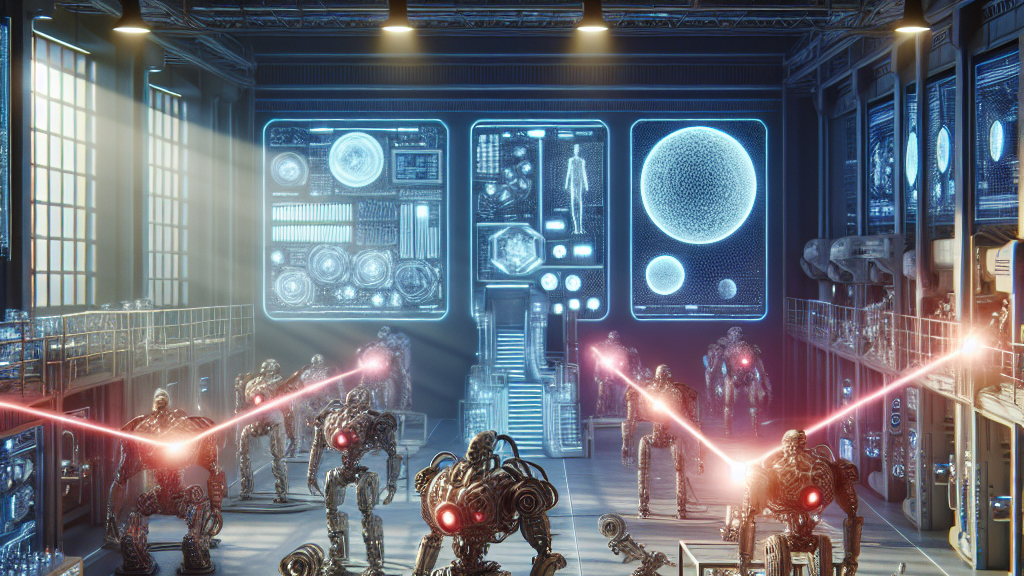
Imagine a world where tiny robots scurry around without ever needing to charge! This is the reality that’s becoming possible with Phaser, a groundbreaking system that uses laser beams to power and control robots wirelessly. No more bulky batteries; just sleek, light-powered machines efficiently doing their tasks.
How does it work? Phaser combines the precision of stereo-vision 3D tracking with powerful laser beams to not only energize but also communicate with robots. The lasers are so precise they deliver the needed power while sending data to keep the robots on task. This means that these robots can zip around at almost double the speed of existing methods, all without a battery in sight!
What could this mean for our future? Picture farms where tiny robots tend to crops all day, or warehouses where they organize products swiftly and silently. By eliminating the need for batteries, we reduce waste and make machines more efficient. Phaser’s laser-powered innovation might just be the key to unleashing the next generation of robotic helpers.
Phaser delivers over 110 mW/cm² to robots, nearly doubling their speed!
FAQs
How does Phaser power robots without batteries?
Phaser uses laser beams to wirelessly deliver energy and data to robots, eliminating the need for batteries and keeping them operational for longer.
What is special about Phaser’s laser technology?
The laser technology in Phaser can deliver concentrated power at multi-meter ranges, allowing robots to move faster and more efficiently while receiving error-free data.
How does Phaser impact current robot technology?
Phaser can nearly double the speed of small, battery-free robots, making them more effective and reducing the need for bulky power sources, leading to more sustainable and versatile robotic applications.
Background
The Phaser system is built on two main principles: laser-based power delivery and communication. It uses high-power laser beams to send energy directly to robots, enabling them to function without traditional batteries. Aided by stereo-vision 3D tracking, Phaser can precisely direct power to moving targets, ensuring efficient energy usage and communication through the same laser light.
History
In recent years, wireless power has evolved from concepts like radio waves to more focused methods like laser beams. Earlier robots often relied on batteries, limiting their operating time and flexibility. Phaser builds upon these developments by employing advanced laser technology for power and data transfer, paving the way for a new era of efficient, battery-free robotics.
Based on “Set Phasers to Stun: Beaming Power and Control to Mobile Robots with Laser Light” by Charles J. Carver, Hadleigh Schwartz, Toma Itagaki, Zachary Englhardt, Kechen Liu, Megan Graciela Nauli Manik, Chun-Cheng Chang, Vikram Iyer, Brian Plancher, Xia Zhou, available on arXiv (arxiv.org/abs/2504.17865), used under CC BY 4.0 (creativecommons.org/licenses/by/4.0/).