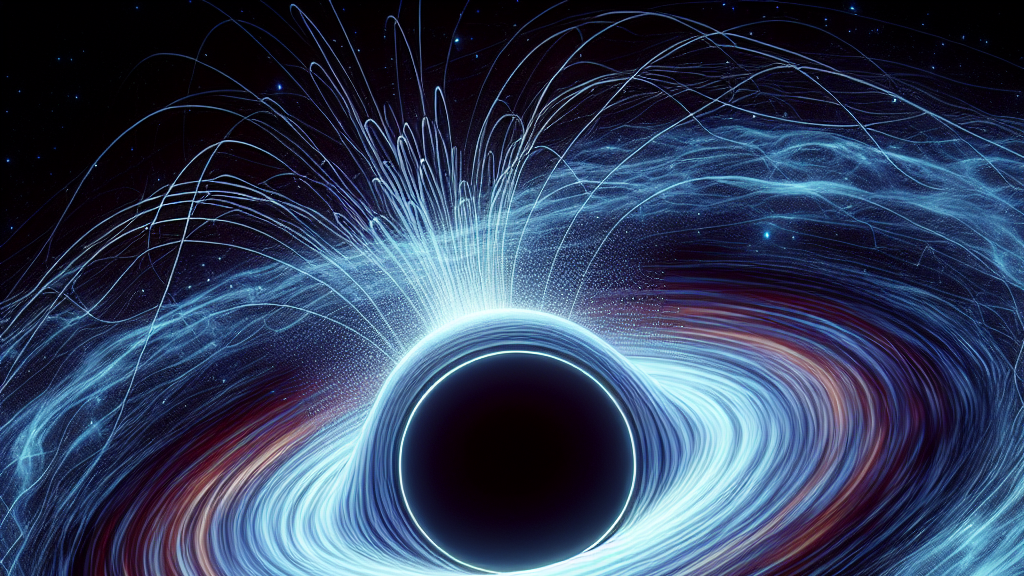
Black holes have long fascinated scientists and stargazers alike, primarily because of their mysterious nature and the idea that they swallow everything, even light. But what if these cosmic vacuum cleaners aren’t as secretive as we thought? Recent research dives deeply into the secrets black holes might whisper back to us, and it turns out they might spill more cosmic tea than we imagined.
This study revisits the famous idea proposed by physicist Stephen Hawking about black holes emitting radiation, known as Hawking Radiation. Here’s the twist: the scientists analyzed what happens when black holes are formed from different initial quantum states—imagine these as the ‘ingredients’ that create the black hole. By looking at black holes made from one big cosmic event versus two smaller ones, they discovered the radiation they emit could hold different information. Using a theory called Algebraic Quantum Field Theory, they could classify this information, like sorting recycled items, to see what secrets each black hole might reveal.
Why does this matter to you? Imagine using black holes as cosmic hard drives full of universe history. If scientists can decode the secrets hidden in their radiation, it might lead to new understandings of our universe’s past and future. One day, this research could even help us retrieve lost information from the edge of our galaxy or help ensure nothing truly disappears in the vastness of space.
Did you know? Black holes might not only consume information but also whisper some of it back to the universe!
FAQs
How can black hole radiation provide information recovery?
Black hole radiation, also known as Hawking Radiation, can reveal differences in the quantum states that formed the black holes. By analyzing this radiation, scientists can potentially retrieve information about the cosmic events that led to the formation of these black holes.
What does it mean when the research classifies information through stimulated emission?
Stimulated emission refers to the process where certain initial quantum states can influence the radiation emitted by black holes. This classification helps understand which information about a black hole’s formation can be recovered based on the radiation it emits.
Why are two smaller excitations different from one large one in black hole formation?
The study found that black holes formed from one large quantum event and those formed from two smaller ones of the same total mass produce different radiation signatures. These differences indicate that distinguishable information is retained in the radiation, providing insights into the black hole’s origins.
Background
Black holes are regions in space where gravity is so strong that nothing, not even light, can escape. According to Hawking’s groundbreaking theory, black holes emit radiation due to quantum fluctuations at their edges, a process now known as Hawking Radiation. Quantum states refer to the initial conditions or properties of the matter that creates the black hole. Algebraic Quantum Field Theory (AQFT) is a framework that helps describe how these quantum states can interact and produce observable effects, like radiation, in a way that can potentially be measured.
History
Stephen Hawking introduced the concept of black hole radiation in the 1970s, bridging the gap between quantum mechanics and general relativity. Previous research has focused primarily on how black holes evaporate over time due to this radiation, suggesting that black holes might not erase information permanently. This study expands on Hawking’s work by examining different initial quantum states and their impact on the information that might be retrieved from the radiation emitted by black holes.
Based on “Black Hole Information From Non-vacuum Localised Quantum States” by Ali Akil, Riccardo Falcone, Nicetu Tibau Vidal, Giulio Chiribella, available on arXiv (arxiv.org/abs/2504.17911), used under CC BY 4.0 (creativecommons.org/licenses/by/4.0/).