





































































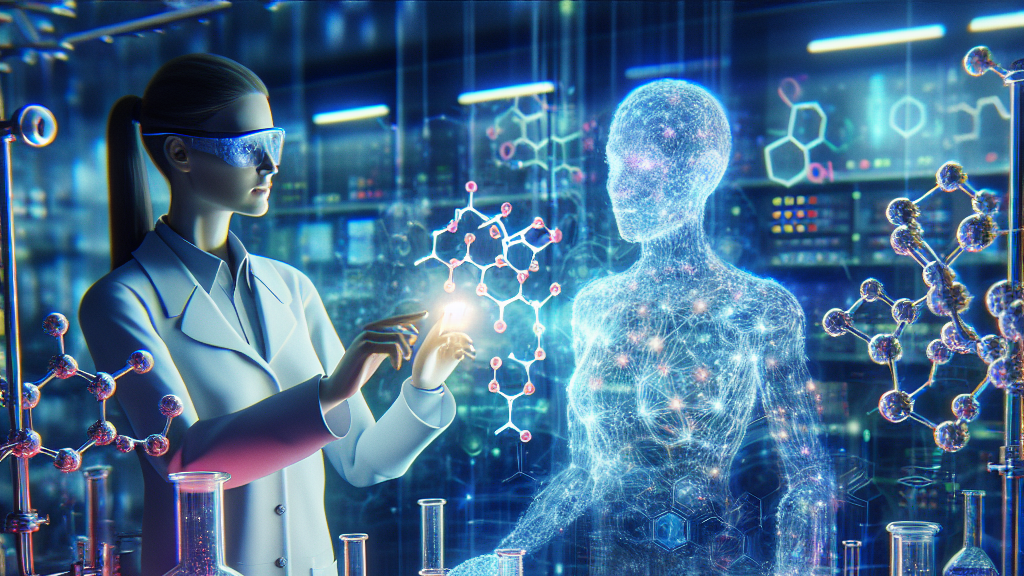
Imagine a future where creating groundbreaking medicines and materials is as easy as asking your phone for directions. That’s what scientists are working toward with Chemma, a cutting-edge AI designed to revolutionize chemical synthesis. Chemma’s ability to quickly assist in finding new ways to create molecules could mean faster development of new treatments and solutions for everyday problems.
At its core, Chemma is like the world’s smartest chemistry tutor that never rests. It’s a large language model, similar to the AI powering chatbots like those you use for customer service, but it’s fine-tuned with over a million questions and answers about chemical reactions. This means Chemma can predict how to create a specific molecule with greater precision than ever before. It’s not just theory either—Chemma was able to help discover a new chemical reaction in record time, collaborating with human experts to test different conditions and find the best solution in just 15 attempts.
The real magic of Chemma lies in its potential to speed up research and reduce costs in numerous industries—from pharmaceuticals that transform lives to energy solutions that could save our planet. Imagine if finding new, affordable, and eco-friendly materials became simpler. Chemma could be the key to unlocking faster discoveries, making a big difference in our daily lives by bringing innovative products to market much sooner and more sustainably.
Chemma, by collaborating with experts, can find chemical solutions in just 15 runs, which would usually take months of trial-and-error.
FAQs
What is Chemma, and how does it relate to AI chemistry?
Chemma is an advanced artificial intelligence model designed to aid in chemical synthesis by processing and understanding a vast amount of chemical reaction data. It helps in making informed predictions about how chemicals can be combined, thus accelerating the discovery of new molecules.
How does Chemma improve chemical synthesis processes?
Chemma improves chemical synthesis by dramatically reducing the trial-and-error typically involved in the process. It utilizes a fine-tuned AI system to predict reaction outcomes, optimize reaction conditions, and propose new synthesis pathways, saving both time and resources.
Can Chemma replace human chemists in the future?
While Chemma excels in processing data and suggesting experiments, it is intended to complement human chemists rather than replace them. Chemma’s strength is in providing data-driven insights that can enhance human expertise, helping chemists discover new reactions and optimize existing ones more efficiently.
How does Chemma’s AI model compare to traditional methods in chemistry?
Traditional methods in chemistry rely on extensive experimentation, which can be time-consuming and costly. Chemma uses advanced AI to analyze patterns and make predictions, which can significantly speed up the research process and improve accuracy over traditional trial-and-error approaches.
What breakthrough did Chemma achieve in the Suzuki-Miyaura reaction?
Chemma successfully helped in the discovery of a new reaction involving cyclic aminoboronates and aryl halides, achieving a high yield with only 15 experimental trials. This demonstrates Chemma’s ability to accelerate chemical research and improve outcomes in organic chemistry synthesis.
Background
Chemical synthesis is the process of creating new molecules by combining different chemicals. It underpins the development of new medicines, materials, and technologies. Traditionally, this process involves a lot of trial-and-error, which can be slow and expensive. However, the introduction of large language models like GPT-4—designed to understand and predict human language—has now been adapted to comprehend chemical reactions, potentially streamlining this complex process.
History
Historically, chemical synthesis relied heavily on the skill and intuition of human chemists, often requiring labor-intensive experimentation to discover new reactions. The emergence of computational chemistry and quantum-chemical calculations provided early attempts to predict reaction outcomes digitally. This study builds upon these advancements by introducing Chemma, a specialized AI using large language models to harness big data for chemical innovation, marking a significant leap towards more autonomous and efficient chemical research.
Based on “Large Language Models to Accelerate Organic Chemistry Synthesis” by Yu Zhang, Yang Han, Shuai Chen, Ruijie Yu, Xin Zhao, Xianbin Liu, Kaipeng Zeng, Mengdi Yu, Jidong Tian, Feng Zhu, Xiaokang Yang, Yaohui Jin, Yanyan Xu, available on arXiv (arxiv.org/abs/2504.18340), used under CC BY 4.0 (creativecommons.org/licenses/by/4.0/).



