





































































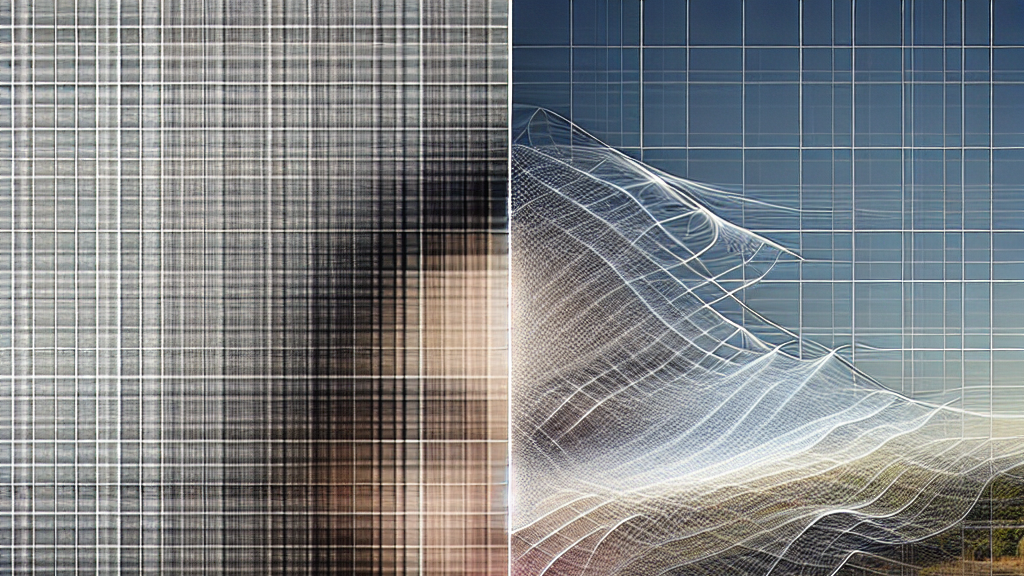
**Imagine taking a blurry photo and making it crystal clear—using math!** That’s exactly what this new research is exploring. By diving into the world of numbers and equations, scientists have discovered a new class of equations that sharpen images. It’s like having magical eyeglasses that turn fuzziness into clarity by applying complex math techniques. But don’t worry, you don’t need to be a mathematician to benefit from this innovation; you just get to enjoy clearer images in your everyday life.
So, what’s the magic behind these equations? They’re called thin-film equations with a fancy twist—a space-time dependent gradient nonlinearity. What that means in simple terms is that these equations adapt depending on the image, smoothing out the blur by considering how things change over time and across the image. Through clever mathematical tricks, researchers have cracked the code on how to determine when these equations will work effectively, ensuring that photos don’t just sharpen but do so in the best possible way. By running computer experiments, they’ve shown that these equations aren’t just theory—they work brilliantly for enhancing photos.
In practical terms, think about the next time you snap a photo at a concert or try to capture a sunset. Instead of ending up with a grainy mess, this research could lead to software that sharpens every detail, making your photo Instagram-ready. Beyond social media, these advancements could help in fields like medical imaging, where clarity is literally a matter of life and death. With these math-driven image enhancements, we’re stepping into a future where the blurriness of the past might just become a thing of the past!
Did you know that math equations can mimic the way light reflects off tiny details, helping to sharpen images just like our eyes naturally do?
FAQs
How do thin-film equations help in image sharpening?
Thin-film equations analyze changes across an image, using a time-space perspective to adjust the focus and enhance clarity.
What is gradient nonlinearity and how does it affect image sharpening?
Gradient nonlinearity adapts the equations based on the image’s characteristics, making the process more precise for sharper results.
What are the practical applications of this image sharpening research?
This research can improve everyday photos, medical imaging, and even enhance visual effects in digital art and film.
How do the findings of this research impact the future of photos and videos?
These equations could be integrated into software, offering a new standard for clarity in both photos and videos, enhancing everything from social media to professional cinematography.
What are blow-up solutions in the context of image processing?
Blow-up solutions refer to scenarios where equations predict instability, which researchers have learned to manage to maintain image clarity.
Background
This research hinges on thin-film equations, a type of mathematical formula that helps model the way liquids spread. In the context of image sharpening, they account for how each part of an image interplays over time and space. Gradient nonlinearity, a core part of this, lets the equations adjust based on the specific details of the image, offering a tailored approach to resolving blurriness.
History
In the past, image processing relied on basic algorithms that treated every picture the same way. Over time, researchers have developed more advanced methods, borrowing from fluid dynamics and other fields, to create smarter image processing techniques. This study takes it further by applying a new class of thin-film equations, overcoming historical limitations and setting new standards for image clarity.
Based on “A class of thin-film equations with space-time dependent gradient nonlinearity and its application to image sharpening” by Yuhang Li, Zhichang Guo, Fanghui Song, Boying Wu, Bin Guo, available on arXiv (arxiv.org/abs/2504.19211), used under CC BY 4.0 (creativecommons.org/licenses/by/4.0/).
