Connect with us

Search by keyword

Space

Could AI Save Us from Dangerous Asteroids?

AI could be our best bet for identifying and predicting potentially dangerous asteroids, making space travel and planetary defense more robust.

Could AI Save Us from Dangerous Asteroids
✨Researched by humans. Explained by robots. Learn more.

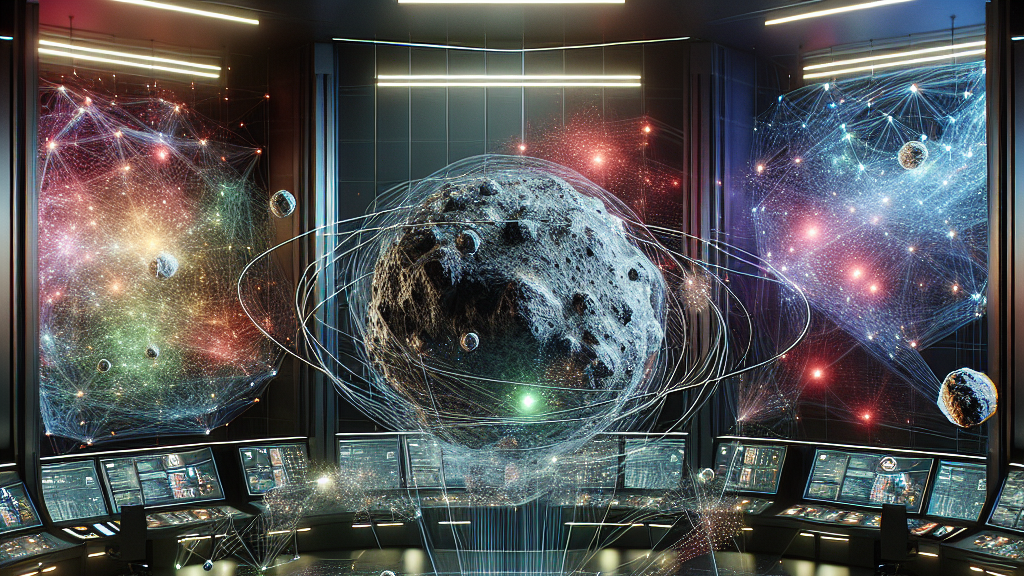
Imagine if artificial intelligence could help us dodge asteroids heading towards Earth. Sounds like science fiction? It’s actually becoming a reality! Researchers have used a cutting-edge AI technique called Graph Neural Network to model asteroids and predict which ones might pose a threat. This is a game-changer for keeping our planet safe and ensuring space missions navigate safely through the cosmos.

Traditionally, identifying hazardous asteroids relied heavily on outdated methods that missed subtle connections between them. But with new AI tech, scientists can examine asteroids as if they were points on a graph connected by their similarities. By feeding in detailed data on 958,524 asteroids, the AI can predict with stunning accuracy which ones are a risk. Even with a tiny fraction labeled as hazardous, the AI achieved a high accuracy rate, proving its potential in space safety.

In the future, this technology could be part of NASA’s Neo Surveyor missions or ESA’s Ramses projects, providing an extra set of eyes to monitor asteroid threats autonomously. Imagine a world where space travel is safe, knowing an AI is constantly analyzing the skies to keep us safe. It’s like having a powerful cosmic shield ready to protect our planet and ensure space missions sail smoothly through space.

Did you know that the AI model can handle over 958,000 asteroids at once, making it a super-efficient space detective?

FAQs

What is a Graph Neural Network and how does it help with asteroids?

A Graph Neural Network is an advanced AI technology that models asteroids as connected data points, helping identify relationships and patterns among them to predict potential threats.

Why is it important to classify potentially hazardous asteroids?

Classifying potentially hazardous asteroids is crucial for planetary defense to protect Earth and ensure safe and successful space missions by identifying and mitigating collision risks.

How accurate is the AI in identifying hazardous asteroids?

The AI model boasts an impressive accuracy of 99%, showing that it is highly reliable in identifying which asteroids might be dangerous.

What are the key features the AI looks for in hazardous asteroids?

The AI focuses on features like albedo (reflectiveness), perihelion distance (closest point to the sun), and the semi-major axis (orbit radius) to determine asteroid hazards.

Background

Graph Neural Networks are a type of artificial intelligence that processes data structured as graphs, which are made up of nodes (data points) connected by edges (relationships). In this study, asteroids are modeled as nodes with information like their orbits and physical properties. The edges between nodes represent their similarities, allowing the AI to understand how the asteroids relate to each other and which ones might be potentially hazardous.

History

Efforts to track asteroids and assess their potential hazard have relied on traditional methods that often missed the finer details of asteroid relationships. Over time, with the increased availability of data and computing power, AI technologies have been increasingly applied to this challenge. This study builds on previous work by applying a sophisticated AI model, a Graph Neural Network, which leverages new techniques for better accuracy and interpretability, offering a significant leap forward in classifying hazardous asteroids.

Based on “Explainable Deep-Learning Based Potentially Hazardous Asteroids Classification Using Graph Neural Networks” by Baimam Boukar Jean Jacques, available on arXiv (arxiv.org/abs/2504.18605), used under CC BY 4.0 (creativecommons.org/licenses/by/4.0/).

Trending

Latest

Can AI Save Water Discover How

Computers

AI is transforming the tech world, but it uses lots of water! A new tool, SCARF, helps us measure and reduce AI's water footprint,...

Whats a Forbush Decrease and Why Should We Care Whats a Forbush Decrease and Why Should We Care

Space

Scientists just observed the biggest solar storm event in years, revealing unexpected cosmic ray patterns. Understanding these changes could help us protect our technology...

Can Cars Spot Danger Faster Than Humans Can Cars Spot Danger Faster Than Humans

Computers

Think about how quickly you react when something unexpected happens on the road. This research brings us closer to creating self-driving cars that can...

Can Fear of the Other Stop Social Harmony Can Fear of the Other Stop Social Harmony

Physics

Fear of the unknown might make it harder for people to agree and get along. This study shows that when people have strong xenophobic...

Can AI Revolutionize Breast Cancer Diagnosis Can AI Revolutionize Breast Cancer Diagnosis

Electricity

This research introduces a groundbreaking AI model that can accurately assess HER2-positive breast cancer using widely accessible staining methods, potentially revolutionizing how we diagnose...

Can AI Transform Your Singing into a Choir Can AI Transform Your Singing into a Choir

Computers

Imagine singing solo and having AI turn you into a choir. This research unveils a groundbreaking AI tool that transforms your voice into rich...

You May Also Like

Computers

AI is transforming the tech world, but it uses lots of water! A new tool, SCARF, helps us measure and reduce AI's water footprint,...

Computers

Think about how quickly you react when something unexpected happens on the road. This research brings us closer to creating self-driving cars that can...

Electricity

This research introduces a groundbreaking AI model that can accurately assess HER2-positive breast cancer using widely accessible staining methods, potentially revolutionizing how we diagnose...

Computers

Imagine a machine capable of reading ancient books, deciphering complex pages with precision! This research is paving the way for AI to unlock the...

Economics

Discover how AI models can unknowingly favor certain races in mortgage decisions and how new methods could dramatically reduce these biases, fostering a fairer...

Computers

This research explores how AI models designed to understand both images and words might improve their performance simply by teaching themselves to think better....

Computers

Imagine if playing games could make a computer program better at understanding and creating text! This research suggests that by using creative tasks like...

Computers

Dive into the world of AI mistrust, where computers don't always know when they're wrong! Discover how teaching AI to see like us might...

Computers

What if talking to a robot could feel as comforting as a therapy session? This research uncovers the striking similarities between human therapists and...

Copyright © 2024 8ig8rain.

Disclaimer: The content on 8ig8rain.com consists of AI-generated summaries of scientific abstracts from arXiv. Please note that most arXiv abstracts are preprints and may not have undergone formal peer review. While these summaries aim to convey key ideas and potential applications, they are provided for informational purposes only and should not be interpreted as validated scientific findings or professional advice. The summaries are intended to educate, spark curiosity, and inspire further exploration of science.