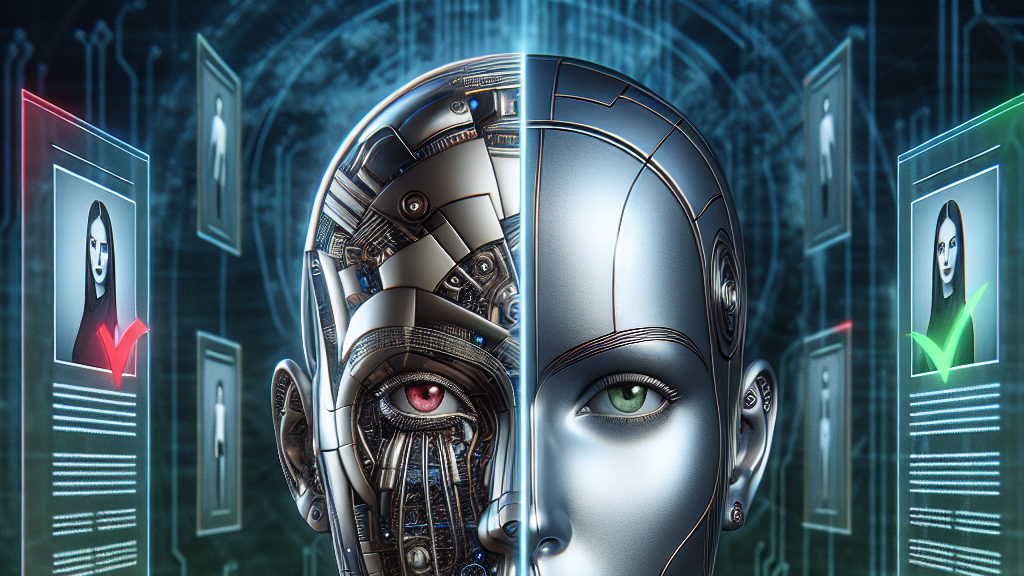
Could AI be undermining gender equality in the workplace? Imagine you’re a company using advanced AI to pick the best candidates for job interviews. You’d think this would eliminate human bias, right? But what if I told you these systems might actually favor men over women, especially in high-paying roles? That’s exactly what researchers found when they tested several AI models on job postings.
The research audited multiple AI models to see if they were biased. They discovered that most models recommended male candidates more often than female candidates for interviews, particularly in male-dominated fields like technology or finance. It seems that these AI systems are learning and reinforcing existing gender stereotypes, favoring men for certain types of jobs and women for others. The study even revealed that the AI’s behavior changes with simulated recruiter personas, aligning with traditional stereotypes when agreeable traits are simulated.
This research is crucial because it impacts how companies might address diversity and fairness in hiring. Imagine a future where your job application is judged not just by your resume but by an AI that might inherently prefer a male candidate. Such biases could limit opportunities across industries and stall progress towards true workplace equality. If AI can be adjusted to recognize and reduce these biases, we might begin to see fairer hiring practices and more inclusive workplaces.
Did you know? Some AI models used for hiring might actually prefer male candidates over female ones, even if they’re equally qualified!
FAQs
How does AI in recruitment exhibit gender bias?
AI systems, particularly large language models, can exhibit gender bias by recommending male candidates for interviews more often than female candidates, especially in high-paying and male-dominated fields. This occurs because these models learn from real-world data that includes historical gender biases.
Why do AI models favor men in certain job roles?
AI models often reflect societal biases present in the training data. If the job postings used to train these models contain gendered language or historical biases, the AI will likely perpetuate these biases by favoring men in roles traditionally seen as male-dominated.
Can AI-based recruitment tools be adjusted to reduce bias?
Yes, AI models can be adjusted to reduce bias. Researchers are exploring ways to infuse AI with diverse perspectives, like simulating less agreeable recruiter personas, which can help decrease stereotyping and promote fairness in AI-driven hiring processes.
What implications does AI bias in hiring have for workplace diversity?
AI bias in hiring can negatively impact workplace diversity by limiting opportunities for women and reinforcing occupational segregation. Addressing and mitigating these biases can help companies foster more inclusive and fair environments.
Is there a way to identify gender-neutral job postings?
Yes, a comprehensive analysis of linguistic features can help identify gender-neutral job ads. Using AI to evaluate and adjust job postings can promote neutral language, thus reducing gender bias in candidate selection.
Background
Generative artificial intelligence, especially large language models, are often used to process and analyze data for decision-making, such as recommending candidates for job interviews. These models learn patterns from large datasets, including job postings, that may contain historical biases, such as gender roles in specific job markets. The research aims to identify if these patterns lead to biased outcomes in AI-driven hiring tools.
History
The use of AI in recruitment has evolved from simple automation tools to complex decision-making systems. Early AI systems focused on keyword matching, while recent advancements allow for nuanced analysis using large language models. Historical biases in training data, such as gender stereotypes, have been known to influence AI decisions, prompting research into identifying and mitigating these biases to ensure equitable hiring practices.
Based on “Who Gets the Callback? Generative AI and Gender Bias” by Sugat Chaturvedi, Rochana Chaturvedi, available on arXiv (arxiv.org/abs/2504.21400), used under CC BY 4.0 (creativecommons.org/licenses/by/4.0/).