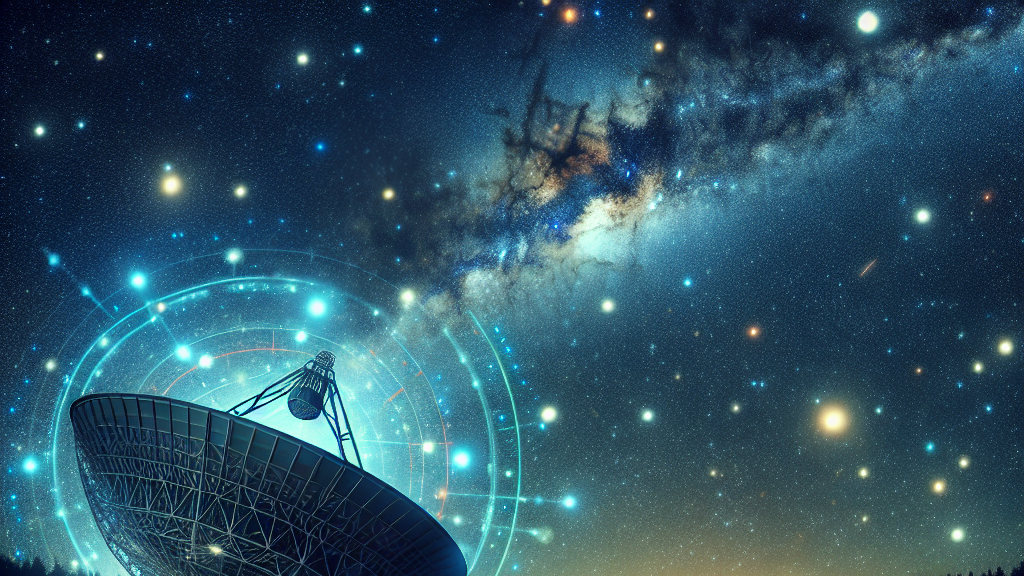
Are aliens trying to communicate with us across the vastness of space? That’s a question that continues to capture our imaginations. Researchers have harnessed the power of artificial intelligence to search for alien signals among the stars. By using advanced machine learning techniques, they’re sorting through a massive amount of data collected by radio telescopes, trying to distinguish potential alien signals from the noise of Earth’s own technology.
The way they do it is fascinating. These scientists train computers to identify anomalies—essentially, anything that doesn’t look quite right—within the data they collect. They focus on signals that might look like the ones our own devices emit but must be from far-off stars. Pinpointing these signals involves delving into deep, multidimensional spaces, a bit like finding a needle in an astronomical haystack, but with machines as the magnet.
So why does this matter to you and me? Well, imagine a future where we finally confirm that we aren’t alone in the universe. This research takes a step towards that possibility. If successful, it could transform our understanding of our place in the cosmos. It might even lead to new technologies or ways of thinking inspired by extraterrestrial life. The search for aliens isn’t just about what’s out there; it’s about discovering the potential of our own technology and imagination.
Each one of us is made of stardust, the same material that might be communicating with us from distant galaxies!
FAQs
How does the search for extraterrestrial technosignatures work?
Researchers collect data from radio telescopes and utilize machine learning algorithms to detect anomalies that might indicate alien technology. This involves analyzing massive amounts of data and filtering out signals that resemble human-made technology to find unusual patterns.
Why do scientists think extraterrestrial signals might look like human technology?
Scientists speculate that any technologically advanced extraterrestrial civilization might use similar communication methods as humans, which would make their signals appear like human-made radio waves, thus making it challenging to distinguish them from our own.
What happens if a potential alien signal is detected?
If a signal is identified as a strong candidate, it undergoes further scrutiny by scientists to eliminate any possibility of interference from Earth-based sources. If it passes these checks, it is considered for more in-depth study and analysis.
Why isn’t finding alien signals easy despite advanced technology?
The challenge lies in the vastness and complexity of space. There are enormous amounts of data to sift through, and potential alien signals could be faint, intermittent, or easily mistaken for Earth-based interference, requiring sophisticated analysis techniques.
Has this research found any conclusive evidence of alien life so far?
As of now, the research has not confirmed any conclusive evidence of extraterrestrial life. However, it continues to refine and advance our methods for searching, increasing the likelihood of a significant discovery in the future.
Background
To understand this research, it’s important to know that technosignatures are signals or markers indicating technologically advanced civilizations. Radio telescopes collect immense volumes of data from the cosmos, and machine learning algorithms are essential to quickly and accurately analyzing this data for any signs that stand out from the usual noise, which could suggest alien technology.
History
The search for extraterrestrial intelligence has been a part of scientific exploration for decades, beginning with the first search for radio signals in the 1960s. Over the years, advancements in technology have improved our ability to collect and analyze data. This study builds on past efforts by incorporating machine learning, allowing scientists to manage and interpret the vast amounts of data generated by modern telescopes.
Based on “Using anomaly detection to search for technosignatures in Breakthrough Listen observations” by Snir Pardo, Dovi Poznanski, Steve Croft, Andrew P. V. Siemion, Matthew Lebofsky, available on arXiv (arxiv.org/abs/2505.03927), used under CC BY 4.0 (creativecommons.org/licenses/by/4.0/).