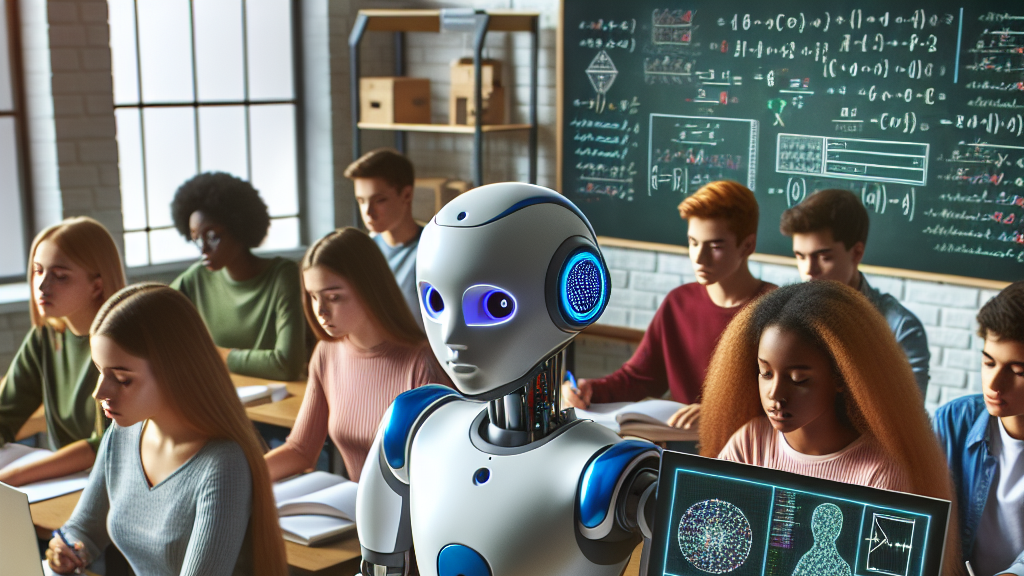
Ever wondered if Artificial Intelligence could ace a college class? Researchers have put this idea to the test by letting AI try its hand at completing an entire semester-long control systems course. The big surprise? It earned a solid B-grade! This study brings to light the impressive capabilities of AI but also highlights areas where it struggles, providing food for thought on its role in education.
The researchers used a language model called ChatGPT, simulating how an average student would use AI throughout their coursework. They tested it across various assignments, from multiple-choice questions to complex programming tasks. While ChatGPT excelled in structured assignments thanks to its knack for pattern recognition, it stumbled with open-ended projects that required creativity and critical thinking.
So, what’s the takeaway here? As AI continues to become smarter, it might just serve as our future classroom buddy, helping students tackle tough subjects like engineering. This study suggests that instead of banning AI tools in education, we could thoughtfully integrate them, ultimately enhancing the learning experience for students everywhere.
AI language models like ChatGPT are already achieving grades close to the average college student score in some technical courses!
FAQs
How did ChatGPT perform in a college control systems class?
ChatGPT managed to achieve a B-grade, with a score of 82.24%, which is close to the class average of 84.99%. It excelled in structured assignments but had challenges with open-ended projects.
What types of tasks were included in the evaluation of ChatGPT’s performance?
The evaluation covered multiple assessment formats, including auto-graded multiple-choice questions, complex Python programming tasks, and long-form analytical writing related to control systems engineering.
How could AI like ChatGPT influence future education systems?
This research indicates that instead of prohibiting AI, educational systems could incorporate AI tools thoughtfully to assist students in understanding complex subjects, potentially transforming how we approach learning.
What is the potential role of AI in engineering education?
AI has the potential to be integrated as a learning aid, helping students with problem-solving, understanding complex concepts, and providing additional support in subjects like engineering.
What were the greatest challenges faced by ChatGPT in the course?
ChatGPT showed limitations in handling open-ended projects, which require creativity and critical thinking, areas where AI still has room for improvement.
Background
Large Language Models (LLMs) like ChatGPT are advanced AI systems trained on vast amounts of text data to understand and generate human-like language. They are capable of performing a variety of tasks, from answering questions to writing essays and even solving complex problems. This research explores how these models can be applied in an educational setting, specifically in technical courses like control systems engineering, to evaluate their effectiveness as a tool for learning.
History
The use of AI in education is not entirely new. Over the years, AI has been gradually integrated into learning management systems, with adaptive learning technologies that tailor content to individual student needs. This research builds on that by evaluating the potential of AI to handle the full scope of a college-level engineering course, focusing on how these models perform across varied types of assignments.
Based on “The Lazy Student’s Dream: ChatGPT Passing an Engineering Course on Its Own” by Gokul Puthumanaillam, Melkior Ornik, available on arXiv (arxiv.org/abs/2503.05760), used under CC BY 4.0 (creativecommons.org/licenses/by/4.0/).