





































































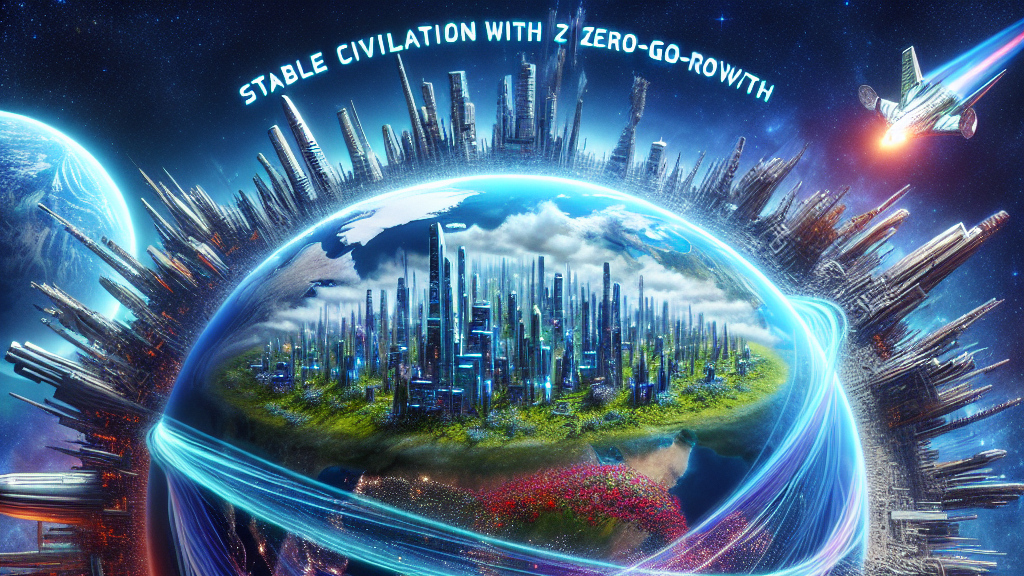
What if we could gaze into a crystal ball and see Earth’s future 1000 years from now? That’s exactly what this mind-bending study attempts to do. By creating ten possible scenarios, scientists are exploring how our world might look in the future, from stable societies with no growth to civilizations that spiral out of control and collapse. Not just for science fiction lovers, this could help us understand what challenges we might face and how to prepare for them.
The researchers used a novel technique called worldbuilding, which evaluates human needs to define observable properties of a future ‘technosphere’—a layer of technology and human activity enveloping the Earth. They looked at different scenarios: some societies remain stable without any further growth, others collapse but find a balanced state again, while a few continue to expand. Fascinatingly, only one scenario foresees rapid growth leading to life beyond our planet. As tech evolves, so does our planet’s ‘technosignature,’ like nitrogen dioxide, which can help differentiate between a pre-agricultural Earth and an advanced industrial one.
Why does this matter? Besides the sheer curiosity, knowing possible future scenarios can guide how we develop technology and plan for Earth’s sustainability. If we can see how a tech-heavy world might work—or not—we can make better choices today. For instance, by identifying signs of a successful or failing society, we can adapt our current strategies to steer toward a more balanced future. Imagine a stable Earth that could last thousands of years or a tech-savvy civilization reaching out to the stars—both are possible paths we could navigate if we’re smart about it.
Did you know that nitrogen dioxide isn’t just a pollutant? In this study, it’s a marker that could help us identify advanced civilizations from light years away!
FAQs
What are technosignatures, and why are they important for Earth’s future?
Technosignatures are detectable signs of technology or industrial activity on a planet. They are important because they provide clues about the presence and type of advanced civilization, helping us understand how societies evolve and potentially allowing us to detect life beyond Earth.
How does worldbuilding help predict Earth’s 1000-year future?
Worldbuilding is a method that creates detailed hypothetical worlds by assessing human needs and technological capabilities. It aids in predicting Earth’s future by generating scenarios that explore different societal paths, from stability to growth or collapse, offering a framework to prepare for various possibilities.
What makes nitrogen dioxide a technosignature, and what can it tell us?
Nitrogen dioxide is a byproduct of industrial processes and can be detected in a planet’s atmosphere. It serves as a technosignature by indicating industrial activity levels, helping differentiate between pre-agricultural, modern, and potential future Earths with varying technological scales.
Can one scenario really predict interstellar expansion?
Yes, one of the scenarios suggests a rapid growth trajectory that could lead humanity to explore and settle beyond Earth. While speculative, it highlights the potential for technological and societal advancements that might enable space colonization.
Background
In futures studies, scenarios are constructed to explore possible future developments by analyzing factors like technology, society, and environment. This study uses worldbuilding—a creative yet systematic approach—to simulate different outcomes for Earth’s future based on technological advancements and human needs, helping identify potential technosignatures, such as atmospheric changes, that indicate industrial activity.
History
Previous research in futurology has focused on short-term predictions, but this study extends the outlook to a millennium. It builds on work that has examined planetary technosignatures, like atmospheric pollutants, for identifying extraterrestrial life. By considering a 1000-year timescale, this study provides a broader perspective on how Earth-like planets might evolve, contributing to fields like astrobiology and sustainability.
Based on “Projections of Earth’s technosphere: Scenario modeling, worldbuilding, and overview of remotely detectable technosignatures” by Jacob Haqq-Misra, George Profitiliotis, Ravi Kopparapu, available on arXiv (arxiv.org/abs/2409.00067), used under CC BY 4.0 (creativecommons.org/licenses/by/4.0/).
