


























































Connect with us

Search by keyword

Space

Can AI Uncover Cosmic Secrets?

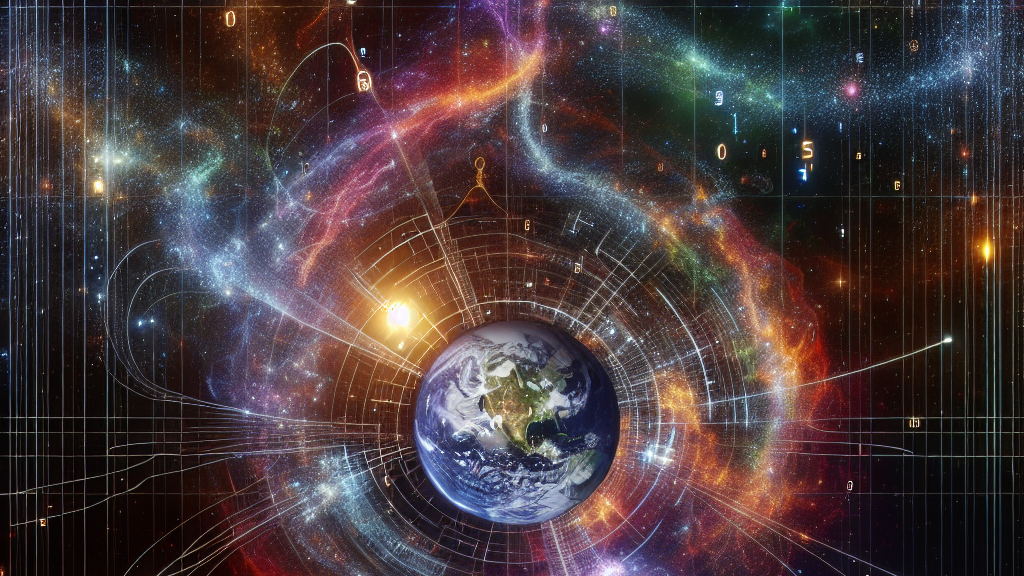
AI is helping scientists unlock the mysteries of cosmic rays from outer space. By using advanced networks called Transformers, researchers are learning more about how these cosmic particles behave and interact, which could lead to groundbreaking insights in space exploration.

Can AI Uncover Cosmic Secrets
✨Researched by humans. Explained by robots. Learn more.

Have you ever looked up at the starry night sky and wondered what secrets are hidden among the stars? Scientists are now using artificial intelligence (AI), specifically a type called Transformers, to explore these mysteries. It’s like giving a detective a supercomputer to solve the most complex space puzzles. Transformers are helping researchers learn about cosmic rays—those high-energy particles that zoom through space and occasionally collide with Earth’s atmosphere.

In the study, scientists used Transformers to look at massive simulations of cosmic rays. Imagine watching a movie of space dust particles swirling and dancing around as they get affected by gravity and other forces. The AI can figure out patterns and behaviors that are hard for human eyes to catch. It’s like having a high-tech eye in the sky that doesn’t miss a beat. By analyzing these patterns, the AI can help us understand where cosmic rays come from and how they interact with galaxies.

But why should you care about this cosmic detective work? Well, by understanding cosmic rays, we can learn more about the universe, potentially leading to new technological advances or even changes in how we communicate via satellites. Imagine if these insights could make internet connections faster or help discover new energy sources! The possibilities are as vast as the universe itself.

Did you know cosmic rays can travel at nearly the speed of light, carrying messages from galaxies far, far away?

FAQs

What are cosmic rays and why are scientists interested in them?

Cosmic rays are high-energy particles that travel through space and can provide insights into the universe’s origins and workings. Scientists study them to understand more about space phenomena and potential technological applications.

How do Transformer networks help in cosmic ray research?

Transformer networks are a type of AI that can analyze complex data patterns, like those in cosmic ray simulations, to uncover hidden patterns and behaviors. This helps scientists learn more about the origins and impacts of cosmic rays.

What potential real-world applications could come from this research on cosmic rays?

Understanding cosmic rays could lead to advances in space exploration, faster internet and communications technology, and possibly new energy sources, sparking technological innovation.

Background

In layman’s terms, Transformer networks are a type of AI that excels at processing vast amounts of data by ‘paying attention’ to important parts of the information, like how our brains focus on a friend speaking in a noisy room. This makes them perfect for analyzing the complex data from cosmic ray simulations and understanding how these particles behave when they hit our atmosphere.

History

The study of cosmic rays dates back to the early 20th century when scientists first detected these high-energy particles coming from outer space. Over the years, advances in technology have allowed researchers to study cosmic rays in more detail, and now AI models like Transformers are taking this to the next level by providing deeper insights and uncovering patterns that were previously hidden.

Based on “What exactly did the Transformer learn from our physics data?” by Martin Erdmann, Niklas Langner, Josina Schulte, Dominik Wirtz, available on arXiv (arxiv.org/abs/2505.21042), used under CC BY 4.0 (creativecommons.org/licenses/by/4.0/).


Trending

Latest

Can AI Save Water Discover How

Computers

AI is transforming the tech world, but it uses lots of water! A new tool, SCARF, helps us measure and reduce AI's water footprint,...

Whats a Forbush Decrease and Why Should We Care Whats a Forbush Decrease and Why Should We Care

Space

Scientists just observed the biggest solar storm event in years, revealing unexpected cosmic ray patterns. Understanding these changes could help us protect our technology...

Can Cars Spot Danger Faster Than Humans Can Cars Spot Danger Faster Than Humans

Computers

Think about how quickly you react when something unexpected happens on the road. This research brings us closer to creating self-driving cars that can...

Can Fear of the Other Stop Social Harmony Can Fear of the Other Stop Social Harmony

Physics

Fear of the unknown might make it harder for people to agree and get along. This study shows that when people have strong xenophobic...

Can AI Revolutionize Breast Cancer Diagnosis Can AI Revolutionize Breast Cancer Diagnosis

Electricity

This research introduces a groundbreaking AI model that can accurately assess HER2-positive breast cancer using widely accessible staining methods, potentially revolutionizing how we diagnose...

Can AI Transform Your Singing into a Choir Can AI Transform Your Singing into a Choir

Computers

Imagine singing solo and having AI turn you into a choir. This research unveils a groundbreaking AI tool that transforms your voice into rich...

You May Also Like

Computers

AI is transforming the tech world, but it uses lots of water! A new tool, SCARF, helps us measure and reduce AI's water footprint,...

Space

Scientists just observed the biggest solar storm event in years, revealing unexpected cosmic ray patterns. Understanding these changes could help us protect our technology...

Computers

Think about how quickly you react when something unexpected happens on the road. This research brings us closer to creating self-driving cars that can...

Physics

Fear of the unknown might make it harder for people to agree and get along. This study shows that when people have strong xenophobic...

Electricity

This research introduces a groundbreaking AI model that can accurately assess HER2-positive breast cancer using widely accessible staining methods, potentially revolutionizing how we diagnose...

Computers

Imagine a machine capable of reading ancient books, deciphering complex pages with precision! This research is paving the way for AI to unlock the...

Economics

Discover how AI models can unknowingly favor certain races in mortgage decisions and how new methods could dramatically reduce these biases, fostering a fairer...

Computers

This research explores how AI models designed to understand both images and words might improve their performance simply by teaching themselves to think better....

Computers

Imagine if playing games could make a computer program better at understanding and creating text! This research suggests that by using creative tasks like...

Copyright © 2024 8ig8rain.

Disclaimer: The content on 8ig8rain.com consists of AI-generated summaries of scientific abstracts from arXiv. Please note that most arXiv abstracts are preprints and may not have undergone formal peer review. While these summaries aim to convey key ideas and potential applications, they are provided for informational purposes only and should not be interpreted as validated scientific findings or professional advice. The summaries are intended to educate, spark curiosity, and inspire further exploration of science.