





































































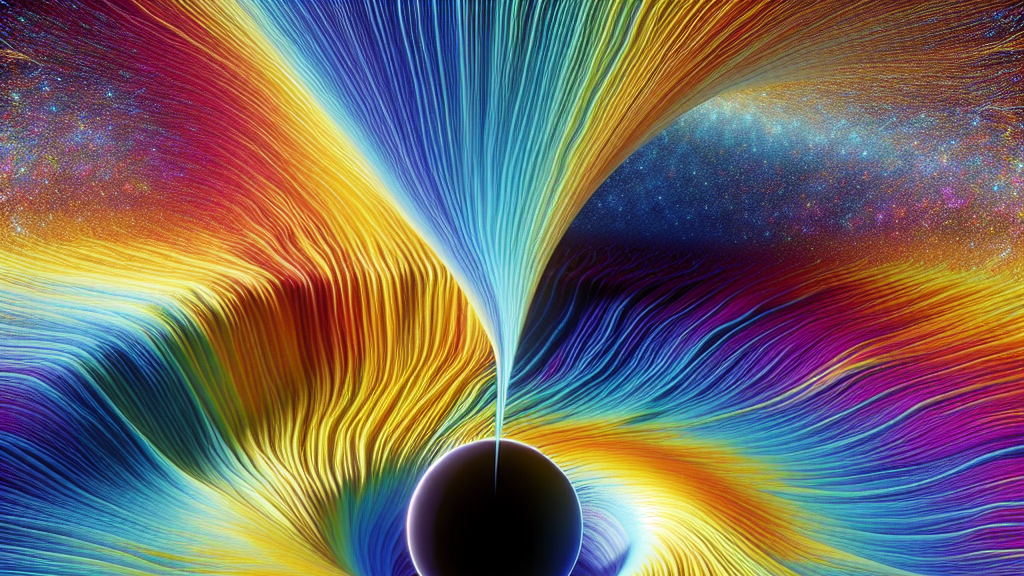
**Prepare to have your mind blown:** Scientists are using artificial intelligence to predict how shockwaves behave around black holes, those mysterious cosmic giants that can gobble up entire stars. Imagine surfing a wave of space-time created by an invisible monster that warps everything around it. That’s what researchers are starting to understand better, thanks to smart algorithms known as Physics-Informed Neural Networks, or PINNs for short. These networks are like the high-tech detective tools of the universe, picking up on clues and patterns that we humans might miss. They follow the complex rules of physics to simulate how shockwaves form—a bit like predicting gigantic cosmic tsunamis in a sea of stars and planets. One key aspect of this new method is its ability to predict both smooth and choppy shockwave patterns, which is crucial because space environments are some of the most unpredictable places known to humankind. **But why should you care?** Well, imagine future space missions navigating these shockwaves more safely, thanks to this research. Your favorite sci-fi shows may soon seem more like documentaries, as we use these discoveries to explore even deeper into space. Understanding how matter behaves in the extreme gravitational fields of black holes could also change how we think about the cosmos and our place within it. **So, the next time you gaze up at the stars, remember:** there’s a team of scientists and cutting-edge AI working to unravel the mysteries of the universe, one shockwave at a time.
A black hole is so powerful it can bend light around it, creating a cosmic mirage known as gravitational lensing.
FAQs
What is the significance of using AI to study black holes?
By using AI, specifically Physics-Informed Neural Networks, scientists can model and predict the behavior of shockwaves around black holes, which improves our understanding of these cosmic phenomena and aids in future space explorations.
How do Physics-Informed Neural Networks differ from regular neural networks?
Physics-Informed Neural Networks include the laws of physics in their architecture, allowing them to model real-world scenarios more accurately than traditional neural networks which primarily rely on data patterns alone.
Why are shockwaves around black holes important to study?
Shockwaves are important because they reveal how matter and energy interact under extreme gravity, helping scientists understand the fundamental nature of the cosmos and potentially improving technology for space travel.
How could this research impact future space missions?
The ability to predict shockwave patterns around black holes could allow spacecraft to navigate safely around these unpredictable regions, potentially opening up new possibilities for space exploration.
What other cosmic phenomena could benefit from AI modeling?
Beyond black holes, AI could help model other complex cosmic phenomena like neutron star collisions, supernovae, or the evolution of galaxies, deepening our understanding of the universe.
Background
Physics-Informed Neural Networks (PINNs) are a special type of AI that integrates the principles and laws of physics into their training. This means they can make predictions grounded in scientific reality, such as simulations of complex phenomena like shockwaves in space, rather than just relying on observed data patterns. These networks are particularly useful for studying environments where direct observation is challenging, like black holes, enabling enhanced simulations of extreme cosmic conditions.
History
The study of black holes and shockwaves has long been a challenging area of research due to the complex mathematics involved in understanding how matter behaves under extreme gravity. Previous models relied heavily on numerical simulations that required enormous computational power. The introduction of AI, particularly the development of neural networks, marked a turning point in this field. Comparable advances have been made in areas like climate modeling and aerodynamics, demonstrating how AI can enhance our predictive capabilities. This new research builds on these methodologies, applying them to the vast and mysterious realm of black holes to provide insights that were previously unreachable.
Based on “Physics-Informed Neural Networks for the Relativistic Burgers Equation in the Exterior of a Schwarzschild Black Hole” by Shuyang Xiang, available on arXiv (arxiv.org/abs/2506.00951), used under CC BY 4.0 (creativecommons.org/licenses/by/4.0/).


