





































































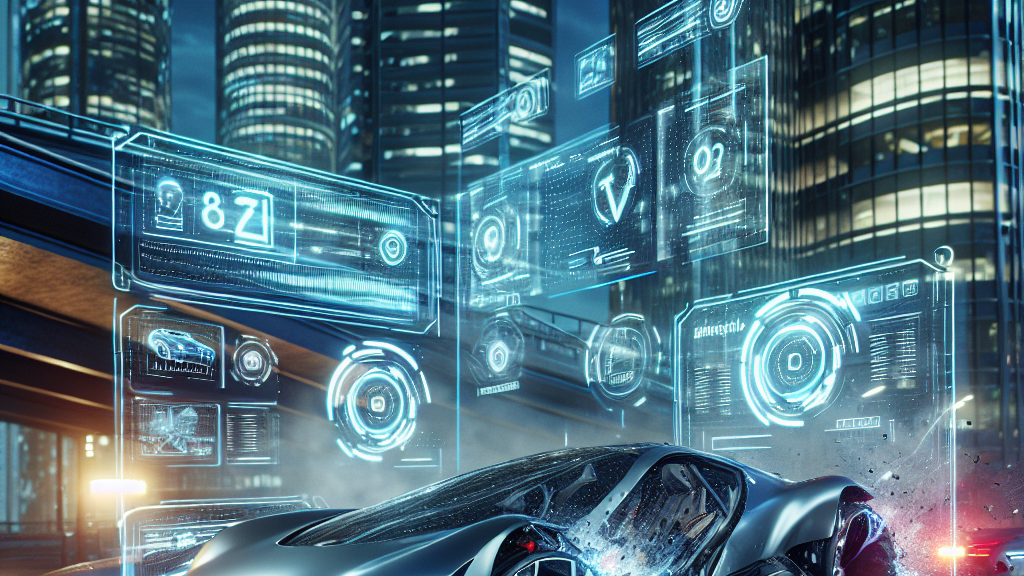
Imagine if we could predict and prevent car accidents before they even happen. The possibility isn’t as far-fetched as it sounds! With the creation of Ctrl-Crash, a new video diffusion model, we can now generate incredibly realistic and controlled car crash simulations—like a crystal ball for road safety experts.
Researchers have long been puzzled by the challenge of generating realistic crash scenarios due to the rarity of actual crash data. But Ctrl-Crash changes the game by using signals such as bounding boxes and initial images to simulate crashes that can vary with each subtle tweak. This means that road safety engineers can test countless “what if” scenarios to better understand and anticipate accidents, all before they occur in the real world.
Picture this: you’re an automotive engineer wanting to test a new safety feature. Instead of waiting for real-world data, you could use Ctrl-Crash’s simulations to test how your feature would perform in different crash scenarios, ensuring that when your technology hits the road, it makes it a safer place for everyone. In the future, we could see cars coming equipped with AI-based features tested via these simulated crash scenarios, potentially saving countless lives.
Did you know? Simulating car crashes can predict and prevent real accidents before they even happen!
FAQs
What is Ctrl-Crash, and how does it help with car crash simulations?
Ctrl-Crash is a groundbreaking video generation model that creates realistic and controllable car crash scenarios using video diffusion techniques, allowing researchers and engineers to study and improve vehicle safety systems.
How does Ctrl-Crash differ from previous methods of simulating crashes?
Unlike past methods, Ctrl-Crash allows for fine-tuned control over crash simulations using parameters like bounding boxes and initial frames, enabling the exploration of numerous scenario variations for better insights into crash dynamics.
Why is realistic car crash simulation important for traffic safety?
Realistic simulations can help in understanding how different factors impact crashes, allowing for better design of safety features and prevention strategies, ultimately reducing accidents and saving lives.
How could this technology affect everyday drivers?
By refining vehicle safety systems and offering better insights into crash dynamics, technology like Ctrl-Crash can lead to safer cars on the roads, enhancing driver safety and reducing accident-related injuries and fatalities.
What real-world applications could arise from Ctrl-Crash’s car crash simulations?
Applications range from advanced driver-assistance systems testing to training AI for autonomous vehicles, making roads safer through well-tested, data-driven insights.
Background
Video diffusion techniques refer to methods used to generate or alter videos using computer algorithms. These techniques have made significant progress in making videos look realistic, but when it comes to simulating rare events like car crashes, they face challenges due to the lack of data. The key methodology in this research is using ‘conditioning signals’—specific inputs like bounding boxes and initial frames—to direct the simulation. Classifier-free guidance is a technique to enhance the quality and control of these simulations by adjusting how much the model relies on each input signal.
History
The foundation of video diffusion techniques lies in generative models that create or modify digital content. Over the years, these techniques have been refined to generate more lifelike and controlled outputs. Previous methods often struggled with accurately depicting rare, complex events due to limited data. This study builds upon those advancements by focusing on car crash simulations, offering a depth of control and realism previously unattainable, marking a new milestone in the intersection of video technology and road safety research.
Based on “Ctrl-Crash: Controllable Diffusion for Realistic Car Crashes” by Anthony Gosselin, Ge Ya Luo, Luis Lara, Florian Golemo, Derek Nowrouzezahrai, Liam Paull, Alexia Jolicoeur-Martineau, Christopher Pal, available on arXiv (arxiv.org/abs/2506.00227), used under CC BY 4.0 (creativecommons.org/licenses/by/4.0/).
