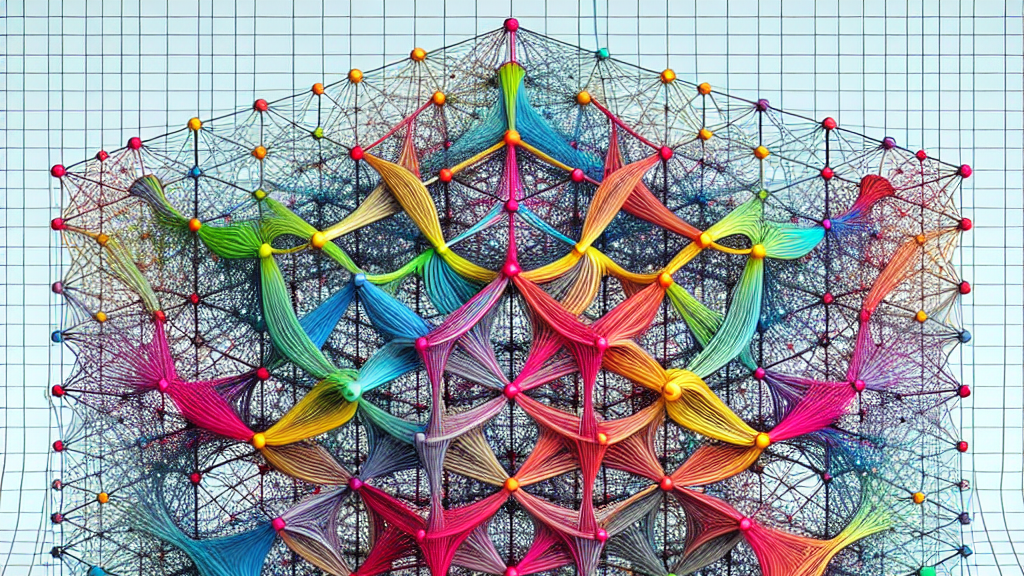
Imagine a world where the very grid under our feet is interwoven with secrets waiting to be unlocked. That’s essentially what scientists have discovered with their groundbreaking work on 2D lattice systems. These grids aren’t just simple, flat surfaces; they conceal a complex web of connections that can tell us more about how the universe at its smallest scales is connected.
In this fascinating study, scientists have taken a closer look at a 2D lattice system where only two neighboring points interact with each other. Unlike previous complex models needing multiple interactions, this simpler setup reveals a unique ground state with a type of energy that scales with volume. What’s even more exciting is an entanglement phase transition, where the energy at a critical point becomes even more intense than previous models. This could potentially lead to revolutionary advances in quantum technology by harnessing these complex interactions.
Imagine this: your next generation of computer technology could operate using principles from this grid system, making devices not only faster but smarter. Think of it as giving technology a mind of its own, one that’s deeply interconnected and capable of performing things we currently only dream of. As we explore these new realms, who knows how they’ll transform our lives?
Did you know that the concept of entanglement was once termed ‘spooky action at a distance’ by Albert Einstein?
FAQs
What is a 2D lattice system in quantum physics?
A 2D lattice system in quantum physics refers to a grid-like structure at an atomic level, where particles are arranged in a two-dimensional plane and interact with their nearest neighbors. This setup is used to study complex interactions and phenomena like entanglement.
How does entanglement phase transition in a 2D lattice affect us?
An entanglement phase transition in a 2D lattice can reveal how particles are interconnected in a way that may lead to the development of new quantum technologies, potentially transforming fields like computing and communication.
Why is the study of 2D grid systems important?
Studying 2D grid systems can help scientists understand fundamental principles of quantum mechanics and lead to new technologies that leverage the unique properties of quantum entanglement for practical applications.
Background
In quantum physics, entanglement refers to a situation where particles become interconnected and the state of one particle instantly influences the state of another, no matter the distance between them. This abstract deals with 2D lattice systems, which are grids of particles or other entities where interactions occur primarily between nearest neighbors. The lattice structure allows for studying the complex entanglement properties and how they change under different conditions, known as phase transitions.
History
Entanglement as a concept has intrigued scientists since it was first described by Albert Einstein, Podolsky, and Rosen in 1935. Over the decades, researchers have explored its implications mostly in one-dimensional systems. The leap to two-dimensional systems posed new challenges, as the increased complexity of interactions makes such studies more demanding. Recent findings have demonstrated the existence of highly entangled states in these 2D systems, prompting further investigation into their potential applications and the underlying physics.
Based on “2D Entanglement from a Single Motzkin Spaghetto” by Zhao Zhang, available on arXiv (arxiv.org/abs/2506.02103), used under CC BY 4.0 (creativecommons.org/licenses/by/4.0/).