


























































Connect with us

Search by keyword

Space

Can AI Uncover Hidden Dark Matter Clues?

AI is stepping up its game in the hunt for dark matter, using pulsars to decode mysterious cosmic signals that could change how we see the universe.

Can AI Uncover Hidden Dark Matter Clues
✨Researched by humans. Explained by robots. Learn more.

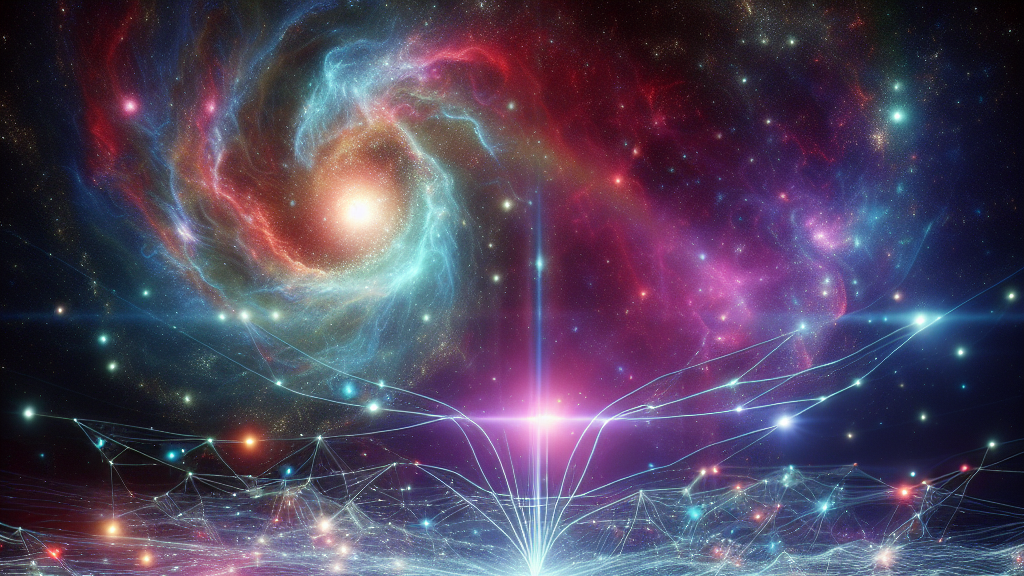
Could AI help us crack one of the universe’s biggest mysteries? Scientists are using cutting-edge machine learning techniques to hunt down ultra-light dark matter, a mysterious substance believed to permeate the cosmos. By analyzing pulsar-timing data—like cosmic metronomes scattered across the sky—researchers hope to detect the faint whispers of dark matter interactions.

In a breakthrough study, researchers employed neural networks to sift through simulated data and identify unique dark matter signals. They tested various models of ultra-light dark matter using three types of neural networks: an autoencoder, a binary classifier, and a multiclass classifier. These AI techniques showed promise in matching the sensitivity of traditional Bayesian methods and were capable of distinguishing between different theoretical models—a fascinating leap for AI in astronomy.

Imagine a future where we can pinpoint dark matter just by looking at the timing of pulsars, small but incredibly dense stars pulsing rhythmically like cosmic clocks. This research could pave the way for real-time detection of dark-matter-induced changes in pulsar orbits, ultimately helping scientists understand a hidden universe that has eluded us for so long.

Pulsars are ultra-dense stars that spin so fast they look like cosmic lighthouses, beaming light across the universe.

FAQs

How is AI used to detect dark matter through pulsars?

AI, particularly neural networks, helps analyze pulsar-timing data, looking for signals indicating interactions with dark matter by identifying patterns that traditional methods might miss.

What makes ultra-light dark matter special?

Ultra-light dark matter is a theorized form of dark matter that could interact with regular matter in subtle ways, potentially detectable by small changes in pulsar orbits.

How do neural networks contribute to dark matter research?

Neural networks can process vast amounts of data efficiently and distinguish between different models of dark matter, providing a powerful tool for astronomers in their search.

What are some potential implications if this AI approach succeeds?

If AI techniques can reliably detect dark matter through pulsar data, it could revolutionize our understanding of the universe and lead to new cosmological models.

Why is pulsar timing data important in this research?

Pulsars serve as highly accurate cosmic timekeepers, and any anomalies in their timing could signal the presence of dark matter, making them ideal for such studies.

Background

Dark matter, though invisible, is thought to make up about 85% of the universe’s mass. Its elusive nature confounds astronomers, but pulsars—remnants of supernova explosions that emit beams of radiation while spinning—could act as cosmic sensors to detect it. Scientists harness the power of AI, specifically neural networks, to scan for subtle changes in pulsar timing that might reveal interactions with dark matter.

History

The search for dark matter has long intrigued scientists, dating back to the 1930s when it was first hypothesized due to unseen mass affecting galactic rotations. Over time, various models and techniques, including Bayesian approaches, have been developed to catch a glimpse of it. This study leverages machine learning, an emerging tool in astrophysics, building on past research but bringing a new level of versatility and detail to the hunt.

Based on “Deep Neural Networks Hunting Ultra-Light Dark Matter” by Pavel Kůs, Diana López Nacir, Federico R. Urban, available on arXiv (arxiv.org/abs/2506.04100), used under CC BY 4.0 (creativecommons.org/licenses/by/4.0/).

Trending

Latest

Can AI Save Water Discover How

Computers

AI is transforming the tech world, but it uses lots of water! A new tool, SCARF, helps us measure and reduce AI's water footprint,...

Whats a Forbush Decrease and Why Should We Care Whats a Forbush Decrease and Why Should We Care

Space

Scientists just observed the biggest solar storm event in years, revealing unexpected cosmic ray patterns. Understanding these changes could help us protect our technology...

Can Cars Spot Danger Faster Than Humans Can Cars Spot Danger Faster Than Humans

Computers

Think about how quickly you react when something unexpected happens on the road. This research brings us closer to creating self-driving cars that can...

Can Fear of the Other Stop Social Harmony Can Fear of the Other Stop Social Harmony

Physics

Fear of the unknown might make it harder for people to agree and get along. This study shows that when people have strong xenophobic...

Can AI Revolutionize Breast Cancer Diagnosis Can AI Revolutionize Breast Cancer Diagnosis

Electricity

This research introduces a groundbreaking AI model that can accurately assess HER2-positive breast cancer using widely accessible staining methods, potentially revolutionizing how we diagnose...

Can AI Transform Your Singing into a Choir Can AI Transform Your Singing into a Choir

Computers

Imagine singing solo and having AI turn you into a choir. This research unveils a groundbreaking AI tool that transforms your voice into rich...

You May Also Like

Computers

AI is transforming the tech world, but it uses lots of water! A new tool, SCARF, helps us measure and reduce AI's water footprint,...

Computers

Think about how quickly you react when something unexpected happens on the road. This research brings us closer to creating self-driving cars that can...

Electricity

This research introduces a groundbreaking AI model that can accurately assess HER2-positive breast cancer using widely accessible staining methods, potentially revolutionizing how we diagnose...

Computers

Imagine a machine capable of reading ancient books, deciphering complex pages with precision! This research is paving the way for AI to unlock the...

Economics

Discover how AI models can unknowingly favor certain races in mortgage decisions and how new methods could dramatically reduce these biases, fostering a fairer...

Computers

This research explores how AI models designed to understand both images and words might improve their performance simply by teaching themselves to think better....

Computers

Imagine if playing games could make a computer program better at understanding and creating text! This research suggests that by using creative tasks like...

Space

Scientists have discovered a new way that tiny early-universe structures might grow into massive black holes, potentially changing our understanding of cosmic evolution! This...

Computers

Dive into the world of AI mistrust, where computers don't always know when they're wrong! Discover how teaching AI to see like us might...

Copyright © 2024 8ig8rain.

Disclaimer: The content on 8ig8rain.com consists of AI-generated summaries of scientific abstracts from arXiv. Please note that most arXiv abstracts are preprints and may not have undergone formal peer review. While these summaries aim to convey key ideas and potential applications, they are provided for informational purposes only and should not be interpreted as validated scientific findings or professional advice. The summaries are intended to educate, spark curiosity, and inspire further exploration of science.
