





































































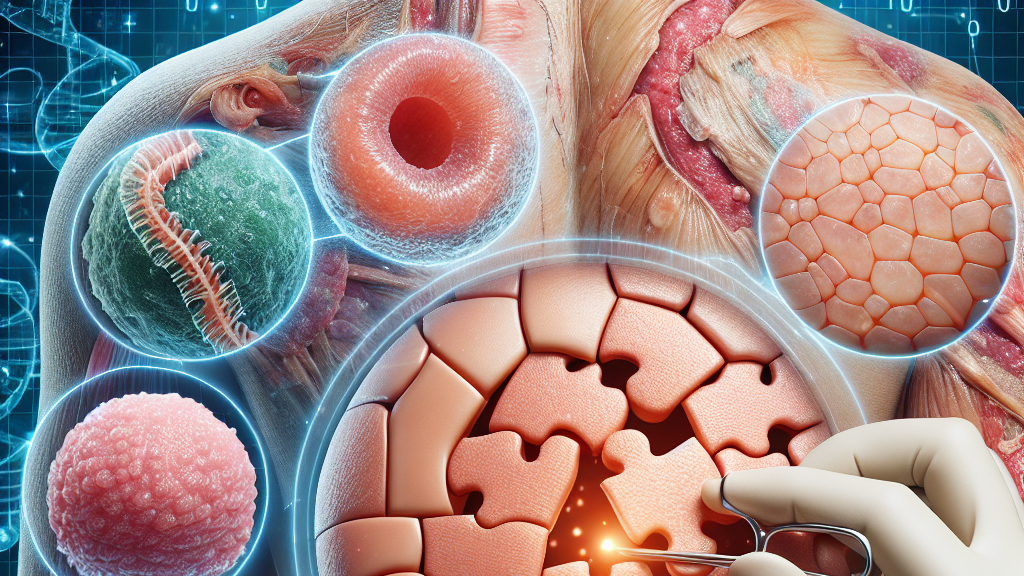
Imagine having a paper cut that just won’t seem to heal. It lingers for days, maybe even weeks, and you can’t help but feel frustrated every time it catches on something. Now imagine if that cut could heal noticeably faster and more efficiently, making your skin as good as new in no time. Scientists are diving into the microscopic world of your skin cells to understand just how we can speed up this natural process. Through studies with tiny creatures like Drosophila or fruit flies, researchers are uncovering the hidden power of tiny forces called active stresses inside our cells. These forces determine how quickly our wounds close up after getting damaged. When a wound forms, our cells work like a well-organized team, shifting and moving in a coordinated dance to cover up the gap. Think of it like a group of people pulling together the edges of a blanket to cover a hole. The way these cells line up and move is super important. The scientists found out that if the forces in the cells act more like pulling, the wound closes faster, but if they push, it takes longer. This fascinating dance even creates tiny, temporary flaws that vanish as the wound heals. So, why does this matter to you? Imagine a world where we could harness this knowledge to create new treatments that help wounds heal quicker, especially for those with slow healing conditions like diabetes. The research offers a glimpse into a future where cuts and surgeries could heal faster, reducing the chance of infections and getting us back to our lives with less worry. That’s not just science fiction – that’s the future of healthcare. And it all starts by looking at something as small as a fly’s wing to understand our own bodies better.
Drosophila, or fruit flies, have been a staple in genetic research for over a century due to their simplicity and fast breeding cycle.
FAQs
What role does nematic order play in wound healing?
Nematic order in cells refers to how cells line up in a parallel fashion, which was observed at the boundaries of wounds in research. This alignment is crucial because it affects how quickly the wound can close, depending on the type of active stress present in the cells.
How can active stresses speed up wound closure?
Active stresses are tiny forces in cells that can either pull inward (contractile) or push outward (extensile). When these forces pull inward, they help cells close wounds faster by drawing the edges together.
Why are fruit flies used in this type of research?
Fruit flies are used because they have similar biological processes to humans, reproduce quickly, and are easier to study, making them ideal for observing cell behavior during wound healing.
Can this research change how we treat wounds?
The insights gained from understanding cell behavior and active stresses could lead to new treatments that harness these mechanics to accelerate wound healing in humans.
What are topological defects in this context?
Topological defects are tiny, temporary disruptions in the cell arrangement that occur during the healing process. They appear as cells move to close the wound and disappear once healing is complete.
Background
The fundamental concept of this research is centered on ‘active stresses’ in epithelial cells. These are forces generated and maintained within a tissue, impacting how quickly or slowly a wound can close. This mechanism is influenced by how the cells line up, a state called ‘nematic order,’ which refers to how cells align parallel to each other, similar to the molecules in liquid crystals. Understanding these concepts helps developers of medical treatments harness these cellular behaviors to potentially accelerate recovery from injuries.
History
Historically, wound healing has been a classic topic of medical research, with initial studies focusing on the macroscopic processes like blood clotting. As biology and technology advanced, attention shifted to the cellular and even molecular level, where the behavior and interaction of individual cells during healing could be studied. The use of the fruit fly model, as pioneered in the early 20th century by researchers like Thomas Hunt Morgan, provided invaluable insights into genetics and developmental biology, laying groundwork for studies like this one observing re-epithelialisation, or how skin cells close over a wound.
Based on “Dynamics of Wound Closure in Living Nematic Epithelia” by Henry Andralojc, Jake Turley, Helen Weavers, Paul Martin, Isaac V. Chenchiah, Rachel R. Bennett, Tanniemola B. Liverpool, available on arXiv (arxiv.org/abs/2506.04922), used under CC BY 4.0 (creativecommons.org/licenses/by/4.0/).
