





































































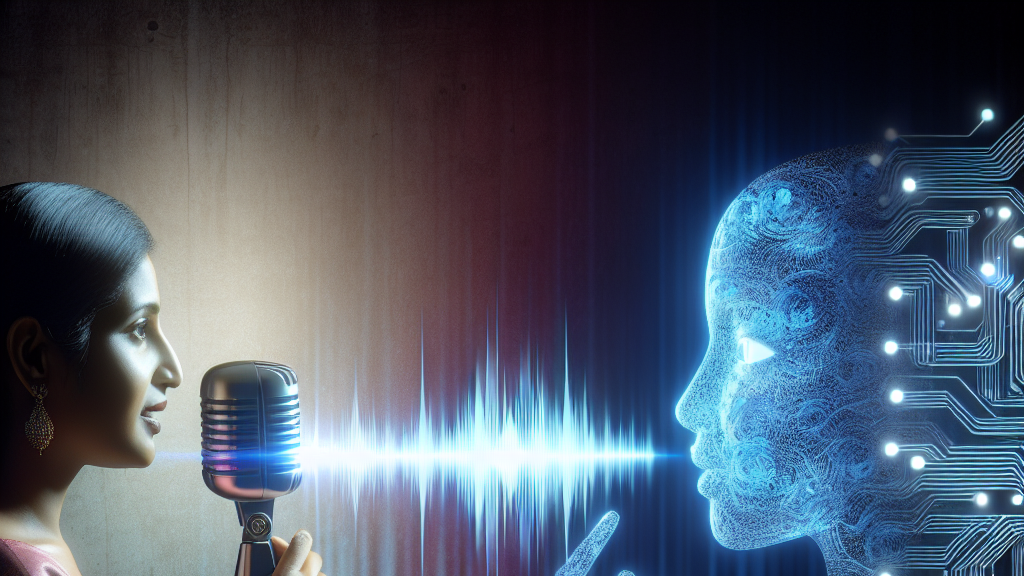
Picture this: losing your ability to speak like you used to, due to a speech disorder. It’s a harsh reality for many, making communication a daily struggle. But what if AI could help you ‘speak’ again with your own voice? That’s the fascinating premise behind a groundbreaking study that delves into personalised Text-to-Speech technologies.
Researchers are working with advanced technology to reconstruct voices using AI. By training large speech models like Parler TTS, they aim to mimic the voices of individuals before they developed their speech disorders. The process involves a meticulously curated dataset enriched with speaker information, which helps fine-tune the AI model. Although the technology is promising in recreating speech patterns, challenges remain in ensuring clear speech and maintaining the original voice’s uniqueness.
Imagine a future where people who have lost their voice to conditions like stroke or ALS can communicate using a voice that sounds like their own. This research might one day lead to applications in personalized assistive devices, giving those with speech disorders their voice and identity back. This isn’t just a tech upgrade; it’s a potential life-changer, transforming how people experience daily interactions and regain their confidence.
Did you know? Over 70 million people globally suffer from speech disorders, making innovations like AI voice reconstruction crucial for improving their quality of life.
FAQs
What is the goal of AI voice reconstruction for speech disorders?
The goal is to recreate a person’s voice using advanced AI technology, allowing individuals with speech disorders to communicate using a voice that closely resembles their pre-condition voice.
How does the Parler TTS model work?
Parler TTS is a large speech model that’s trained with a specially curated dataset. It works by generating speech that mimics the unique characteristics of a person’s voice prior to their speech disorder.
Can AI really make speech for those with disorders more intelligible?
While AI models show promise in mimicking voices, maintaining clear speech and consistency is challenging. Researchers are exploring ways to improve intelligibility and speaker identity in AI-generated speech.
How might this research affect everyday life for people with speech disorders?
By enabling personalized Text-to-Speech technologies, this research could significantly enhance communication abilities, providing individuals with speech disorders a voice that reflects their unique identity, ultimately improving their quality of life.
What are the future directions for AI in voice reconstruction?
Future research aims to enhance the controllability of AI models, improve voice consistency, and ensure the generated speech is both intelligible and true to the original speaker’s identity.
Background
Speech disorders can disrupt a person’s ability to communicate effectively. Personalised Text-to-Speech (TTS) aims to provide individuals with synthetic voices that resemble their own. This involves complex AI models, like Parler TTS, trained on data reflecting the speaker’s unique voice characteristics before the onset of their condition.
History
The journey of Text-to-Speech technology began with basic robotic voices and has evolved into sophisticated AI models that can emulate natural-sounding speech. This research builds on advances in machine learning and large speech models, pushing the boundaries of how personalized these technologies can become.
Based on “Can we reconstruct a dysarthric voice with the large speech model Parler TTS?” by Ariadna Sanchez, Simon King, available on arXiv (arxiv.org/abs/2506.04397), used under CC BY 4.0 (creativecommons.org/licenses/by/4.0/).
