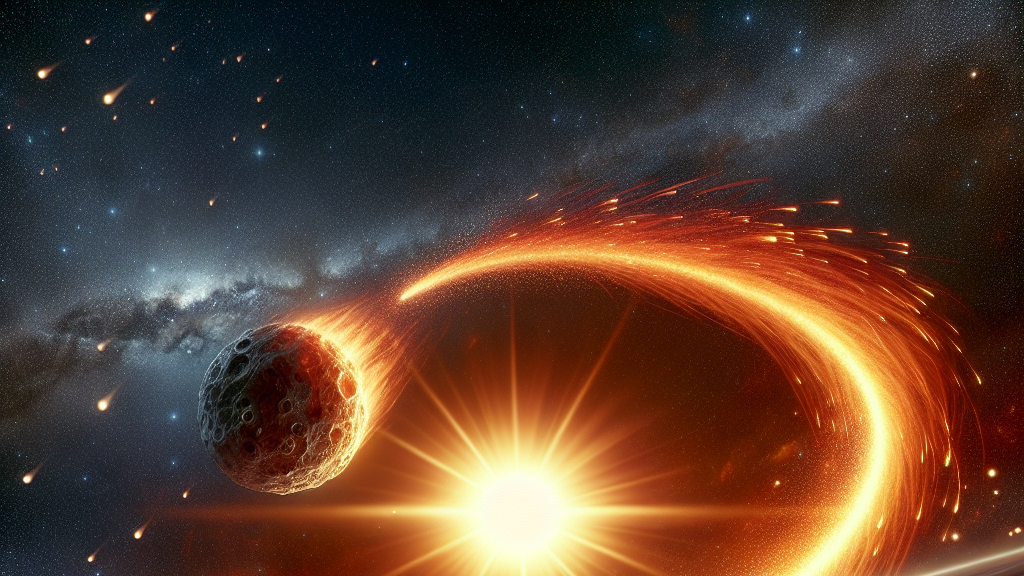
Comets are like cosmic time capsules, keeping secrets of our solar system’s birth. C/2021 O3 caught scientists’ interest because it came precariously close to the sun, raising questions about whether it would survive or shatter into cosmic dust. The mystery deepened when observations showed an unusual pattern in the light it scattered, hinting at unknown behaviors of long-period comets.
By combining data from large ground-based telescopes and specialized space probes, scientists have pieced together a story that is both surprising and fascinating. Initial observations revealed a small change in light intensity as the comet approached the sun, contrasting with what you’d expect if it was shedding icy particles. The comet’s brightness dimmed significantly after passing the sun, but rather than being obliterated, it left a trail of tiny debris particles.
What does this mean for us? The survival of C/2021 O3 could help scientists understand the stability of comets that could potentially come close to Earth. If comets with big nuclei like this one can withstand the sun, they might hold more secrets about our solar neighborhood—and possibly influence future space exploration missions, revealing whether these icy wanderers could be resources or threats.
Comet C/2021 O3 survived a close encounter with the sun, leaving behind a mysterious debris trail.
FAQs
What makes comet C/2021 O3’s close encounter with the sun so interesting?
Comet C/2021 O3’s near-sun encounter is intriguing because most comets do not survive such an intense approach. Scientists expected it to break apart and scatter, but observations suggested it may have stayed intact against odds, revealing resilience and new insights into cometary behavior.
Why did scientists think comet C/2021 O3 would be destroyed?
Scientists initially thought comet C/2021 O3 would be destroyed due to the extreme heat and gravitational forces near the sun. Typically, these forces cause comets to disintegrate, but this one surprised us with its survival, sparking curiosity about its composition and physical properties.
How could the study of comet C/2021 O3 affect future space missions?
Understanding the resilience of comet C/2021 O3 might inform future space missions by revealing the structural makeup of comets that could be mined for resources. It also helps scientists prepare for potential comet encounters with Earth, offering insights into deflection or observation strategies.
What do the light patterns of comet C/2021 O3 tell us?
The light patterns observed from comet C/2021 O3 suggested unusual scattering properties that differ from typical comets, hinting at unique surface materials or structure. This finding helps scientists refine models of comet composition and behavior.
How does the survival of comets impact our understanding of the solar system?
The survival of comets like C/2021 O3 provides clues about the early solar system, as these bodies are considered to be pristine objects from its formation. Studying them helps scientists unlock secrets about the solar system’s evolution and the processes that shaped planetary bodies.
Background
Comets are icy bodies orbiting the sun, often dubbed ‘dirty snowballs.’ They hold ancient materials from the early solar system. As they approach the sun, their icy surface sublimates, creating a glowing coma and tail. Studying their interaction with solar heat and gravity helps scientists understand their structure and origin. Concepts like ‘perihelion’ (the closest point to the sun) and ‘photometry’ (measuring light) are key to analyzing comets.
History
The study of comets dates to ancient times, but significant advances came with modern telescopes. In the early 20th century, researchers proposed models for cometary tails and orbits. The 1990s and 2000s saw missions like Giotto and Rosetta gather close-up data. C/2021 O3 builds on this legacy by testing cometary resilience and shedding light on unexplored behaviors, making it a pivotal case in long-period comet studies.
Based on “Down But Not Out: The Case of Long-Period Comet C/2021 O3 (Panstarrs)” by David Jewitt. Jing Li, Michael Jaeger, Yoonyoung Kim, available on arXiv (arxiv.org/abs/2506.09263), used under CC BY 4.0 (creativecommons.org/licenses/by/4.0/).