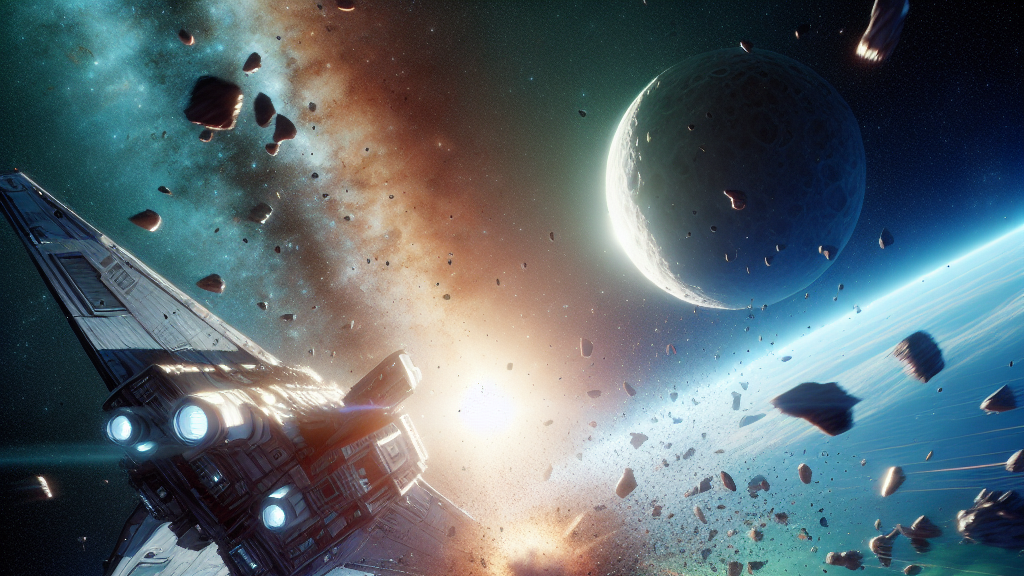
Have you ever wondered how we might reach some of the farthest regions of our solar system in the future? Scientists are looking into two groundbreaking propulsion technologies that could take us to Sedna, a distant and mysterious celestial body, faster than ever before. Instead of waiting decades for a trip, these methods promise much shorter travel times, making space exploration more accessible and exciting.
The first method involves a fusion-powered rocket called the Direct Fusion Drive, or DFD. This isn’t your average rocket engine – it’s powered by a reaction similar to what happens in the sun, using a special combination of hydrogen and helium. The DFD could potentially take us to Sedna in about 10 years. Then there’s the solar sail, a massive, lightweight reflective structure that catches the sun’s rays (and a little boost around Jupiter) to propel itself across the cosmos. With this, we could glide to Sedna in a swift 7 years!
Imagine a future where we dispatch probes to explore distant planets and icy bodies like Sedna quickly and efficiently. Such missions could unravel the secrets of our solar system and enhance our understanding of planetary formation. These innovations in space travel might even inspire new technologies for our daily lives, driving advancements in energy and propulsion systems on Earth.
Sedna, named after the Inuit goddess of the sea, is one of the most distant known objects in our solar system.
FAQs
What is Sedna and why is it important?
Sedna is a distant celestial body, far beyond Pluto, that helps us understand the outer reaches of our solar system. Studying it could reveal clues about the formation and evolution of planets.
How does the Direct Fusion Drive work?
The Direct Fusion Drive (DFD) uses thermonuclear fusion, combining hydrogen and helium, to produce large amounts of energy. This energy propels the rocket by generating thrust, allowing faster space travel.
What makes the solar sail propulsion unique?
Solar sails use sunlight for propulsion, much like wind sails on ships. By catching solar radiation, they provide a continuous and steady push, allowing spacecraft to travel great distances with no fuel.
What challenges do missions to Sedna face?
Missions to Sedna face challenges such as long travel times, power availability, and communication across vast distances. Advanced propulsion methods like DFD and solar sails aim to overcome these hurdles.
How soon could a mission to Sedna realistically launch?
A mission could potentially launch in the coming decades if these advanced propulsion technologies prove feasible, taking advantage of Sedna’s orbit to optimize travel time.
Background
To reach the outer parts of our solar system, we need more than traditional rocket technology. Two cutting-edge propulsion methods are under study: the Direct Fusion Drive and a solar sail. The fusion drive operates like a mini-sun, combining elements to release energy, similar to how nuclear reactions power stars. On the other hand, solar sails take advantage of the pressure of sunlight to propel spacecraft, offering a fuel-free means of travel over vast distances.
History
In the past, missions to the outer solar system relied on chemical propulsion, which is slow and requires long durations. With the discovery of Sedna in 2003, interest in exploring these distant regions grew, prompting scientists to consider innovative propulsion methods. Over the years, research on fusion propulsion has seen advancements, while solar sailing has become practical, highlighted by successful demonstrations like NASA’s LightSail.
Based on “Feasibility study of a mission to Sedna — Nuclear propulsion and advanced solar sailing concepts” by Elena Ancona, Roman Ya. Kezerashvili, Savino Longo, available on arXiv (arxiv.org/abs/2506.17732), used under CC BY 4.0 (creativecommons.org/licenses/by/4.0/).