Connect with us

Search by keyword

Computers

Are New Underwater Robots the Future of Ocean Exploration?

AI-driven robots could transform ocean exploration by enabling the creation of highly efficient underwater gliders with unique shapes, increasing the reach and effectiveness of environmental monitoring.

Are New Underwater Robots the Future of Ocean Exploration
✨Researched by humans. Explained by robots. Learn more.

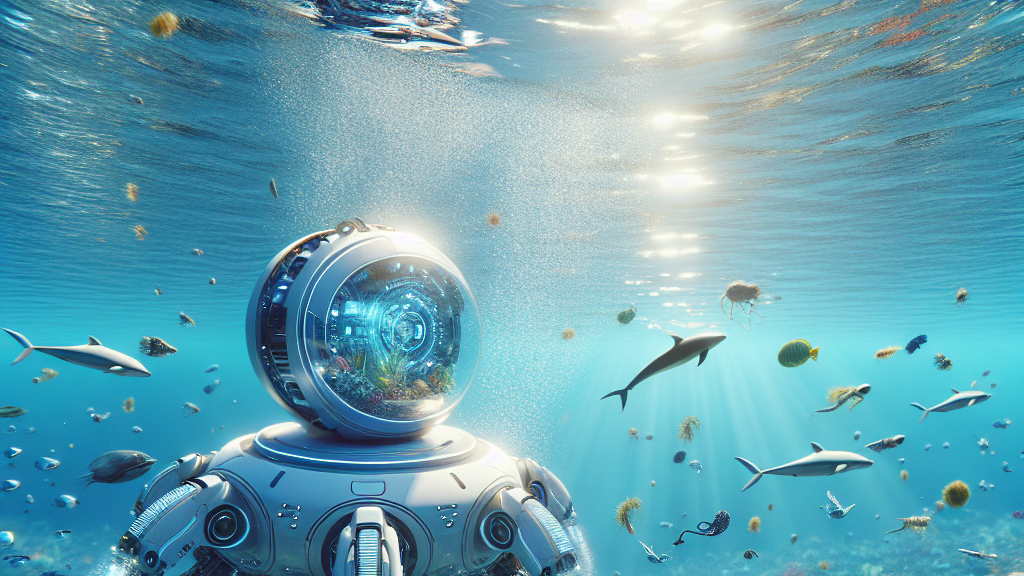
Imagine a future where underwater robots can glide through the ocean, exploring the depths with the grace of a dolphin and the precision of a scientist. Thanks to innovative research, we’re one step closer to making this a reality. By harnessing the power of artificial intelligence, researchers have developed a way to design unique and efficient underwater robots that could change the way we explore and monitor our oceans.

Traditional robot design methods often relied on trial and error, which limited the variety of shapes and efficiency of underwater gliders. Researchers have now overcome these challenges with an AI-enhanced framework that co-optimizes both shape and control signals. By using a reduced-order geometry representation, combined with a neural-network-based fluid model, this breakthrough allows for quick iterations and evaluations, enabling designs that were previously unimaginable.

The impact of this research goes beyond just creating cool new robots. Imagine these efficient gliders being used for long-range ocean exploration and environmental monitoring, collecting data with minimal energy consumption. This could lead to a deeper understanding of our oceans and help in the fight against climate change by improving our ability to monitor environmental changes, such as ocean temperatures and currents, across vast areas.

Underwater robots designed using AI can achieve energy efficiency beyond what traditionally designed robots can reach.

FAQs

What is the core focus of this research on underwater robots?

This research focuses on developing an AI-enhanced framework to design efficient underwater robots by optimizing their shape and control signals.

How does AI improve the design of underwater robots?

AI enables the rapid iteration and evaluation of various designs, leading to more complex and energy-efficient hull shapes by using a neural-network-based fluid surrogate model.

What are the real-world applications of this underwater robot research?

The research can significantly enhance ocean exploration and environmental monitoring by providing highly efficient and long-range gliders that collect data over extended periods.

Why is energy efficiency important for underwater robots in this context?

Energy efficiency extends the range and duration of underwater missions, allowing robots to cover larger areas and gather more data without frequent recharging.

How does this research differ from traditional underwater robot development methods?

Unlike traditional methods that rely heavily on trial and error, this research uses an automated AI framework, drastically reducing design time and allowing for unprecedented shape diversity and optimization.

Background

Autonomous underwater gliders are robots that move through water by adjusting their buoyancy and wings. Traditional design involves manual iteration, which limits shape innovation. In this study, researchers use artificial intelligence to streamline the design process by simulating complex interactions between water and the robot’s shape, allowing for more efficient and novel designs.

History

Underwater robots have evolved from simple diving devices to complex gliders capable of sampling the ocean’s depths. Initially, glider designs relied on conventional trial and error, which hindered rapid innovation. Recent advances in computational power and AI allow for the modeling of intricate solid-fluid interactions, pushing the boundaries of design far beyond previous limitations.

Based on “AI-Enhanced Automatic Design of Efficient Underwater Gliders” by Peter Yichen Chen, Pingchuan Ma, Niklas Hagemann, John Romanishin, Wei Wang, Daniela Rus, Wojciech Matusik, available on arXiv (arxiv.org/abs/2505.00222), used under CC BY 4.0 (creativecommons.org/licenses/by/4.0/).


Trending

Latest

Can AI Save Water Discover How

Computers

AI is transforming the tech world, but it uses lots of water! A new tool, SCARF, helps us measure and reduce AI's water footprint,...

Whats a Forbush Decrease and Why Should We Care Whats a Forbush Decrease and Why Should We Care

Space

Scientists just observed the biggest solar storm event in years, revealing unexpected cosmic ray patterns. Understanding these changes could help us protect our technology...

Can Cars Spot Danger Faster Than Humans Can Cars Spot Danger Faster Than Humans

Computers

Think about how quickly you react when something unexpected happens on the road. This research brings us closer to creating self-driving cars that can...

Can Fear of the Other Stop Social Harmony Can Fear of the Other Stop Social Harmony

Physics

Fear of the unknown might make it harder for people to agree and get along. This study shows that when people have strong xenophobic...

Can AI Revolutionize Breast Cancer Diagnosis Can AI Revolutionize Breast Cancer Diagnosis

Electricity

This research introduces a groundbreaking AI model that can accurately assess HER2-positive breast cancer using widely accessible staining methods, potentially revolutionizing how we diagnose...

Can AI Transform Your Singing into a Choir Can AI Transform Your Singing into a Choir

Computers

Imagine singing solo and having AI turn you into a choir. This research unveils a groundbreaking AI tool that transforms your voice into rich...

You May Also Like

Computers

Discover how setting a simple power cap on processors can lead to 25% more energy efficiency compared to traditional methods, all while maintaining good...

Computers

Imagine saving electricity without sacrificing your computer’s performance. This study shows that a simple power cap can make your server more energy-efficient by up...

Materials

Researchers have discovered that plasma-powered engines can achieve the highest efficiency possible by using a unique caloric equation of state. This breakthrough could open...

Physics

Switching to electricity-based technology like heat pumps and electric cars makes our energy use much more efficient and sustainable. By doing this, we can...

Materials

This research uncovers how tiny hair-like structures, cilia, help microorganisms move with precision and efficiency, potentially leading to breakthroughs in medical devices and robotics.

Computers

This research explores how different galloping styles can make robots move more efficiently, potentially saving energy and influencing future robot designs.

Physics

Move over, quantum computers! P-computers could soon be the powerhouse for solving tough real-world problems efficiently and with less energy.

Computers

New wireless technology might make our phones last longer between charges by using energy more efficiently, thanks to smarter antennas.

Computers

Imagine solving complicated puzzles way faster than any regular computer could—they’re called Ising machines, and they’re growing into a huge deal because they save...

Copyright © 2024 8ig8rain.

Disclaimer: The content on 8ig8rain.com consists of AI-generated summaries of scientific abstracts from arXiv. Please note that most arXiv abstracts are preprints and may not have undergone formal peer review. While these summaries aim to convey key ideas and potential applications, they are provided for informational purposes only and should not be interpreted as validated scientific findings or professional advice. The summaries are intended to educate, spark curiosity, and inspire further exploration of science.