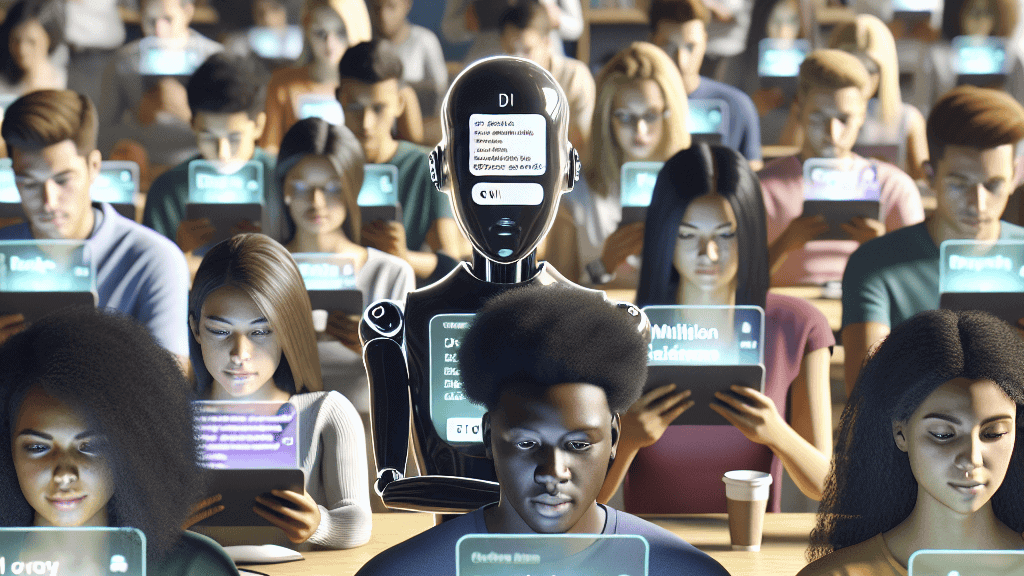
**Imagine a classroom where every student has a personal tutor that gets them.** No more one-size-fits-all education! With AI advancements, like Microsoft’s innovative PHI-3 model, we’re inching closer to this dream. This AI can now ace multiple-choice questions with nearly 91% accuracy, thanks to some tweaks that turn it into a whiz at figuring out the best answer even when faced with tricky wording or ambiguous situations. Forget about struggling through practice tests alone—your digital tutor’s got your back! This breakthrough translates to automated tutors that are not only smarter but also more attuned to each student’s needs, making learning an enjoyable experience rather than a chore.
Picture this: teachers setting up practice quizzes that adapt to students’ strengths and weaknesses effortlessly, freeing up time for creative teaching and one-on-one attention where it’s needed most. This means more tailored feedback and a deeper understanding of subjects, right at students’ fingertips. The integration of such intelligent systems into educational settings not only promises to enhance learning but also prepares students better for the real-world challenges they will face.
**A future where education adapts to each learner’s pace and style is becoming a reality.** With smarter AI like PHI-3, students can receive instant feedback, identify areas they need to focus on, and get more out of every study session. Imagine preparing for exams with an AI that helps you tackle confusing questions and calms your test jitters. As these models become more integrated into classrooms, they hold the potential to transform education, creating a more engaging, inclusive, and effective learning environment for everyone.
The refined AI model increased its accuracy from 62% to an impressive 90.8%, drastically improving its performance.
FAQs
What unexpected discovery did scientists make?
They found that by fine-tuning the PHI-3 language model, it could answer multiple-choice questions with over 90% accuracy.
How does this AI model enhance learning?
It provides instant, tailored feedback to students, helping them understand their strengths and weaknesses, and making learning more efficient.
Why is the decrease in perplexity important?
A lower perplexity means the AI generates text that is clearer and more relevant to the questions, improving comprehension and accuracy.
What role does this AI play in education?
It’s poised to revolutionize learning by making automated tutoring more effective and personalized, benefiting both students and teachers.
How might this technology change classrooms?
By allowing for personalized learning experiences, freeing up teachers to focus on creative and individualized instruction, enhancing overall educational outcomes.
Background
Large Language Models (LLMs) like Microsoft’s PHI-3 are trained to understand and generate text that sounds like it was written by a human. They work by learning patterns in data, which helps them predict what text should come next. However, because language can be complex and ambiguous, these models sometimes make ‘hallucinations,’ or errors, when given vague prompts. The key to harnessing their power lies in fine-tuning them to reduce these errors, especially for tasks like answering multiple-choice questions where precision is crucial.
History
The journey of language models began decades ago with rule-based systems and evolved into statistical models. Recent breakthroughs were marked by neural networks that could process vast amounts of text data, culminating in models like OpenAI’s GPT series. This study builds on these developments by focusing on making models not just smart, but also efficient and reliable for specific educational tasks, marking a new milestone in how AI can support learning.
Based on “(WhyPHI) Fine-Tuning PHI-3 for Multiple-Choice Question Answering: Methodology, Results, and Challenges” by Mohamed Hisham Abdellatif, available on arXiv (arxiv.org/abs/2501.01588), used under CC BY 4.0 (creativecommons.org/licenses/by/4.0/).