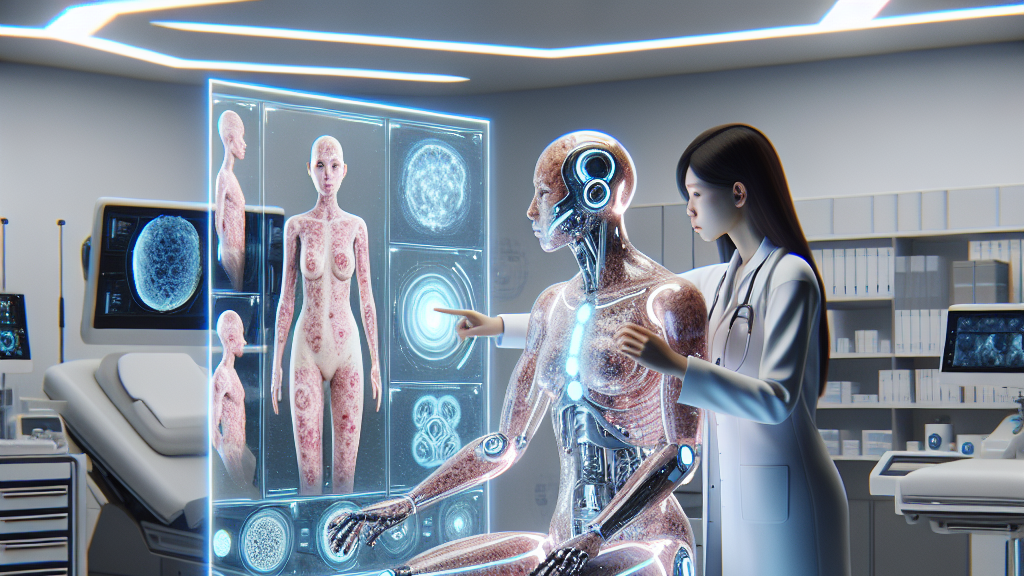
Imagine a world where machines and doctors join forces for the perfect diagnosis. That’s what this new research has achieved by developing a collaboration between AI and medical experts to produce perfect skin disease images. This innovation isn’t just science fiction but a real breakthrough in healthcare where technology meets human expertise to enhance medical imaging accuracy.
The researchers created a framework called MAGIC, which stands for Medically Accurate Generation of Images through AI-Expert Collaboration. Instead of relying solely on machines, they incorporated expert feedback to guide AI in creating more realistic skin disease images. This collaboration ensures that the images are not only accurate but clinically useful, bridging the gap between quantity and quality in medical imaging.
The benefits of this research are vast. For one, it allows for a higher diagnostic accuracy, which is particularly crucial when dealing with rare or complicated skin diseases. By training with synthetically accurate images, medical models can improve understanding and identification of skin diseases, making doctor visits more effective. Imagine a future where AI-generated images help your doctor diagnose you faster and more accurately—it’s no longer just a dream!
Did you know? The MAGIC framework increased diagnostic accuracy by over 9% just by using AI-generated images!
FAQs
What makes the MAGIC framework so special in medical imaging?
The MAGIC framework stands out because it combines AI with expert medical knowledge to create synthetic yet highly accurate medical images. This collaboration ensures the images are clinically relevant and useful for diagnostic purposes.
How does the AI improve the accuracy of diagnosing skin diseases?
The AI improves diagnostic accuracy by using expert-reviewed synthetic images for training. This increases the AI’s ability to recognize and accurately identify different skin conditions, even in challenging cases where real-world data is scarce.
Why is human expertise important in AI-generated medical images?
Human expertise ensures that AI-generated images are not just realistic but medically accurate. Experts provide essential feedback that guides AI to produce images that truly reflect the complexity of human conditions, improving their reliability in clinical settings.
Can this research affect everyday medical practices?
Yes, it can greatly enhance everyday medical practices by streamlining the diagnostic process for skin diseases. Faster and more accurate diagnoses can improve patient outcomes and make healthcare more efficient.
What challenges do AI models face without expert collaboration?
Without expert collaboration, AI models may produce medically inaccurate images that could lead to incorrect diagnoses. Expert input ensures the accuracy and reliability of the images, which is essential for effective medical use.
Background
Medical imaging is a crucial component of diagnosing various conditions, but its reliability is often undermined by limited data and disease variability. Diffusion models can generate synthetic images to fill this gap, but they lack clinical precision without expert collaboration. By integrating human expertise into the image creation process, we can ensure that these synthetic images are not only plentiful but also accurate and clinically useful.
History
The journey towards integrating AI into medical diagnostics has been ongoing, with significant strides made in areas like automated image reading. However, the challenge of producing clinically valid synthetic images has persisted until now. Previous methods often relied heavily on manual evaluations or inflexible algorithms. The MAGIC framework builds on these efforts, leveraging the burgeoning capabilities of AI and human collaboration to enhance the clinical utility of synthetic images.
Based on “Doctor Approved: Generating Medically Accurate Skin Disease Images through AI-Expert Feedback” by Janet Wang, Yunbei Zhang, Zhengming Ding, Jihun Hamm, available on arXiv (arxiv.org/abs/2506.12323), used under CC BY 4.0 (creativecommons.org/licenses/by/4.0/).