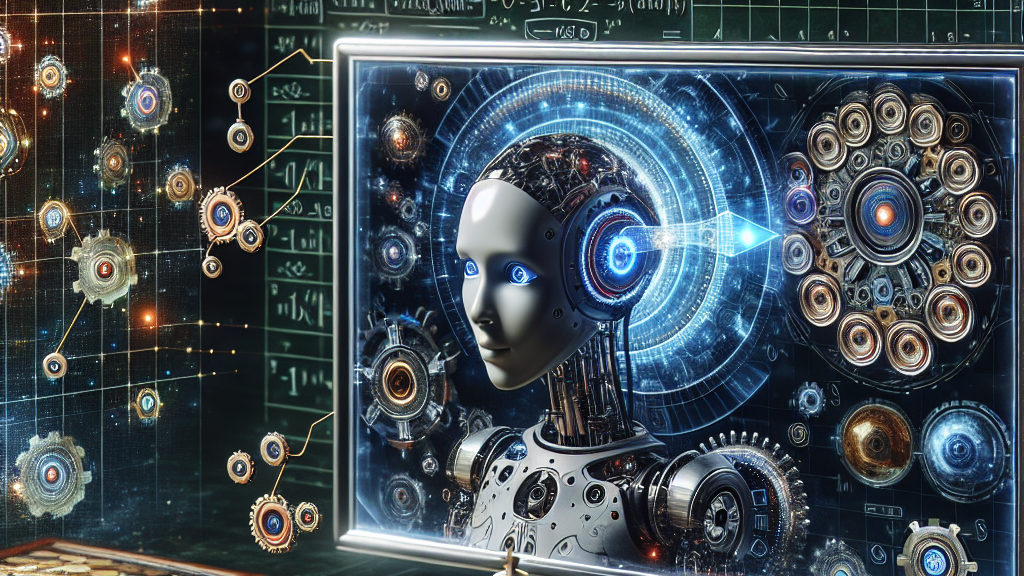
Imagine if your computer could not only solve complex math problems but also learn from its mistakes and improve over time. That’s exactly what new AI models are aiming to do. Researchers have developed a system called SPHERE that helps smaller AI models to think more like humans by learning from their past errors and trying out different problem-solving paths. This is a big deal because it means more reliable AI that can handle complex scenarios without frequent hiccups.
SPHERE is a self-evolving tool that goes beyond static methods like pre-programming or prompt engineering. It enhances an AI’s ability to solve tough math problems by generating its own solutions, correcting mistakes, and exploring various ways to reach the solution. Tests have shown that models trained with SPHERE perform at a higher level than many existing AI systems, even rivaling some of the most advanced ones like GPT-4.
In the future, imagine using your smartphone to solve intricate math problems or even help with personal finance with a simple query, all thanks to smarter AI. With improved accuracy and adaptability, AI could take over many time-consuming tasks, giving us more freedom to focus on what truly matters.
Did you know? SPHERE-trained AI can sometimes outsmart GPT-4 in math problem-solving!
FAQs
What makes SPHERE different from other AI training methods?
SPHERE enhances AI by allowing it to self-generate solutions, correct errors, and explore diverse reasoning paths, unlike static methods that can’t adapt to new problems.
How does SPHERE improve mathematical reasoning in AI?
By enabling AI to iterate its problem-solving process, SPHERE helps AI models learn from mistakes and become more adaptable and reliable in tackling complex math problems.
Can smaller AI models really compete with larger ones using SPHERE?
Yes, SPHERE equips smaller AI models with enhanced reasoning abilities, allowing them to perform on par with or even surpass some larger models in certain mathematics-based benchmarks.
Why is closing the reasoning gap in AI important?
Improved reasoning makes AI more reliable across various applications, from educational tools to financial planning, ultimately creating smarter and more efficient technology that benefits everyday life.
Could SPHERE’s approach be applied to other fields beyond math?
Absolutely! The self-evolving model of SPHERE has the potential to transform how AI approaches problem-solving in fields like science, engineering, and even language processing.
Background
Large language models, or LLMs, are advanced AI systems that excel at understanding and generating human-like text. Despite their prowess, they struggle with complex multi-step tasks like solving tough math problems due to challenges like error propagation, where a small mistake can lead to bigger ones, and their inflexibility in adapting to various reasoning styles. The research aims to overcome these hurdles by introducing an innovative tool called SPHERE that enhances the reasoning capabilities of smaller language models (SLMs).
History
The journey to improve AI’s problem-solving capabilities has been ongoing. Initially, attempts were made through fine-tuning, a method where models were adjusted using specific datasets, but these lacked flexibility. Prompt engineering, where AI is guided with carefully crafted inputs, provided some improvements but still fell short for complex tasks. SPHERE represents a significant breakthrough by introducing a self-evolving mechanism that lets AI models learn and adapt dynamically, building on past efforts and significantly advancing AI’s reasoning capabilities.
Based on “Self-Evolved Preference Optimization for Enhancing Mathematical Reasoning in Small Language Models” by Joykirat Singh, Tanmoy Chakraborty, Akshay Nambi, available on arXiv (arxiv.org/abs/2503.04813), used under CC BY 4.0 (creativecommons.org/licenses/by/4.0/).