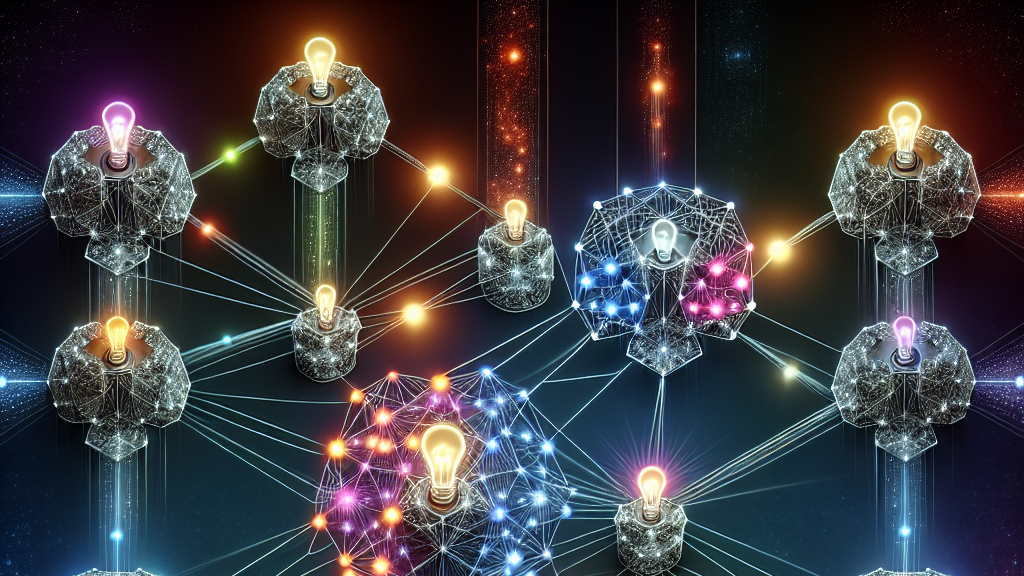
Imagine if computers could learn and grow smarter just like we do, by sharing ideas and building on what they know. That’s exactly what researchers are exploring with a cutting-edge concept in artificial intelligence (AI) called ‘agentic AI.’ These systems can independently tackle different challenges but communicate and share what they’ve learned to create a powerhouse of collective knowledge. It’s almost like giving machines their own version of teamwork!
The groundbreaking aspect of this study is a new approach called MOSAIC, which lets different AI agents work together despite not interacting directly or having a central boss. Imagine a world where AI agents can choose the best knowledge by recognizing similarities in tasks, much like picking the best answer when solving a puzzle. The key is in combining these abilities with unique AI tricks, such as neural network masks and something fancy called ‘Wasserstein embeddings’ for figuring out which skills to use and share.
This teamwork allows AI to solve problems much faster than they’d manage alone. Think of it like how we learn quicker when studying with friends who know different parts of a subject. Beyond just problem-solving, this approach gradually builds a progressive learning path, starting with easy challenges and moving to more complicated ones. It could mean more advanced AI systems in the future, capable of tackling tasks thought impossible just a few years ago!
Did you know? The MOSAIC approach allows AI to learn some tasks that would be impossible if they worked separately!
FAQs
What is Agentic AI and why is it important?
Agentic AI refers to systems that operate independently to learn and make decisions, acting with autonomy. It’s important because it mirrors human-like learning processes, enabling AI to adapt and scale with greater efficiency over time.
How does the MOSAIC approach improve AI learning?
The MOSAIC approach enhances AI learning by allowing multiple AI agents to share and reuse knowledge without needing a central controller. This increases learning speed and helps solve complex tasks that single AI systems may struggle with.
What makes Agentic AI different from traditional AI?
Unlike traditional AI, which often needs a centralized control or coordination, Agentic AI can independently learn and adapt while collaborating through shared knowledge, making it more efficient and scalable.
Why is collaborative learning in AI considered beneficial?
Collaborative learning in AI is beneficial because it allows for faster adaptation, solving more complex tasks, and continuously evolving AI capabilities by building on shared experiences and knowledge among different agents.
How does the concept of learning curricula apply to AI in this research?
The learning curricula in AI refers to a sequence of tasks that gradually increase in difficulty. MOSAIC facilitates the emergence of such curricula, allowing AI systems to build their knowledge from easier tasks and progress to harder ones, similar to human learning.
Background
In the realm of artificial intelligence, some systems can operate autonomously—without needing constant human guidance. This concept is known as ‘agentic AI.’ It emphasizes systems that are self-directed, can make decisions over time, and improve by learning from their experiences, just like humans. Key to this research is how AI can learn collectively and independently, solving problems through shared knowledge without the need for a central command.
History
Exploring the autonomy of AI systems hasn’t been the first attempt to innovate AI’s learning potential. Earlier research relied heavily on guided learning, requiring substantial human input and central control. The shift towards agentic AI introduces a significant evolution, moving from isolated learning to independent systems that can share and integrate knowledge, building on the idea of AI teamwork.
Based on “Collaborative Learning in Agentic Systems: A Collective AI is Greater Than the Sum of Its Parts” by Saptarshi Nath, Christos Peridis, Eseoghene Benjamin, Xinran Liu, Soheil Kolouri, Peter Kinnell, Zexin Li, Cong Liu, Shirin Dora, Andrea Soltoggio, available on arXiv (arxiv.org/abs/2506.05577), used under CC BY 4.0 (creativecommons.org/licenses/by/4.0/).