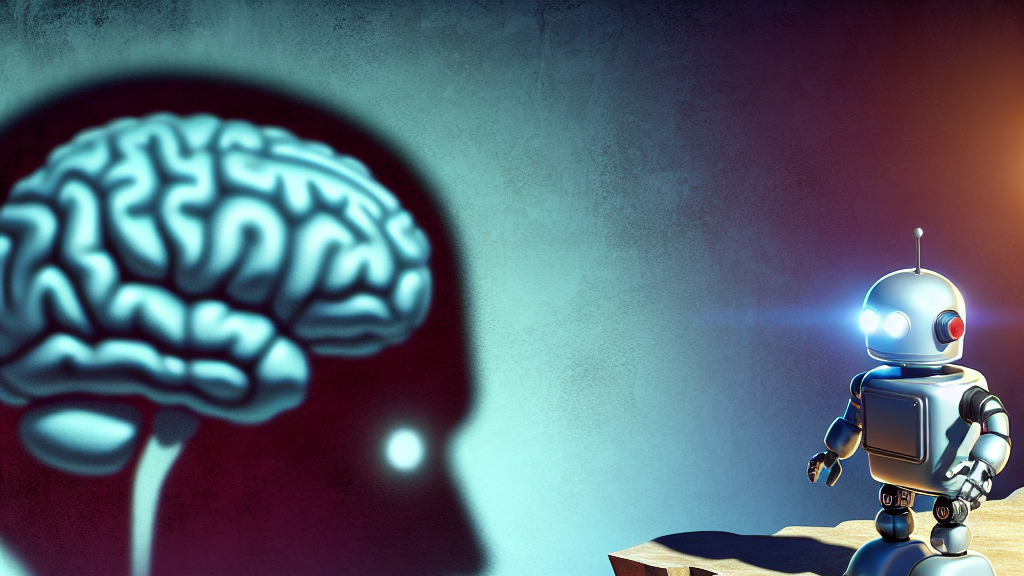
What if machines could learn the same way animals do, by experiencing fear and avoiding danger? That’s the cutting-edge research happening right now, with scientists looking at the early development of the brain’s fear center, the amygdala, to inspire a new kind of artificial intelligence. This approach is all about teaching machines to avoid negative outcomes by using internal motivations, much like we avoid touching a hot stove after burning ourselves once.
Researchers have designed a unique memory-augmented neural network to create what’s called an ‘intrinsic reward function.’ This is like giving a machine its own inner voice that warns, ‘Hey, this is dangerous, stay away!’ By applying these insights, the machine can learn to avoid ‘death’ states—those tricky situations where making a wrong move could have catastrophic consequences. This system, tested in a virtual environment, helps the AI navigate and solve challenges that come with unclear danger signs.
Imagine the practical applications: from smarter self-driving cars that are even better at avoiding accidents, to robots that can independently navigate hazardous environments like disaster zones without explicit instruction. By incorporating a fear-like mechanism, machines are becoming smarter and more autonomous, learning not just from programmed rules, but from experiences that mirror human and animal behavior.
Surprisingly, even AI can ‘learn’ to avoid danger using concepts inspired by the human brain’s fear response!
FAQs
{“How does fear conditioning help AI avoid danger?“:”
Fear conditioning in AI is inspired by the biological process where animals learn to avoid harmful situations. By integrating an ‘intrinsic reward function,’ AI can identify and steer clear of dangerous states, much like animals do when they learn from past experiences.
“}, {“What is an intrinsic reward function in AI?“:”
An intrinsic reward function provides internal feedback to an AI system, encouraging it to explore safe paths and avoid harmful ones. It’s akin to an inner ‘voice’ or guidance system that helps the AI make better decisions without explicit instructions.
“}, {“Why is it difficult for AI to learn from environments with negative consequences?“:”
In realistic environments, negative states with no feedback, like ‘death,’ are challenging for AI to navigate because they provide no direct information to the system for learning. The ‘fear’ system helps overcome this by using internally generated signals.
“}, {“How does this research impact everyday technology?“:”
This research could revolutionize fields such as self-driving cars and robotics by enabling machines to respond more intuitively to hazardous situations, improving safety and autonomy compared to systems that rely strictly on pre-programmed instructions.
“}, {“What is a memory-augmented neural network?“:”
A memory-augmented neural network is an AI system designed to have a memory component, allowing it to store and recall information, similar to how humans use memory to inform decisions and avoid repeating mistakes.
“}
Background
In AI development, the concept of reinforcement learning is key. It’s about teaching machines to make decisions by rewarding them for good outcomes. Biological concepts like the development of the amygdala, which is involved in fear responses, are now being used to model how AI can avoid dangerous situations by rewarding them internally—a technique inspired by fear conditioning in animals.
History
Traditional AI often relies on clear, programmed rewards or penalties to learn tasks, but they struggle with environments where negative states occur with little feedback. This research builds on past exploration of intrinsic motivation and goal-oriented behavior in AI, inspired by animal psychology, to improve adaptive learning in complex environments.
Based on “Avoiding Death through Fear Intrinsic Conditioning” by Rodney Sanchez, Ferat Sahin, Alexander Ororbia, Jamison Heard, available on arXiv (arxiv.org/abs/2506.05529), used under CC BY 4.0 (creativecommons.org/licenses/by/4.0/).