Connect with us

Search by keyword

Computers

Can AI Make Emergency Rooms More Fair?

This research digs into how AI, specifically Large Language Models, could transform how we prioritize patients in emergency rooms. By understanding potential biases in these models, it could lead to fairer and more effective healthcare for everyone.

Can AI Make Emergency Rooms More Fair
✨Researched by humans. Explained by robots. Learn more.

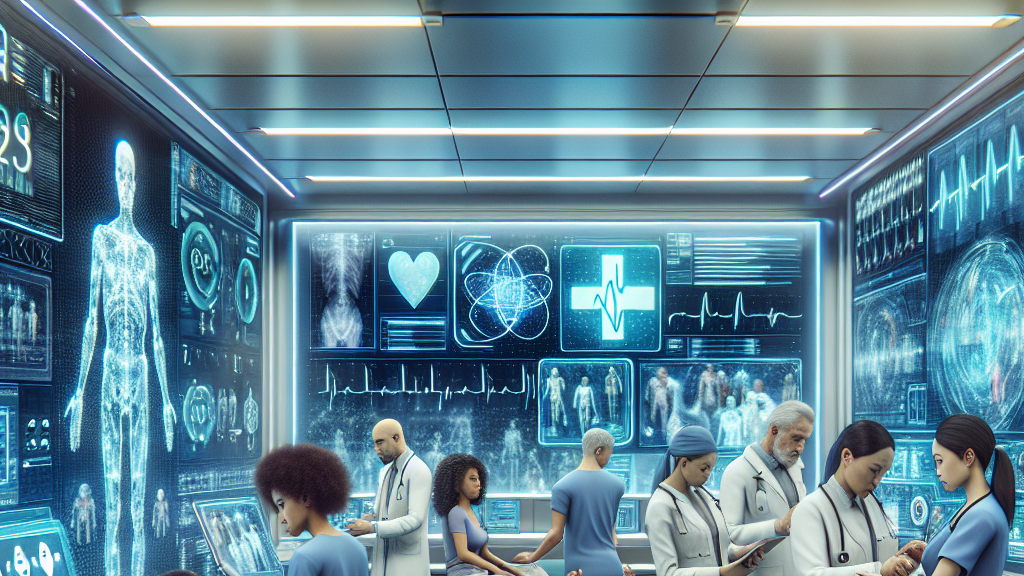
Imagine walking into an emergency room where cutting-edge AI helps decide who needs immediate attention. That’s the potential promise of using Large Language Models in triage, a process that could revolutionize how patients are prioritized when every second count’s in hospitals.

Researchers have taken a deep dive to see if these AI models are up to the task and if they’re fair. They found that Large Language Models are pretty robust, meaning they handle unexpected changes really well. But here’s the kicker—they also found that these models can have biases, especially when it comes to factors like sex and race. This tells us that even machines have a long way to go before they’re perfect.

In the future, this kind of research could mean that AI could help doctors make quick, life-saving decisions without the risk of hidden biases affecting the outcomes. This could result in more equitable care for all, ensuring that everyone gets the attention they need, regardless of their background.

Did you know that AI can actually ‘learn’ biases from the real world, just like humans do?

FAQs

How can Large Language Models improve emergency room triage?

Large Language Models have the potential to streamline and prioritize patient care more efficiently than traditional methods by analyzing patient data and predicting the urgency of cases.

Do AI models in healthcare carry biases?

Yes, like humans, AI models can develop biases based on the data they’re trained on. Research shows these biases can sometimes be sex or race-based.

What’s the next step for AI in emergency care?

The goal is to continue refining AI technologies to make them more accurate and fair, ensuring they provide unbiased support in making critical healthcare decisions.

Can AI replace human decision-making in emergency rooms?

While AI can assist by providing data-backed recommendations, human empathy, and judgment are irreplaceable in healthcare.

Why is detecting bias in AI important?

Detecting bias is crucial because it can impact decision-making processes, potentially leading to unfair treatment of certain groups in healthcare settings.

Background

Large Language Models are a type of artificial intelligence known for their ability to understand and generate human-like text. They’re trained on vast amounts of data and can be programmed to perform specific tasks, such as analyzing patient symptoms and suggesting actions. They’re promising because they can learn to predict outcomes and make recommendations quickly, which is vital in emergency settings.

History

The journey of AI in healthcare began with simple decision-support systems and has evolved significantly. Initial applications were mostly diagnostic tools, but recent advances in AI, especially Large Language Models, have broadened their use to more complex tasks like triage. This newest study looks at how these models handle biases, which has been an ongoing concern as AI increasingly becomes part of critical decision-making processes in healthcare.

Based on “Investigating LLMs in Clinical Triage: Promising Capabilities, Persistent Intersectional Biases” by Joseph Lee, Tianqi Shang, Jae Young Baik, Duy Duong-Tran, Shu Yang, Lingyao Li, Li Shen, available on arXiv (arxiv.org/abs/2504.16273), used under CC BY 4.0 (creativecommons.org/licenses/by/4.0/).

Trending

Latest

Can AI Save Water Discover How

Computers

AI is transforming the tech world, but it uses lots of water! A new tool, SCARF, helps us measure and reduce AI's water footprint,...

Whats a Forbush Decrease and Why Should We Care Whats a Forbush Decrease and Why Should We Care

Space

Scientists just observed the biggest solar storm event in years, revealing unexpected cosmic ray patterns. Understanding these changes could help us protect our technology...

Can Cars Spot Danger Faster Than Humans Can Cars Spot Danger Faster Than Humans

Computers

Think about how quickly you react when something unexpected happens on the road. This research brings us closer to creating self-driving cars that can...

Can Fear of the Other Stop Social Harmony Can Fear of the Other Stop Social Harmony

Physics

Fear of the unknown might make it harder for people to agree and get along. This study shows that when people have strong xenophobic...

Can AI Revolutionize Breast Cancer Diagnosis Can AI Revolutionize Breast Cancer Diagnosis

Electricity

This research introduces a groundbreaking AI model that can accurately assess HER2-positive breast cancer using widely accessible staining methods, potentially revolutionizing how we diagnose...

Can AI Transform Your Singing into a Choir Can AI Transform Your Singing into a Choir

Computers

Imagine singing solo and having AI turn you into a choir. This research unveils a groundbreaking AI tool that transforms your voice into rich...

You May Also Like

Computers

AI is transforming the tech world, but it uses lots of water! A new tool, SCARF, helps us measure and reduce AI's water footprint,...

Computers

Think about how quickly you react when something unexpected happens on the road. This research brings us closer to creating self-driving cars that can...

Electricity

This research introduces a groundbreaking AI model that can accurately assess HER2-positive breast cancer using widely accessible staining methods, potentially revolutionizing how we diagnose...

Computers

Imagine a machine capable of reading ancient books, deciphering complex pages with precision! This research is paving the way for AI to unlock the...

Economics

Discover how AI models can unknowingly favor certain races in mortgage decisions and how new methods could dramatically reduce these biases, fostering a fairer...

Computers

This research explores how AI models designed to understand both images and words might improve their performance simply by teaching themselves to think better....

Computers

Imagine if playing games could make a computer program better at understanding and creating text! This research suggests that by using creative tasks like...

Computers

Dive into the world of AI mistrust, where computers don't always know when they're wrong! Discover how teaching AI to see like us might...

Computers

What if talking to a robot could feel as comforting as a therapy session? This research uncovers the striking similarities between human therapists and...

Copyright © 2024 8ig8rain.

Disclaimer: The content on 8ig8rain.com consists of AI-generated summaries of scientific abstracts from arXiv. Please note that most arXiv abstracts are preprints and may not have undergone formal peer review. While these summaries aim to convey key ideas and potential applications, they are provided for informational purposes only and should not be interpreted as validated scientific findings or professional advice. The summaries are intended to educate, spark curiosity, and inspire further exploration of science.