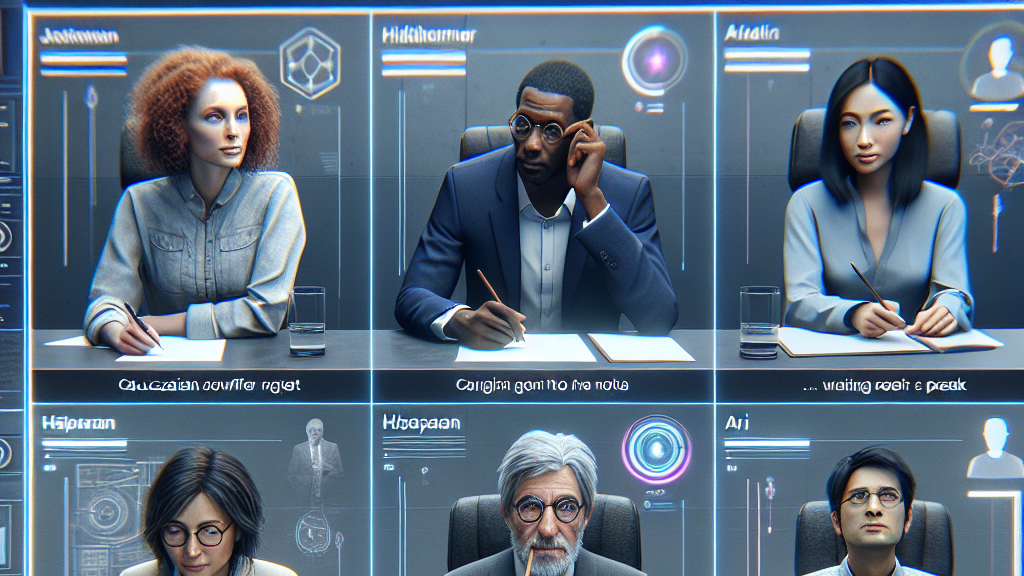
Ever been in a video call where it felt like one person was doing all the talking? You’re not alone! It’s a common issue, and it can make meetings less productive and fair. But what if technology could help change that? Introducing FairTalk, a fascinating new system that uses AI to balance speaking turns in video conferences.
FairTalk works by predicting when people in the meeting want to speak. It uses real data from online video calls to understand the natural cues we give off when we want to say something. When it detects someone is ready to speak, it mimics human behaviors to signal their intention subtly, helping the conversation flow more evenly.
Imagine your next Zoom meeting feels more like a seamless conversation at a dinner party. Everyone shares their ideas equally, and you actually get to hear from each person. FairTalk could transform not just meetings but any scenario where digital communication happens, ensuring fairer and more inclusive discussions, whether it’s a family video chat or a global business conference.
Did you know that subtle signals like eye movement and head nods can predict when someone wants to speak?
FAQs
How does AI technology make video calls fairer with FairTalk?
AI technology in FairTalk predicts when participants in a video call want to speak and subtly signals these intentions, ensuring everyone gets a fair chance to contribute in an online discussion.
Can FairTalk really detect when someone wants to speak in a video meeting?
Yes, FairTalk uses machine learning trained on video conference data to detect subtle cues like eye movements and gestures that indicate a participant’s desire to speak.
What impact could FairTalk have on the inclusivity of online meetings?
FairTalk can make online meetings more inclusive by automatically balancing speaking turns, ensuring all participants have the opportunity to contribute to the discussion equally.
Are there any design considerations from FairTalk’s user feedback?
User feedback on FairTalk indicated that while the system effectively balances speaking turns, the impact wasn’t always noticeably perceived, suggesting further refinement in visualizing speaking intentions is needed.
Why is balancing speaking turns in video calls important?
Balancing speaking turns in video calls is crucial for inclusivity and productivity, as it ensures all voices are heard and respected, leading to more comprehensive discussions and better decision-making.
Background
At its core, FairTalk relies on machine learning to understand and predict human behaviors in video calls. It is based on the concept of turn-taking, where participants in a conversation take turns speaking. Traditionally, we’ve relied on visual and auditory cues like eye contact or clearing one’s throat to signal the desire to speak. FairTalk automates this process by analyzing video data to learn these cues, using algorithms to predict when someone is likely to want to contribute to the conversation.
History
Turn-taking research has a rich history in linguistics and psychology, focusing on how humans naturally manage speaking turns during conversations. FairTalk builds on this research by using modern technology to enhance virtual communication, where visual and auditory cues might be less perceptible. Previous attempts to automate digital communication have focused on speech recognition and natural language processing, but FairTalk diverges by applying machine learning models trained explicitly on video conferencing scenarios.
Based on “FairTalk: Facilitating Balanced Participation in Video Conferencing by Implicit Visualization of Predicted Turn-Grabbing Intention” by Ryo Iijima, Shigeo Yoshida, Atsushi Hashimoto, Jiaxin Ma, available on arXiv (arxiv.org/abs/2505.20138), used under CC BY 4.0 (creativecommons.org/licenses/by/4.0/).