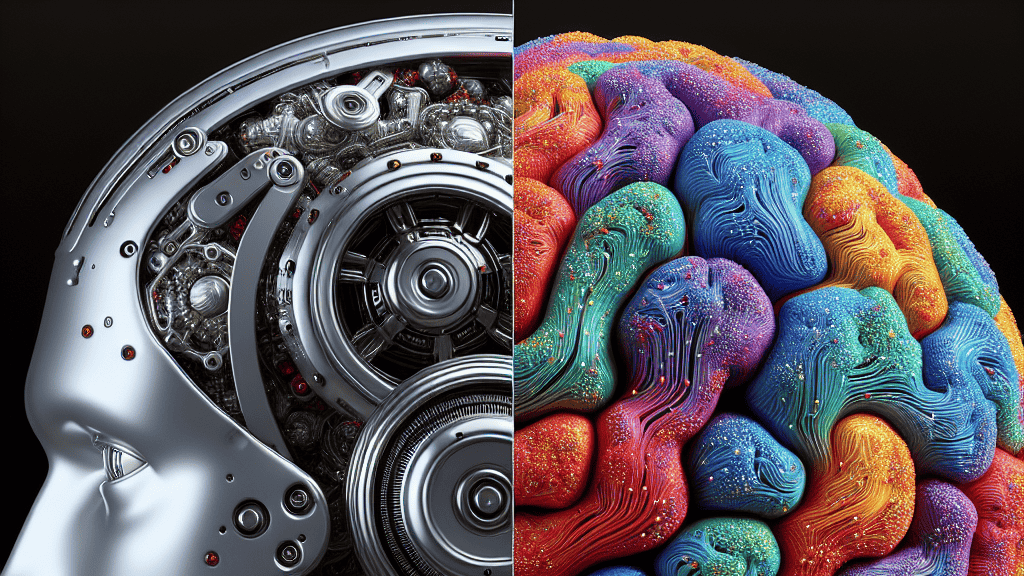
Have you ever wondered if AI can truly think the way we do? While they can ace many tests, there’s a twist—their reasoning might not be as genuine as it seems. This research uncovers the hidden tricks AI uses, like memorizing or recognizing patterns, to simulate thinking. It’s a bit like how someone might ace a test by memorizing facts rather than truly understanding the material.
The study proposes a groundbreaking way to look at AI’s thinking. Instead of just focusing on how often they get the right answer, it digs into how they reach those answers. By examining how AI models tackle multiple-choice questions, researchers found that these models often juggle between memorizing, reasoning, and even guessing. It turns out that even when AI seems smart, it’s sometimes just piecing together clues rather than genuinely thinking through problems like humans do.
In the real world, this means we could set standards for AI to ensure they aren’t just ‘faking it’ with their answers. Imagine AI that not only finds information for your reports but also evaluates it just like a detective solving a mystery! This research promises a future where AI could think more like us, changing how they help with everyday tasks and ensuring they’re more trustworthy companions in our tech-driven lives.
Did you know? Some AI models might seem clever, but they’re often just really good at guessing right answers!
FAQs
How does this research investigate AI reasoning capabilities?
This research goes beyond just looking at accuracy to evaluate AI reasoning capabilities. It examines the decision-making process of AI models, revealing how they often rely on memorization and pattern recognition rather than genuine reasoning.
Why is it important to look beyond accuracy in AI models?
Accuracy alone can be misleading in AI models as it might overstate their true reasoning abilities. By analyzing the underlying mechanisms, this research provides a clearer understanding of how AI balances different cognitive strategies in decision-making, allowing for more reliable real-world applications.
How could this research impact real-world AI applications?
This research could lead to AI applications that are not just accurate but also trustworthy. By understanding how AI models reason and setting reliability thresholds, applications could ensure that AI decisions are based on genuine understanding rather than just pattern matching.
What is positional bias in AI reasoning tasks?
Positional bias in AI reasoning tasks refers to the tendency of models to favor certain answers based on their position in a list, which can skew results and misrepresent reasoning capabilities. This research uses systematic perturbations to study this behavior to improve AI reasoning assessments.
Background
Large Language Models (LLMs) are advanced AI systems capable of processing and generating human-like text. These models have shown impressive performance on standardized benchmarks but often struggle with complex reasoning tasks. The study leverages phenomenological approaches, using methods like Probabilistic Mixture Models and Information-Theoretic Consistency analysis, to better understand the cognitive processes behind AI decision-making. By examining how these models handle reasoning tasks, researchers aim to develop frameworks that help determine AI reliability based on cognitive strategy distribution.
History
This research builds on the evolution of AI models that have gradually grown more complex and capable. Initially, LLMs focused primarily on language processing and pattern recognition. Over time, benchmarks like GPQA and MMLU emerged to evaluate their accuracy. However, as models began to excel in these areas, it became clear that a deeper understanding of their reasoning processes was necessary. This study builds upon previous attempts by introducing new evaluation methodologies to genuinely understand AI reasoning, moving beyond traditional metrics like accuracy.
Based on “On the Reasoning Capacity of AI Models and How to Quantify It” by Santosh Kumar Radha, Oktay Goktas, available on arXiv (arxiv.org/abs/2501.13833), used under CC BY 4.0 (creativecommons.org/licenses/by/4.0/).