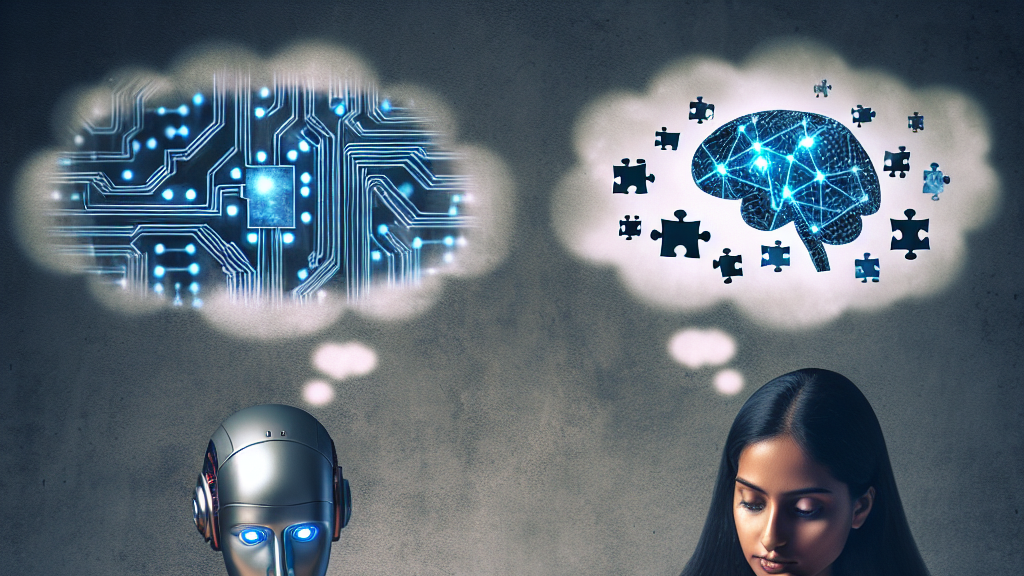
Imagine a world where computers can think like us. That’s not just science fiction anymore—it’s happening. Researchers are teaching AI not just to answer questions, but to think creatively like solving a puzzle. It’s a bit like showing a friend all the different ways they can fix something around the house, rather than just completing the task for them.
This study explores how AI tackles brainteasers, which are puzzles that can have more than one solution. By breaking down these problems into smaller parts, AI can either use a clever shortcut or go step-by-step until it finds the answer. This research digs into how our AI friends not only get to the answer accurately but do it in a way that’s smart and creative, showing that machines might be learning to think in ways we never expected.
In the future, this ability will mean AI can help us come up with new ideas or solutions that we might not immediately think of. Imagine AI helping students figure out a tough math problem by suggesting different strategies, or coming up with fresh designs and products in industries by thinking outside the box. This research reflects a step forward in making AI a more inventive thinker, potentially boosting creativity in our daily lives.
Brainteasers can have multiple solutions, and AI often chooses creative paths to solve them, just like humans do!
FAQs
How do language models solve brainteasers with creative solutions?
Language models use a combination of semantic parsing, generating mathematical solutions, self-correcting against right answers, and step-by-step solution sketches to creatively solve brainteasers.
Why is it significant that AI can solve puzzles like humans?
AI tackling puzzles like humans indicates that AI can approach problems creatively, which might lead to innovative solutions in various fields and everyday challenges.
What improvements are needed for AI to become better at reasoning through problems?
AI still occasionally relies on brute force methods even when creative solutions are available, suggesting a need to enhance its ability to recognize and opt for more efficient reasoning strategies.
How can brainteasers help evaluate an AI’s reasoning capabilities?
Brainteasers are ideal for assessing AI because they require understanding, planning, and decision-making, showcasing the model’s ability to think like a human by choosing among multiple possible solutions.
What role does creative problem-solving play in AI development?
Creative problem-solving in AI is crucial for designing systems that can tackle new, unforeseen challenges, leading to advancements in innovation, adaptability, and learning processes.
Background
This research focuses on understanding how advanced AI models think—not just giving right answers but diving into the ‘how’ behind their problem-solving strategies. It’s like challenging a computer to solve a Rubik’s cube not by memorizing moves, but by figuring out its own inventive ways to get there.
History
Over the years, AI has become excellent at solving specific problems with high accuracy. However, the goal has shifted towards understanding the reasoning process. Previous studies looked at accuracy but rarely at how well AI models mimic human-like problem-solving approaches, which is what this research is now addressing by studying detailed thought processes involved in solving brainteasers.
Based on “Creativity or Brute Force? Using Brainteasers as a Window into the Problem-Solving Abilities of Large Language Models” by Simeng Han, Stephen Xia, Grant Zhang, Howard Dai, Chen Liu, Lichang Chen, Hoang Huy Nguyen, Hongyuan Mei, Jiayuan Mao, R. Thomas McCoy, available on arXiv (arxiv.org/abs/2505.10844), used under CC BY 4.0 (creativecommons.org/licenses/by/4.0/).