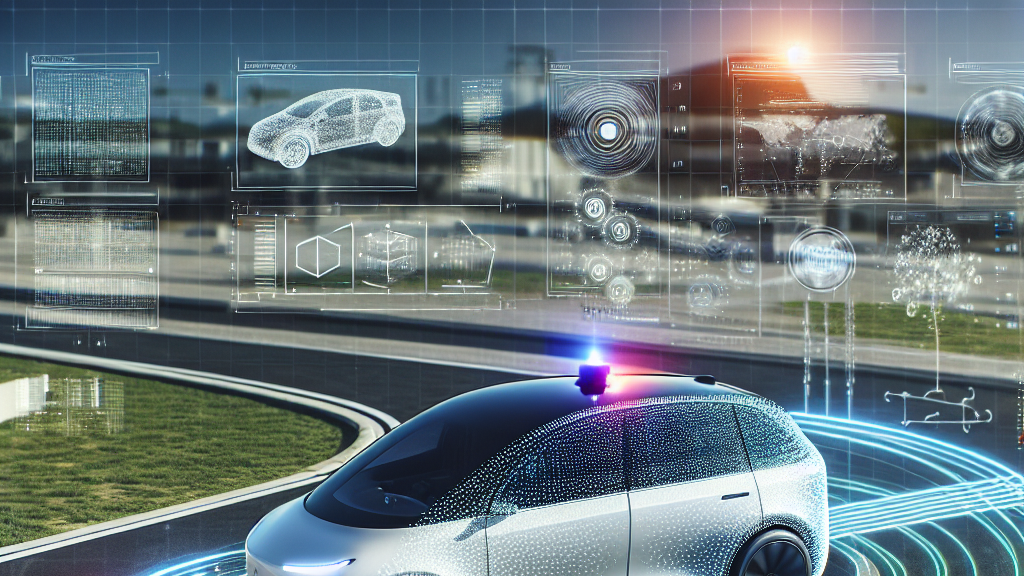
**Imagine if your car could react like a professional stunt driver in emergencies!** This mind-blowing concept isn’t just for the movies—it’s becoming real thanks to groundbreaking research. Through AI and car simulations, scientists are teaching self-driving cars to perform high-risk moves safely. So, in the future, your ride might just be able to dodge danger with the flair of a Hollywood action scene, all while keeping you safe inside. That’s pretty cool if you ask us! At the heart of this innovation is something called ManeuverGPT. It’s a kind of digital brain that uses language processing power to instruct cars on how to pull off breathtaking moves like the J-turns stunt drivers use. Researchers are simulating these scenarios in a virtual world with a system called CARLA. The magic happens through a conversation-like process where the AI receives prompts to adjust its steering and speed. This way, it refines its actions without needing to relearn from scratch. It’s like having the ultimate practice space where self-driving cars can learn to outsmart obstacles in style. **Now imagine this real-world example:** You’re cruising down the highway when—bam!—an obstacle suddenly blocks your path. Instead of panicking, your car calmly calculates the best evasive move. With AI at the helm, it might swerve with precision, guiding you to safety and possibly saving your life. As this technology matures, we could see it becoming as common as airbags and seat belts. It’s a thrilling glimpse into a future where smart cars truly think on their wheels!
Did you know that the J-turn is a maneuver used by stunt drivers and secret agents to quickly reverse direction at high speed?
FAQs
What is the core technology behind AI stunt driving in cars?
The cutting-edge technology is a framework called ManeuverGPT, which uses language processing to control cars for high-risk maneuvers, improving their ability to dodge danger like stunt drivers.
How do autonomous vehicles learn these complex maneuvers?
Autonomous cars practice in a virtual simulation called CARLA, where AI is prompted to adjust its maneuvers iteratively, ensuring safe and agile responses without retraining from scratch.
What real-life scenarios could benefit from AI-driven stunt maneuvers?
In emergencies, such as avoiding sudden obstacles on the road, AI could help vehicles perform precise, quick maneuvers to steer passengers to safety, much like the swift reflexes of a stunt driver.
How does ManeuverGPT ensure safety during these complex maneuvers?
ManeuverGPT uses a blend of language-based reasoning with algorithmic checks for physics and safety, making sure every maneuver respects physical limits and safety constraints.
What are the limitations of this AI-driven stunt driving technology?
Although promising, the technology faces challenges with numeric precision and scenario complexity, meaning it still needs refinement to handle all possible real-world situations safely.
Background
The science behind teaching cars to handle like stunt drivers involves two key technologies: language processing and simulation. Large language models act like a brain for the cars, interpreting instructions and making decisions. Meanwhile, simulation environments like CARLA provide a virtual playground where AI can practice. Safety is prioritized by integrating algorithmic checks to ensure all maneuvers adhere to real-world physics.
History
The journey to this research started with basic autonomous driving systems that could handle straightforward tasks like lane-keeping and parking. As technology advanced, so did the potential for more dynamic and responsive driving. Inspired by Hollywood’s stunt drivers, researchers sought to emulate these complex maneuvers in autonomous vehicles. ManeuverGPT represents a next-gen leap, combining language processing with sophisticated simulations to achieve this goal.
Based on “ManeuverGPT Agentic Control for Safe Autonomous Stunt Maneuvers” by Shawn Azdam, Pranav Doma, Aliasghar Moj Arab, available on arXiv (arxiv.org/abs/2503.09035), used under CC BY 4.0 (creativecommons.org/licenses/by/4.0/).