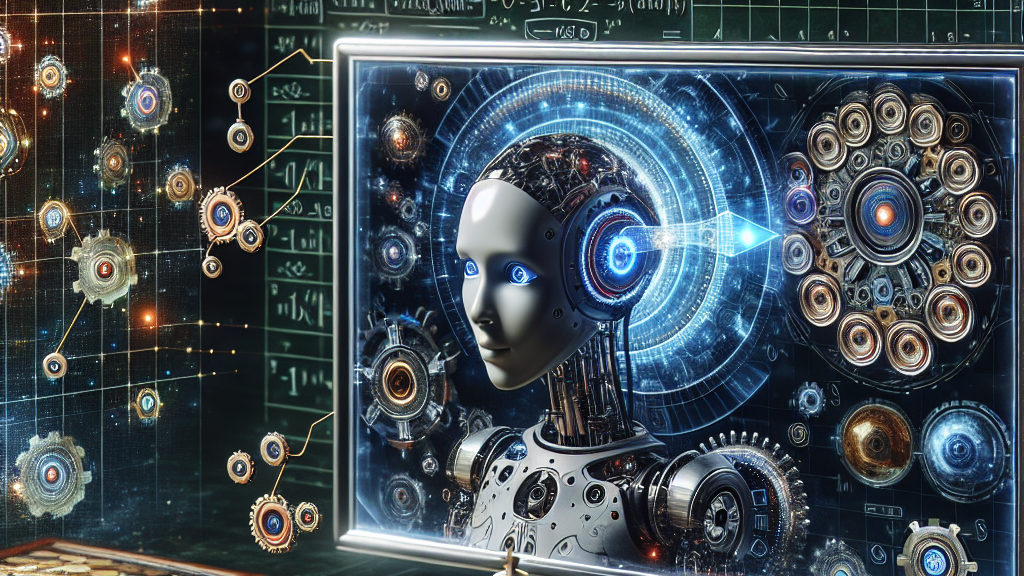
Have you ever watched a video and thought, ‘Wow, that’s complex’? Imagine if computers could not only see, but understand those complexities! That’s what the latest breakthrough in AI video comprehension seeks to tackle with a system called MotionEpic.
MotionEpic uses cutting-edge technology to break down videos into bite-sized pieces, enabling machines to understand every little movement and change, just like our brains do. It’s a little like teaching a computer to watch videos the way we do, by first picking up on small details and gradually understanding the bigger picture. Imagine explaining a complicated scene, like a dancing flash mob or an intricate magic trick, to someone who’s never seen it before. That’s what MotionEpic does on a grand scale.
What does this mean for you? Picture a world where your personal AI assistant doesn’t just play your favorite shows but also helps you understand them better, like highlighting important scenes or predicting plot twists. This technology has the potential to transform educational content, enhance entertainment experiences, and even aid in professional tasks like video editing. It’s like having a super-smart friend who sees and explains everything with precision!
MotionEpic can break down a video scene much like explaining a complex magic trick step by step.
FAQs
What unexpected discovery did scientists make?
Researchers found that by using a Chain-of-Thought approach, similar to human reasoning, they could significantly improve how AI understands videos, allowing machines to ‘think’ through video content step-by-step.
Why is MotionEpic important for the future of technology?
MotionEpic paves the way for more intelligent video content analysis and interaction, with potential applications ranging from entertainment to education and professional video editing.
How does this technology differ from previous video understanding methods?
Unlike prior methods that primarily focus on surface-level analysis, MotionEpic delves into fine-grained pixel details and builds a holistic cognitive understanding through a novel Chain-of-Thought reasoning framework.
Could this have practical uses in everyday life?
Absolutely! This tech can enhance personal AI assistants, making them better at summarizing content, aiding in video editing, and even potentially spotting details we might miss.
How soon could we see this tech in our devices?
While the tech is still developing, its open-source nature means that improvements and applications could develop rapidly, bringing new features to consumer devices sooner than expected.
Background
Video understanding in AI involves teaching a machine not just to see what’s happening in a video, but to comprehend and reason through it like a human. This requires understanding both the visual aspects (spatial) and how things change over time (temporal). A breakthrough in this field is the integration of spatial-temporal scene graphs to represent this information in a more detailed and nuanced way.
History
Video understanding has been a longstanding challenge in AI research. Earlier methods focused primarily on interpreting video content based on visual cues, without deeper reasoning. Recent advancements have incorporated machine learning techniques to improve comprehension, but MotionEpic represents a significant leap by combining cognitive reasoning models with fine-grained scene comprehension strategies.
Based on “Video-of-Thought: Step-by-Step Video Reasoning from Perception to Cognition” by Hao Fei, Shengqiong Wu, Wei Ji, Hanwang Zhang, Meishan Zhang, Mong-Li Lee, Wynne Hsu, available on arXiv (arxiv.org/abs/2501.03230), used under CC BY 4.0 (creativecommons.org/licenses/by/4.0/).