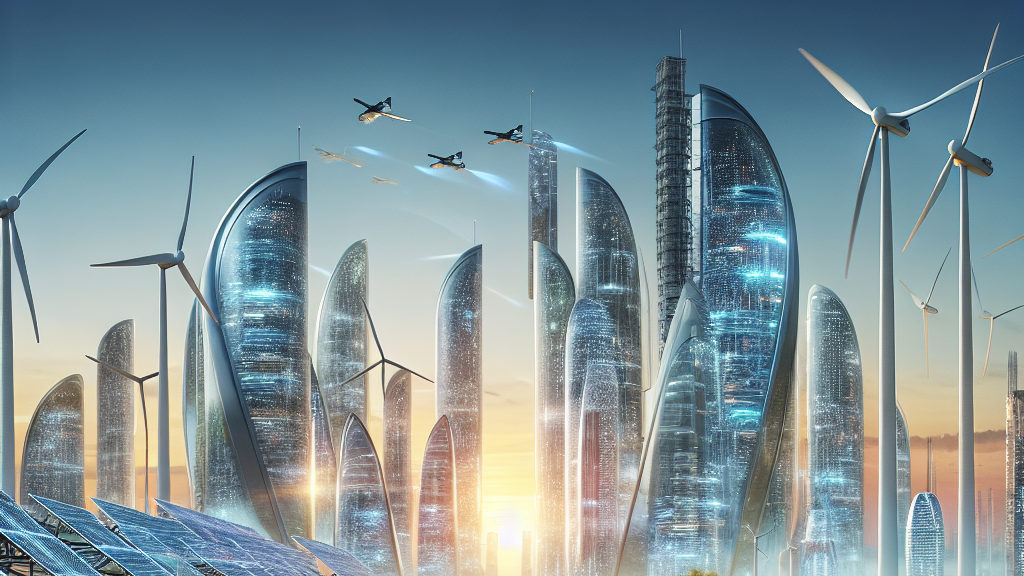
Imagine flying a kite that not only dances gracefully in the wind but also powers your home! This isn’t just child’s play—it’s the future of renewable energy. Scientists are exploring how high-flying kites could capture the wind’s power and convert it into electricity more efficiently than traditional wind turbines. This new kid on the block, Airborne Wind Energy, has the potential to change how we think about powering our world.
Instead of relying on bulky wind turbines, research has crafted a radical approach by using kites to harness high-altitude winds, which are often stronger and more consistent. With smart algorithms known as Reinforcement Learning, these kites can figure out the best patterns in the sky to capture maximum energy. Unlike previous methods that needed detailed wind models, these kites learn from the wind itself, adapting and optimizing their movements on the fly, even in the face of unpredictable and turbulent conditions.
In the not-so-distant future, your local energy provider could harness these kite technologies to supply clean energy to your neighborhood. With their high-flying flexibility, these kites could provide an innovative and sustainable way to meet energy demands without the large and sometimes cumbersome infrastructure of traditional wind farms. By tapping into the limitless supply of high-altitude winds, we are one step closer to a cleaner, greener future.
Did you know that the wind at higher altitudes can be up to twice as strong as near the ground?
FAQs
How does Airborne Wind Energy differ from traditional wind turbines?
Airborne Wind Energy involves using high-flying kites or gliders instead of stationary turbines. They capture stronger, more consistent winds at higher altitudes, potentially generating more energy with less infrastructure.
What role does Reinforcement Learning play in Airborne Wind Energy?
Reinforcement Learning enables kites to learn optimal flying paths by adapting to real-time wind conditions, unlike traditional methods that rely on predefined models. This makes the system more efficient and adaptable.
How might Airborne Wind Energy impact renewable energy in the future?
Airborne Wind Energy could revolutionize renewable energy by providing a more efficient and flexible way to harness wind power, especially in areas where traditional wind infrastructures aren’t feasible.
Background
Airborne Wind Energy (AWE) seeks to capture the powerful winds at high altitudes using flying devices like kites, which are tethered to ground stations to generate electricity. Traditional wind turbines face challenges such as size, cost, and variability in wind conditions near the ground. By using Reinforcement Learning, a type of machine learning, engineers can create kites that learn and adapt their flight paths to maximize energy capture without relying on fixed wind models.
History
Wind energy has long been used by traditional turbines; however, they are limited by their size and the lower, less consistent wind speeds available at ground level. Kite-based systems date back to early aviation and technology experiments but have recently gained attention as a viable energy source. Reinforcement Learning marks a significant advancement by enabling kites to operate efficiently in real-time conditions, learning and adapting to new situations, which refines past attempts and offers a more promising future.
Based on “Harvesting energy from turbulent winds with Reinforcement Learning” by Lorenzo Basile, Maria Grazia Berni, Antonio Celani, available on arXiv (arxiv.org/abs/2412.13961), used under CC BY 4.0 (creativecommons.org/licenses/by/4.0/).