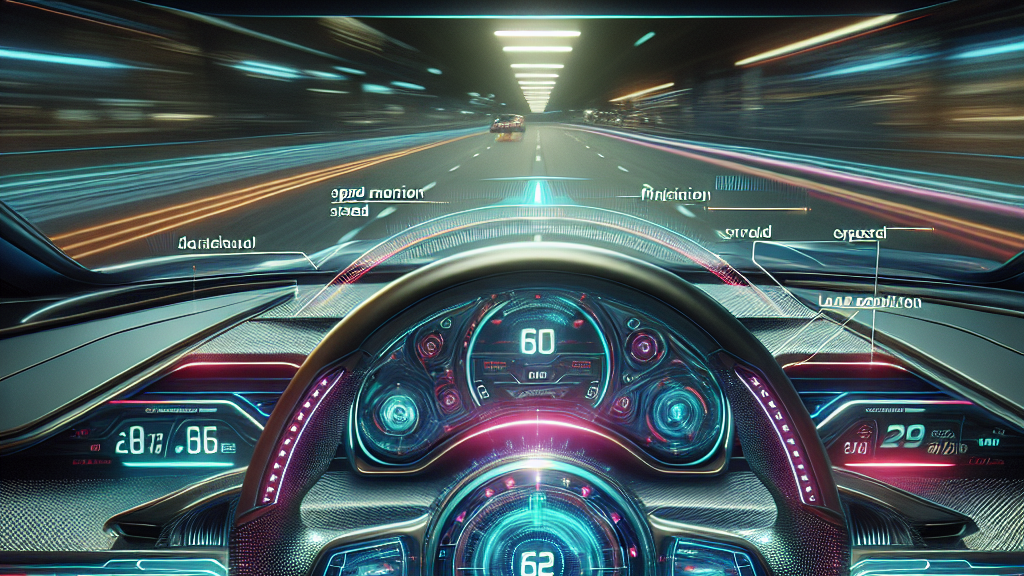
Imagine a world where your car has a guardian angel that keeps you safe without being annoying. That’s precisely what a human-centered safety filter (HCSF) does! It’s a breakthrough in ensuring you’re both secure and in control while driving a smart car. No more sudden brakes or jerked wheels—just smooth, almost invisible support that has your back when you need it the most.
The secret sauce behind this is a neural safety value function, which learns by interacting with the system and applies something called a quality control barrier function safety constraint. If that sounds like a mouthful, think of it as a safety net for your actions that doesn’t want to steal the show. It’s specifically designed for complex systems where you might not know all the ins and outs (like those high-speed racing games), so you can drive with confidence knowing it’s got you covered.
Imagine the thrill of a race, where every move counts, but you have that tiny edge because your car’s safety system is with you. That’s what they tested with the high-fidelity car racing simulator, Assetto Corsa. Drivers loved it; they were safer and happier without the nagging tug of traditional safety measures. It means in the future, your car might keep you safer on the road and make the ride pleasant without making you feel like you’re not in control.
Traditional safety features often intervene abruptly, but this new tech steps in so gently you might not even notice it!
FAQs
What is the human-centered safety filter mentioned in the research?
The human-centered safety filter is a new technology designed to enhance safety in shared autonomy systems like smart cars. It provides support without overly intervening, helping keep drivers safe while allowing them to maintain control.
How does the human-centered safety filter improve user satisfaction?
This safety filter improves user satisfaction by providing smoother interventions that enhance safety without being invasive or taking away the driver’s sense of control, unlike conventional safety systems that can cause abrupt and noticeable changes.
Why is the human-centered safety filter significant in high-speed scenarios?
In high-speed scenarios, maintaining control and safety without sudden corrections is crucial. The filter’s smooth and minimal interventions ensure drivers remain in control, reducing the chance of accidents while maximizing comfort and satisfaction.
How was the human-centered safety filter tested?
The filter was tested using Assetto Corsa, a high-fidelity car racing simulator. This allowed researchers to assess its effectiveness in edge-of-seat driving scenarios, gauging both driver perception and actual safety benefits compared to no assistance and traditional safety systems.
What makes the human-centered safety filter different from conventional safety filters?
Unlike conventional safety filters, which can cause abrupt changes, the human-centered safety filter provides smoother and less intrusive interventions. This is achieved without needing extensive knowledge of the system dynamics, making it versatile for various autonomous systems.
Background
Shared autonomy refers to scenarios where humans and systems work together, like drivers using smart cars. Traditionally, safety measures like automatic braking could be abrupt and jarring. This research proposes a new system that integrates neural networks to identify when to intervene smoothly, maintaining human control while enhancing safety.
History
In the past, safety in autonomous systems often relied on predefined rules or abrupt interventions. As technology advanced, researchers sought to create systems that could adapt and learn, resulting in solutions like the proposed human-centered safety filter that balances safety with user comfort and control.
Based on “Safety with Agency: Human-Centered Safety Filter with Application to AI-Assisted Motorsports” by Donggeon David Oh, Justin Lidard, Haimin Hu, Himani Sinhmar, Elle Lazarski, Deepak Gopinath, Emily S. Sumner, Jonathan A. DeCastro, Guy Rosman, Naomi Ehrich Leonard, Jaime Fernández Fisac, available on arXiv (arxiv.org/abs/2504.11717), used under CC BY 4.0 (creativecommons.org/licenses/by/4.0/).