





































































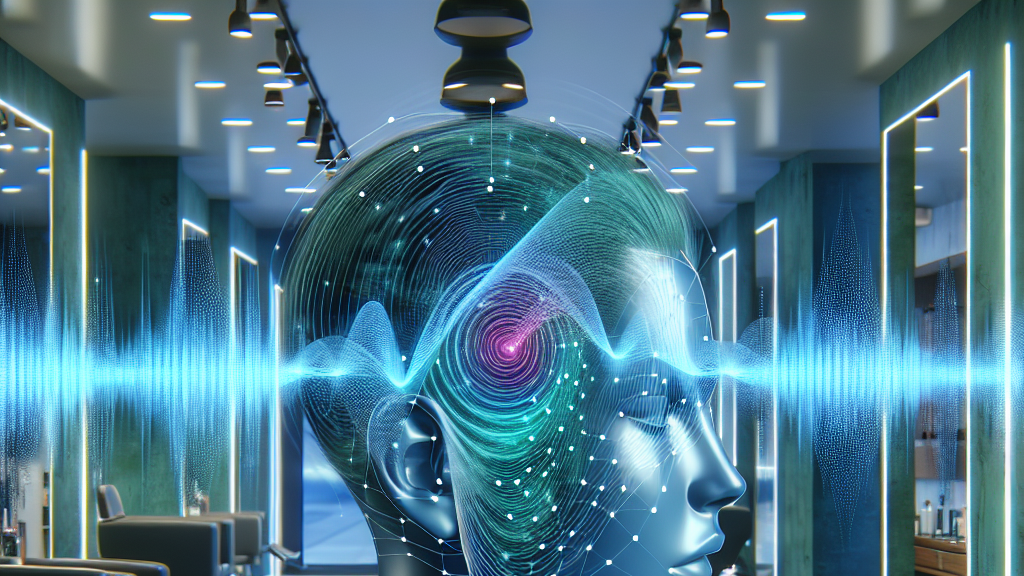
Imagine walking into a salon, and instead of someone tugging at your hair to figure out its type and condition, they simply use sound waves. This might sound like the future, but thanks to groundbreaking research, it’s closer than you’d think. Scientists have discovered how sound waves can interact with an object like your hair, providing critical information about its type and moisture content without any physical contact.
The secret lies in acoustic scattering. When sound waves hit an object, they scatter in ways that carry a wealth of information about that object’s structure and material. By analyzing these scattered sound waves using AI-driven, deep-learning technology, researchers can accurately classify hair types and determine moisture levels with nearly 90% accuracy. They’ve tested various AI approaches, and the most successful was a self-supervised model fine-tuning, which means the AI learned and improved by itself over time.
The potential for this technology goes beyond just hair care. It could revolutionize how we classify materials and objects across industries in a privacy-preserving way since it doesn’t rely on cameras or visual inputs. Imagine a future where sound waves help diagnose issues in machinery without needing to take anything apart or where they assess your skin’s health, all while keeping your data private and secure.
Sound waves can ‘read’ your hair’s moisture level without ever touching it!
FAQs
How can sound waves be used for hair assessment?
Sound waves interact with hair and scatter in ways that reveal information about hair type and moisture level. By analyzing the scattered sound waves using AI and deep learning, researchers can accurately classify hair without any physical contact.
What makes acoustic scattering a privacy-preserving technology?
Acoustic scattering doesn’t rely on visual data, meaning it doesn’t require images or video, which protects personal privacy. Instead, it uses sound waves to gather information, offering a non-invasive and secure method for object classification.
Could this technology be applied beyond hair analysis?
Absolutely! Acoustic scattering technology has the potential to be used in numerous industries, such as diagnosing machinery issues without disassembling parts or assessing skin health, all while preserving privacy by not using visual data.
What accuracy does the AI-driven model achieve in hair classification?
The research achieved nearly 90% classification accuracy by using a fine-tuned, self-supervised AI model, meaning it learned and improved over time without needing constant supervision.
How does deep learning enhance the classification process using sound waves?
Deep learning algorithms can pick up complex patterns in the scattered sound waves, allowing for more precise classifications than traditional methods. As these models learn, they continuously improve their accuracy in interpreting the sound data.
Background
Acoustic scattering occurs when an incident sound wave hits an object and spreads out or ‘scatters’ in various directions. This scattering encodes information about the object’s physical properties, such as structure and material. Using advanced algorithms, particularly deep learning, scientists can decode this information, providing insights that were previously only accessible through direct contact or visual inspection.
History
The use of acoustic methods for analysis has been evolving over the years, with initial studies focusing on underwater sonar and medical imaging. Recent advances in AI and deep learning have allowed researchers to refine these techniques for more diverse applications. This study builds on those foundations by applying acoustic scattering and AI to a new field—hair assessment—demonstrating both technological advancement and a new perspective on non-invasive diagnostics.
Based on “Acoustic scattering AI for non-invasive object classifications: A case study on hair assessment” by Long-Vu Hoang, Tuan Nguyen, Tran Huy Dat, available on arXiv (arxiv.org/abs/2506.14148), used under CC BY 4.0 (creativecommons.org/licenses/by/4.0/).
