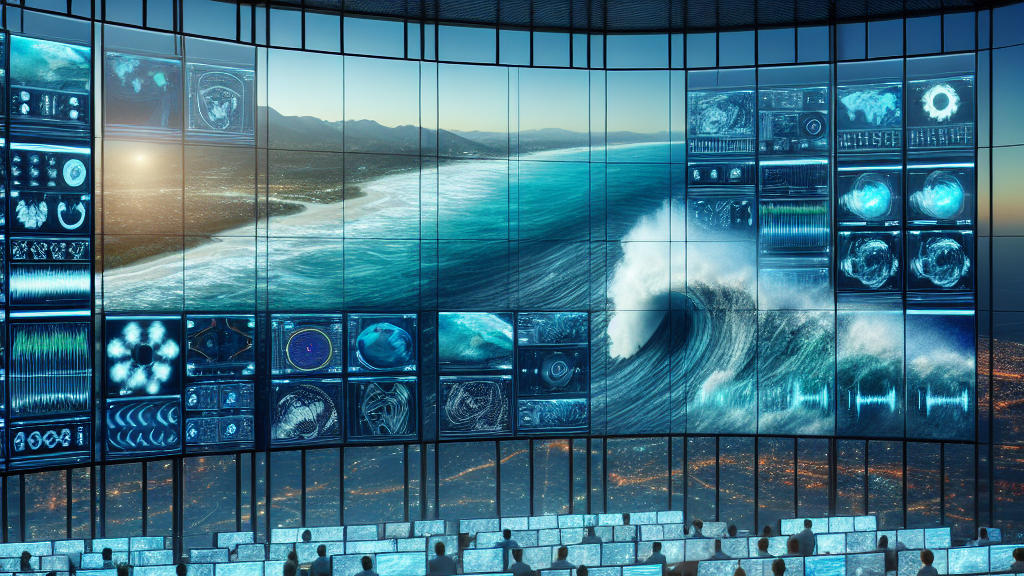
Ever wished we could predict natural disasters before they hit? Thanks to cutting-edge technology, we might be on the brink of making that dream a reality. Scientists have developed a system that uses sound waves from the ocean floor to predict tsunamis almost instantly. This technology could radically change how we respond to earthquakes and impending tidal waves, potentially saving thousands of lives in affected coastal areas.
The core of this revolutionary tech is something called a digital twin. Imagine it as a digital replica of a real-world system—in this case, the ocean floor and its reactions to seismic activities. By using data from sensors and complex math, this twin can predict with incredible speed and accuracy how and when a tsunami might hit. The system leverages cutting-edge graphics processing units (GPUs) to compute these predictions much faster than previously thought possible, meaning that what used to take years of calculations can now be performed in seconds.
So, why does this matter to you? Picture a scenario where coastal communities can be warned of tsunamis almost instantly, giving them precious minutes to evacuate and prepare. Imagine being able to protect lives and property with just a few seconds’ notice, all thanks to an invisible network of sensors and data. This technology is not just about forecasts; it’s about safeguarding futures and changing the way we interact with our planet.
The system’s speed increase is so drastic it’s like compressing 50 years of calculations into just 0.2 seconds!
FAQs
How does this ocean-floor technology predict tsunamis?
This innovative system uses a digital twin, a virtual model of the ocean floor, which receives data from seafloor sensors to predict when a tsunami might occur. It then processes this data using high-speed computational algorithms to offer real-time predictions.
Why focus on the Cascadia subduction zone for tsunami prediction?
The Cascadia subduction zone is a highly active seismic area known for generating significant earthquakes and tsunamis. Studying this zone can enhance prediction capabilities and improve safety for vulnerable coastal communities.
What makes this tsunami prediction technology so fast?
This technology utilizes advanced graphics processing units (GPUs) and innovative mathematical algorithms to process enormous datasets rapidly, enabling predictions in mere seconds rather than years.
How could this technology impact coastal communities?
This advanced prediction system offers real-time tsunami alerts, allowing coastal communities to evacuate and prepare, potentially saving lives and reducing damage during natural disasters.
What are digital twins, and how are they used in tsunami prediction?
Digital twins are virtual replicas of real-world systems. In tsunami prediction, they model the ocean floor’s behavior to forecast how seismic activity might cause tsunamis, using real-time data to improve response times and accuracy.
Background
The scientific concept at the heart of this research is the digital twin, which acts as a virtual representation of a physical system. By integrating data from real-world sensors, such as those on the ocean floor, and running complex calculations, these twins can simulate and predict physical phenomena like tsunamis. Bayesian inversion is a statistical method used here to update the model based on new data. This approach helps refine tsunami predictions by accounting for uncertainties and adapting in real time.
History
Previous tsunami warning systems relied heavily on historical data and took significant time to generate results. Recent advances in digital models and computational power have dramatically improved the speed and accuracy of these predictions. By building on these improvements, this new study utilizes a novel blend of seafloor acoustics, digital twins, and advanced computing to offer unprecedented speed in early warning systems.
Based on “Real-time Bayesian inference at extreme scale: A digital twin for tsunami early warning applied to the Cascadia subduction zone” by Stefan Henneking, Sreeram Venkat, Veselin Dobrev, John Camier, Tzanio Kolev, Milinda Fernando, Alice-Agnes Gabriel, Omar Ghattas, available on arXiv (arxiv.org/abs/2504.16344), used under CC BY 4.0 (creativecommons.org/licenses/by/4.0/).