





































































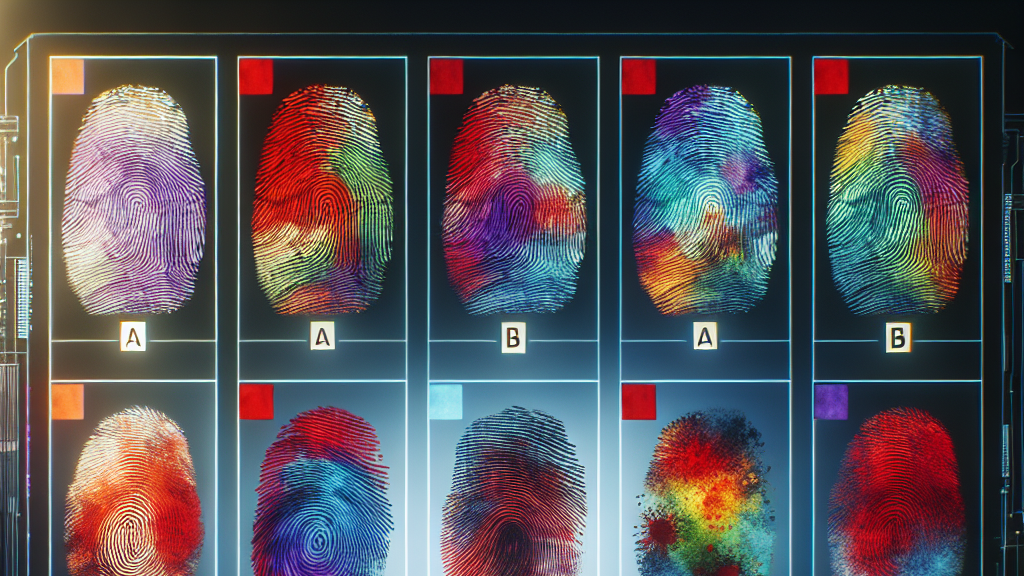
Have you ever wondered if your fingerprints could tell more than just your identity? In a world where personal identification is crucial for security, healthcare, and forensic sciences, scientists embarked on a study to see if there’s any hidden link between the whorls and loops on your fingers and your blood type. Imagine the possibility of unlocking information about your health with just a touch of your finger!
In this intriguing investigation, researchers analyzed the fingerprints of 200 people, classifying them into patterns like loops, whorls, and arches. They then compared these patterns with the participants’ blood groups. Despite the fascinating premise, the results showed no significant correlation between a person’s fingerprint pattern and their blood type. While this outcome might seem anticlimactic, it emphasizes the independence of these two traits and hints that perhaps our fingerprints are more mysterious than we thought.
But don’t dismiss the study just yet. The journey doesn’t end here! This research paves the way for future explorations that could integrate advanced technologies like machine learning and a broader range of biometric signals. Imagine a world where a simple scan could provide a holistic picture of a person’s identity and health, making identification faster, cheaper, and potentially more accurate. The future is ripe with possibilities!
Did you know that the loops pattern is the most common fingerprint type, and blood group O+ is the most prevalent worldwide?
FAQs
How reliable are fingerprints for personal identification?
Fingerprints are highly reliable for personal identification due to their uniqueness, even among identical twins. However, they don’t reveal details about other biological traits like blood type.
Did the study find any correlation between fingerprint patterns and blood groups?
No, the study did not find a significant correlation between fingerprint patterns and blood groups, showing that these traits are independent of each other.
Why is it important to explore connections between fingerprint patterns and blood type?
Exploring potential connections can open doors to more comprehensive identification systems, improving security and healthcare by integrating multiple biometric signals.
What future technologies could enhance biometrics research?
Machine learning and artificial intelligence could significantly improve biometric research by analyzing complex patterns and integrating diverse data sources for better identification accuracy.
How might this research impact everyday life in the future?
Research like this could lead to faster and cheaper personal identification methods, impacting areas like airport security, crime investigation, and personalized healthcare.
Background
Personal identification in forensic science, security, and healthcare often relies on biometrics. Fingerprints are unique to each person, serving as a reliable identification tool. However, understanding other potential links between fingerprints and biological markers like blood type could revolutionize identification methods by offering quick and multifaceted insights into a person’s identity.
History
The use of biometrics dates back to ancient civilizations where unique physical features were used for identification. Over time, forensic science has evolved, integrating DNA profiling and iris scanning for high accuracy. Previous studies have explored various biometric correlations, but none have conclusively tied fingerprint patterns to blood groups. This study builds on that history by analyzing a specific potential link between fingerprints and blood type.
Based on “Predicting Blood Type: Assessing Model Performance with ROC Analysis” by Malik A. Altayar, Muhyeeddin Alqaraleh, Mowafaq Salem Alzboon, Wesam T. Almagharbeh, available on arXiv (arxiv.org/abs/2506.02062), used under CC BY 4.0 (creativecommons.org/licenses/by/4.0/).
