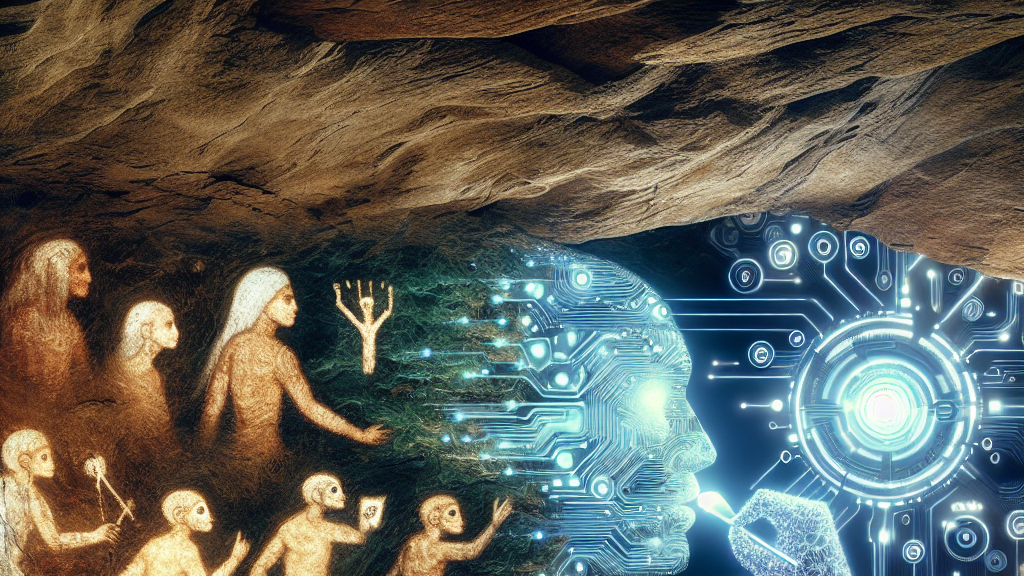
Once upon a time, long before emojis and texting, humans began to communicate with each other using simple drawings and symbols. These were the first forms of writing, bridging the gap between spoken language and the permanent record of ideas. Fast forward to today, and scientists are not just looking back to understand how these early symbols came about but are also using artificial intelligence to uncover the secrets of our ancient communication methods.
In the fascinating realm of AI research, scientists have created something called the ‘Signification Game,’ a kind of simulation where agents, think of them like virtual characters, learn to communicate using pictographs. The game focuses on how these agents can use their ‘visual theory of mind’—a scientific way of saying they can guess what others are thinking based on clues—to create and understand these early symbols. This research isn’t just playing around; it’s a huge step in understanding how our brains might have learned to associate objects with images, a key step in developing writing systems.
But why does this matter to you? Well, imagine one day using a universal symbolic language that transcends words, maybe even helping us communicate with animals or simplify human-computer interaction. It’s like the next evolution of communication, opening up new ways to express ideas and share knowledge. This research is not just a look back at where we started but an exciting leap forward into how we might connect with the world around us, beyond words.
Over 5,000 years ago, the earliest writing systems began with simple drawings called pictographs—sort of like history’s first emojis!
FAQs
How is AI used to study ancient writing systems?
Scientists are using AI to simulate how early humans might have communicated with symbols, allowing virtual agents to learn and use pictographs in a simulated environment called the Signification Game.
What is the ‘Signification Game’ mentioned in the AI writing research?
The Signification Game is a simulation where AI agents learn to communicate actions and ideas using pictographic symbols, showing how early forms of writing might have emerged.
Why is studying ancient communication methods with AI important?
Understanding how early writing systems developed can help us create new ways of communication, possibly even allowing better interaction with animals or more intuitive human-computer interfaces.
Could this AI research change how we communicate today?
This research could lead to new symbolic languages that simplify communication across different cultures or between humans and machines, potentially revolutionizing how we share information.
Background
Symbolic writing systems represent ideas using symbols or pictographs. These first appeared as simple drawings that visually resembled their meaning, like a picture of the sun representing the actual sun. A theory of mind in this context refers to an agent’s ability to understand that other agents have intentions and thoughts, crucial for developing communication systems.
History
For millennia, writing evolved from simple pictographs to complex symbolic systems that convey abstract ideas. The study of pictographs has often focused on their emergence or evolution separately. However, this research combines both aspects to better understand the cognitive processes behind early human communication, emphasizing a connection to both human and animal cognition.
Based on “Visual Theory of Mind Enables the Invention of Proto-Writing” by Benjamin A. Spiegel, Lucas Gelfond, George Konidaris, available on arXiv (arxiv.org/abs/2502.01568), used under CC BY 4.0 (creativecommons.org/licenses/by/4.0/).