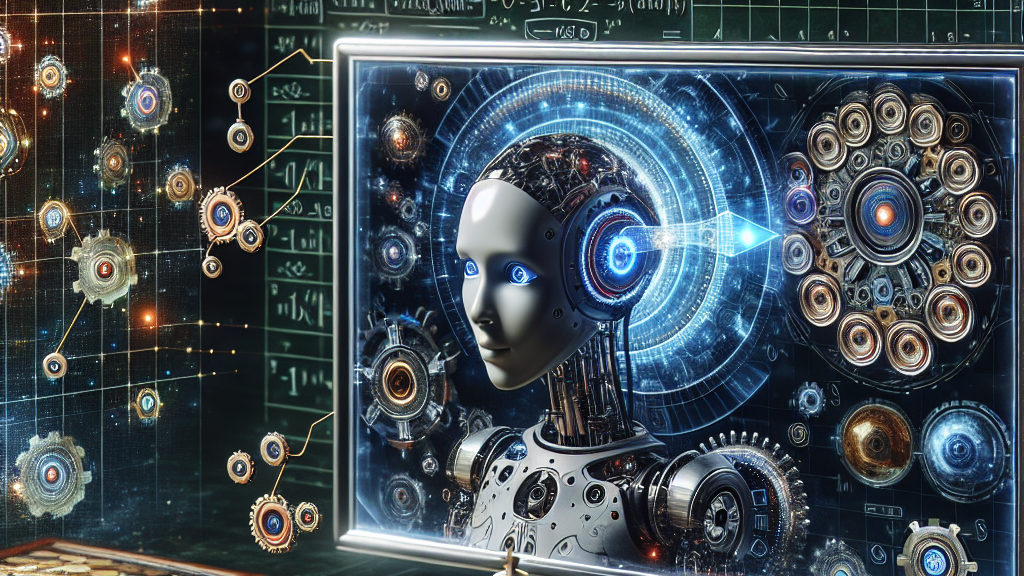
Ever wonder how AI gets so smart? There’s a hidden step in the training process that can make all the difference. This tweak involves a little something called a ‘projection head,’ which acts like a filter, sifting out the noise and ensuring the important stuff gets through. It’s like having a super assistant that makes sure the AI only focuses on what really matters.
The research uncovered a fascinating insight: this projection head works as an information bottleneck. That means it filters out all the irrelevant noise and distractions from the data, leaving AI to learn from only the most critical information. Researchers found that by adding and then removing this projection head during initial training, they dramatically improved AI’s ability to perform actual tasks afterward. Think of it like wearing weights while training, then taking them off for the big game.
So, what does this mean for you? Well, as AI continues to improve with these kinds of advances, we can expect more personalized tech that understands your needs better, smarter apps that predict what you want before you even ask, and maybe even more intuitive tech that makes life easier—and that’s just scratching the surface.
Did you know that a simple extra step during AI training can lead to over 30% better performance in real-world applications?
FAQs
What role does the projection head play in AI training?
The projection head acts as a filter during AI training, sifting out irrelevant information and allowing the AI to focus on what’s important. This step boosts the AI’s ability to learn and perform tasks more effectively.
How does the projection head improve AI performance?
By acting as an information bottleneck, the projection head ensures that the AI only learns from the critical parts of the data, leading to more accurate and efficient decision-making in real-world applications.
What real-world benefits can we expect from this research on AI training?
With advances like this, we could see technology that better understands user needs, smarter predictive applications, and overall more intuitive tech that enhances daily life.
How has this approach been tested?
Researchers tested this approach using several datasets like CIFAR-10, CIFAR-100, and ImageNet-100, consistently finding improvements in the AI’s downstream performance.
Why is the discovery about the projection head important?
This discovery helps create more effective AI systems by refining how AI learns, resulting in technology that can potentially revolutionize everyday experiences and tasks.
Background
In AI training, contrastive learning is a method where the AI learns by comparing different data samples. The ‘projection head’ is an extra layer added to the AI’s neural network during training, which is then removed before the AI is put to actual work. This step allows the AI to filter out unnecessary information during training, enhancing its learning efficiency.
History
In the past, AI training mainly focused on providing vast amounts of data to improve learning. However, researchers found that not all data is equally important. The concept of a projection head emerged as a way to refine the learning process by reducing the noise in data, a subtle yet effective concept that has shown to boost AI performance significantly.
Based on “Projection Head is Secretly an Information Bottleneck” by Zhuo Ouyang, Kaiwen Hu, Qi Zhang, Yifei Wang, Yisen Wang, available on arXiv (arxiv.org/abs/2503.00507), used under CC BY 4.0 (creativecommons.org/licenses/by/4.0/).