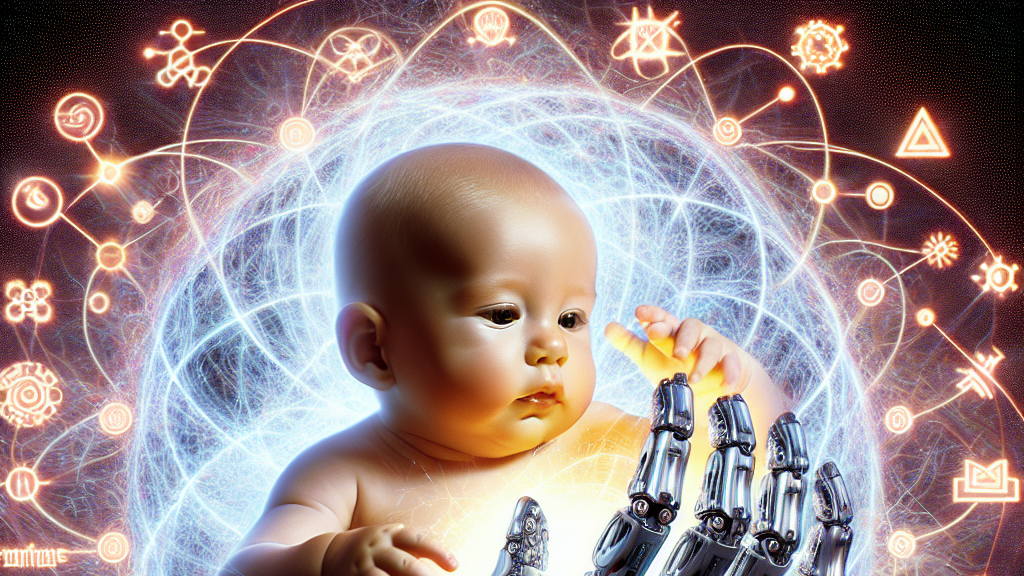
Imagine if babies could teach AI how to learn! That’s the kind of breakthrough we’re talking about. While infants seem to soak up new concepts like sponges, artificial intelligence often struggles to keep up with human-like efficiency and accuracy. New research is diving into how these tiny humans manage such an impressive feat, offering insights that could transform AI development as we know it.
In the study, scientists explored how infants learn concepts like animacy and goal attribution—basically understanding what’s alive and predicting actions. It turns out, babies use these early ideas to grasp even more complex ones down the line. This early understanding helps them predict future events, offering a distinct advantage when compared to traditional AI models, which need tons of examples to learn effectively. By mimicking this process, AI can potentially learn more efficiently, requiring less data while achieving better results.
Think about it: if machines could harness the magic of infant learning, they could become smarter, faster, and more adaptable. Imagine our devices predicting our needs before we even press a button, or a robot assistant quickly learning new tasks without endless programming. The implications are endless, and they start with understanding the astonishing learning power of a baby. This research could be the first step toward bridging the gap between human and machine learning, unlocking incredible new possibilities in technology.
Infants can learn new concepts with just a few examples, a skill many AI models still struggle with.
FAQs
How do infants learn complex concepts faster than AI?
Infants use early-acquired concepts like animacy and goal attribution to learn new, more complex ideas. This natural ability allows them to predict and adapt quickly, a skill AI models generally find challenging.
Why is understanding infant learning important for AI development?
By understanding how infants efficiently grasp complex concepts, we can design AI systems that learn with similar efficiency and adaptability, using fewer examples to achieve better outcomes.
What are animacy and goal attribution?
Animacy is recognizing something as alive, and goal attribution involves predicting future actions based on understanding intentions. These concepts help infants make sense of the world and are used to build more complex ideas.
Could AI ever match the learning capability of infants?
While current AI models lag behind in learning efficiency, studying infants’ learning strategies could help develop AI systems that are faster and more capable, closing the gap between human and machine learning.
What practical applications could emerge from this research?
Understanding infant learning can lead to smarter, more intuitive AI systems that require less data to learn new tasks, resulting in more responsive and adaptable technology in everyday life.
Background
Infants learn through a process of observing and interacting with the world around them, forming foundational concepts early on. These concepts, such as understanding animacy (what’s alive) and goal attribution (inferring intentions), are crucial for making sense of their environment and predicting future events. This ability to learn efficiently and accurately from minimal examples is something current AI models struggle with, often needing vast amounts of data to perform similar tasks.
History
Historically, research in cognitive science has explored how infants develop cognitive abilities. While early studies largely focused on descriptive accounts of infant learning, recent advances have allowed for a more detailed understanding of the underlying processes. Comparisons between human learning and artificial intelligence have sparked interest in creating more human-like AI models, prompting researchers to mimic cognitive strategies observed in infants.
Based on “From Infants to AI: Incorporating Infant-like Learning in Models Boosts Efficiency and Generalization in Learning Social Prediction Tasks” by Shify Treger, Shimon Ullman, available on arXiv (arxiv.org/abs/2503.03361), used under CC BY 4.0 (creativecommons.org/licenses/by/4.0/).