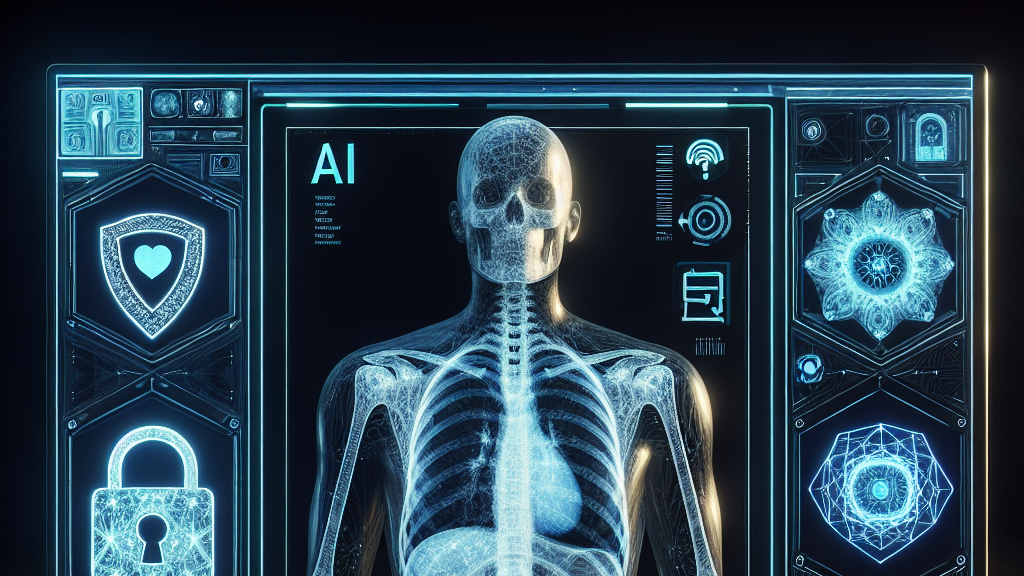
AI is getting smarter every day, even capable of creating medical images like X-rays. But there’s a catch—these systems might accidentally memorize patient information, posing a risk to privacy. This study dives into how texts used to train these models may leave behind clues that could compromise patient data if not managed well.
By examining the language used in prompts and tokens, researchers found that de-identification markers, supposed to protect patient identity, are ironically among the most memorized pieces of information by AI models. This not only surprises the scientific community but also shows that privacy risks are more complex than previously thought. Existing methods to mitigate this memorization during model use haven’t been effective, highlighting a pressing issue in artificial intelligence applications in medicine.
Imagine a future where your medical data is safe even when shared with an AI system for analysis. Researchers propose new strategies to tackle the memorization problem, ensuring that AI can be trusted in critical applications like healthcare. By solving these issues, AI could transform medical imaging securely, improving diagnostics and patient care without compromising privacy.
Did you know that AI can memorize specific phrases from its training data, even if it’s supposed to keep information confidential?
FAQs
How do generative AI models pose a risk to patient privacy?
Generative AI models risk patient privacy by potentially memorizing training data, including sensitive information like patient details in medical images, which could then be unintentionally disclosed.
Why are de-identification markers among the most memorized in AI training data?
Surprisingly, de-identification markers, meant to protect identity, are often repeated in training data, making them more memorable to AI models, which inadvertently increases privacy risks.
What is the MIMIC-CXR dataset and why is it important?
The MIMIC-CXR dataset is a large collection of chest X-rays and associated data used primarily for training AI models in medical imaging. It is crucial for advancing research but needs careful handling to ensure patient privacy.
Why are current mitigation strategies ineffective at reducing AI memorization?
Current strategies fail because they don’t address the deep-rooted way AI models learn and remember data, especially when it involves repeated phrases or markers, necessitating new approaches to manage this memorization.
How might this research change the future of synthetic chest X-ray generation?
This research could lead to improved privacy-preserving methodologies in AI, enabling safer synthetic generation of medical images without exposing sensitive patient information, thus maintaining patient trust and data security.
Background
Generative models are a type of AI that, when given some prompts, can create new data that mimics real-world examples. In medical imaging, these models are trained with datasets like MIMIC-CXR to produce images such as chest X-rays. However, during training, these models might memorize specific data details, posing privacy concerns. ‘De-identification’ refers to methods that strip personal identifiers from data to protect privacy, but if these markers become memorable to AI, they might inadvertently highlight sensitive information.
History
Generative models have transformed diverse fields, from creating art to medical imaging. The MIMIC-CXR dataset, central to this study, has been pivotal in developing AI for medical uses but also highlights challenges with data privacy. Prior research primarily focused on developing models for accurate image generation. This study shifts focus to understanding and mitigating memorization in AI, building on earlier concerns about data privacy and protection in AI applications.
Based on “The Devil is in the Prompts: De-Identification Traces Enhance Memorization Risks in Synthetic Chest X-Ray Generation” by Raman Dutt, available on arXiv (arxiv.org/abs/2502.07516), used under CC BY 4.0 (creativecommons.org/licenses/by/4.0/).