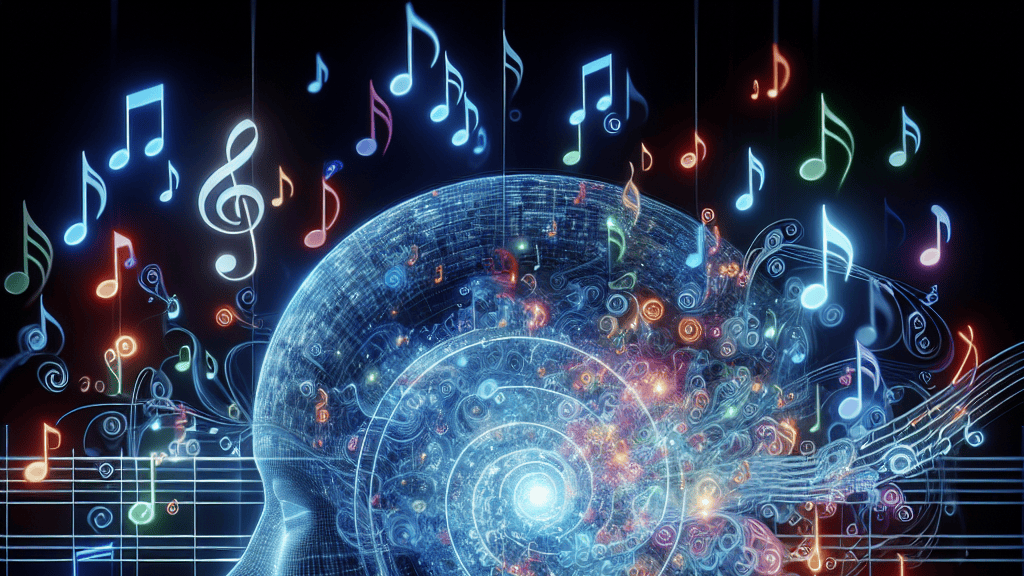
Have you ever wondered if a computer could listen to a musical chord and tell you exactly which notes are being played? Thanks to recent breakthroughs in neural networks, this might not be science fiction for much longer. Inspired by previous Nobel-winning discoveries, researchers are pushing the boundaries of AI by showing how a group of neural networks, when working together, can do more than just recognize patterns – they can actually disentangle them. It’s like having an ear for music, but it’s completely artificial!
The main idea here is based on the principle ‘more is different’. By layering what’s known as associative Hebbian networks, scientists found that these neural networks could do much more than just basic tasks like pattern recognition. Imagine listening to a complex symphony and being able to sing each part separately. That’s essentially what these networks are achieving by breaking down composite signals into their individual elements, similar to separating notes from a chord. It’s a step beyond basic AI capabilities, hinting at a potential future where machines could understand complex data structures in ways we’ve only dreamed of.
So, what does this mean for us in the real world? Think about voice assistants that could not only recognize songs but understand different instruments in a piece of music, or educational tools that could help music students learn by identifying individual notes in a chord. This technology could even extend to interpreting complex visual signals or breaking down language tones. The possibilities are as endless as the notes on a keyboard, promising a harmony between technology and creative expression that could change how we experience music and beyond.
The principle of ‘more is different’ means that complex systems can have properties not evident from their individual parts!
FAQs
What is the principle of ‘more is different’ in AI research?
The principle of ‘more is different’ suggests that complex systems can exhibit behaviors and capabilities that their individual components do not have on their own. In AI research, this means that combining multiple neural networks can lead to innovative functions, like pattern disentanglement, which individual networks alone cannot achieve.
How does the concept of pattern disentanglement work in AI?
Pattern disentanglement in AI involves deconstructing a composite input signal, such as a musical chord, into its fundamental parts, like individual notes. This capability is achieved through layered neural networks that work together to separate and identify distinct elements from a combined signal.
What real-world applications could arise from AI that can disentangle patterns?
AI capable of pattern disentanglement could revolutionize fields such as music analysis, where machines could break down complex compositions into single notes, aiding in music education and creativity. It could also impact areas like audio editing, voice recognition, and even visual data interpretation.
How is this AI research connected to Nobel-winning discoveries?
This AI research is inspired by past Nobel-winning discoveries related to disorder in systems. Scientists like Philip Anderson and Giorgio Parisi have shown that complex systems, when analyzed as a whole, reveal the ‘more is different’ phenomenon, leading to new insights and applications in AI.
Why does this AI advancement matter in our daily lives?
This advancement in AI matters because it represents a significant leap towards more intelligent and capable machines that can understand and manipulate complex data. It opens doors to new technologies that can enhance our interactions with music, art, communication, and beyond, promising a richer integration of AI in everyday life.
Background
The core principle at play here is ‘more is different’, which posits that complex systems often possess unique properties that cannot be inferred from their individual components. This has been observed in areas such as magnetic systems and spin glasses, and is now being applied to neural networks. These networks are computational models inspired by the human brain, capable of recognizing patterns and solving problems through associative learning.
History
The idea of ‘more is different’ was first introduced by Nobel Laureate Philip Anderson in the context of condensed matter physics. His work laid the groundwork for understanding complex systems, which has been further expanded into AI applications in recent years by other researchers, including Nobel-winning physicists. By understanding how disorder and complexity can lead to emergent properties, scientists are now exploring these ideas in the design of neural networks.
Based on “Networks of neural networks: more is different” by Elena Agliari, Andrea Alessandrelli, Adriano Barra, Martino Salomone Centonze, Federico Ricci-Tersenghi, available on arXiv (arxiv.org/abs/2501.16789), used under CC BY 4.0 (creativecommons.org/licenses/by/4.0/).