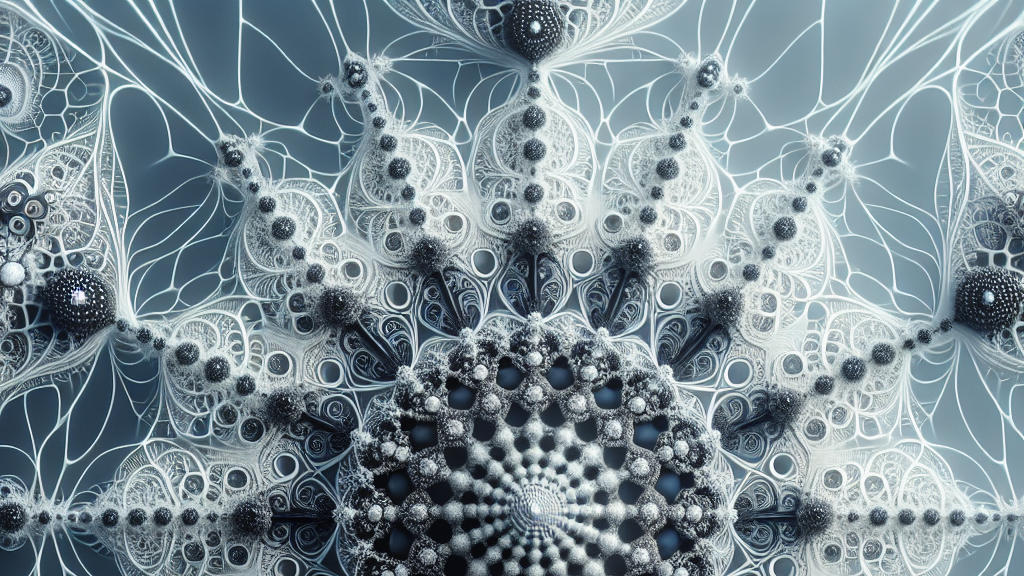
**Did you know that fractals might just hold the key to the next big leap in quantum technology?** Imagine a stunningly complex pattern that doesn’t just exist on paper but has unique properties when it interacts with electrons. Researchers have taken a deep dive into such fractal geometries to uncover their secrets when joined with the mysterious world of quantum mechanics and magnetic fields. It turns out, these patterns can do something extraordinary: they can trap electrons, or in other words, block their passage entirely under certain conditions. A remarkable feat made possible by the quantum quirks of the universe!
The science behind this magic lies in the behavior of electrons as they travel through a fractal structure. When a consistent magnetic field is applied, every closed loop in the fractal interacts with the electrons in a peculiar way through what’s called the Aharonov-Bohm effect. This effect gives those electrons a special “tag” that influences how they move. When scientists hit the sweet spot, the electrons find themselves stuck, unable to move through the fractal. What’s even more exciting is that this behavior is resistant to disorder, meaning it works even when the setup isn’t perfect.
Imagine using this fractal electron trap to build superior quantum computers or sensors! With the ability to control electron flow so precisely, we could design super-efficient algorithms or even create new types of materials. This could revolutionize technology, making processes faster and energy consumption lower, which might even lead to greener tech solutions. And to think it all starts with a simple fractal pattern and a dash of quantum magic!
Fractals are self-repeating patterns that exist both in nature, like snowflakes, and in abstract mathematical designs.
FAQs
What is a quantum fractal geometry, and why is it important?
A quantum fractal geometry is a structure that repeats itself at various scales and has unique electronic properties due to quantum effects. It’s important because these properties can influence how electrons behave, potentially leading to advancements in technology and materials science.
How does the magnetic flux affect electron transport in fractals?
Magnetic flux interacts with the electrons traveling through a fractal by introducing a phase shift known as the Aharonov-Bohm effect. This can influence the paths electrons take, potentially trapping them within the structure under certain conditions.
What real-world applications could this research have?
This research could lead to the development of more efficient quantum algorithms and advanced materials. It might also improve technologies such as quantum computing and energy-efficient devices.
Can electrons really be ‘caged’ within a fractal structure?
Yes, by carefully adjusting the magnetic flux through a fractal structure, electrons can be effectively trapped or caged, blocking their movement. This phenomenon is due to the complex interplay of the fractal geometry and quantum effects.
Are fractals only theoretical, or do they exist in nature?
Fractals are not only theoretical; they exist in nature, such as in the branching of trees, the formation of snowflakes, and the patterns of coastlines.
Background
Fractals are intriguing patterns that repeat themselves at different scales, and they show up in both natural and mathematical forms. Quantum mechanics is the branch of physics that deals with the very small, like electrons, and introduces effects that defy our everyday experiences. In this research, scientists are looking at how patterns within fractals interact with electrons when exposed to a magnetic field, focusing on a fascinating quantum effect called the Aharonov-Bohm effect. This effect suggests that even if electrons don’t cross through a magnetic field directly, they still ‘feel’ its presence and alter their behavior.
History
Fractals have been a subject of scientific intrigue for decades. Initially, they were used to describe complex structures in nature and mathematics. Over time, researchers uncovered their potential in various fields, including computer graphics and signal processing. This study builds on the understanding that fractals aren’t just aesthetically pleasing patterns but have the potential to influence quantum properties, laying a foundation for cutting-edge technologies.
Based on “Aharonov-Bohm caging of an electron in a quantum fractal” by Biplab Pal, available on arXiv (arxiv.org/abs/2505.11590), used under CC BY 4.0 (creativecommons.org/licenses/by/4.0/).