





































































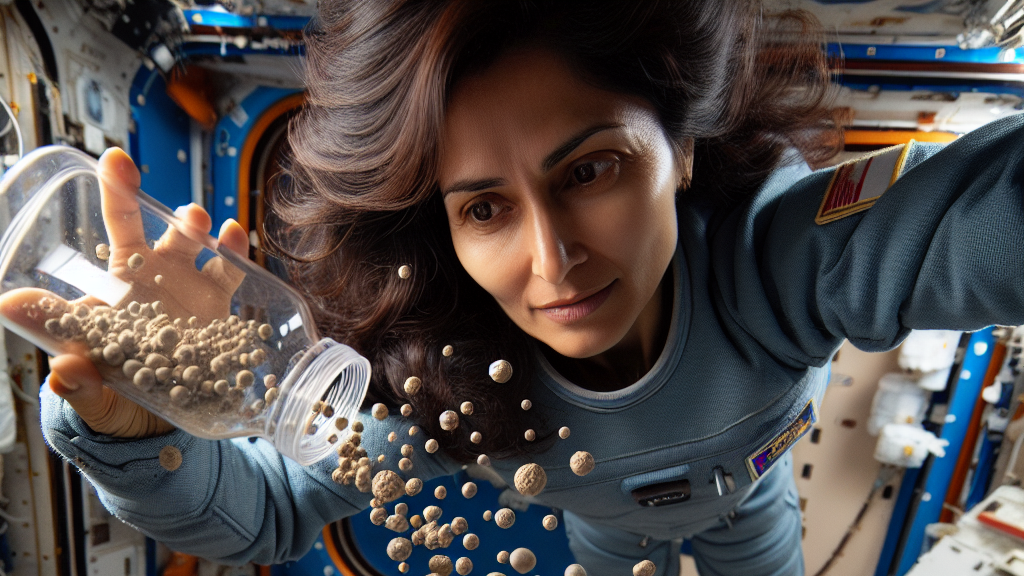
Imagine if simply shaking something in space made it grow faster! That’s essentially what scientists discovered with clay particles on the International Space Station. Without Earth’s gravity, these particles clump together differently, thanks to the station’s slight wobbles. It turns out that these tiny vibrations, caused by the station’s movements, help particles to aggregate faster than they would back on Earth.
While researchers initially set out to watch how clay particles come together in the absence of gravity, they stumbled upon an exciting find: the station’s natural oscillations were actually speeding up the clumping process. This was confirmed by experiments conducted on the station as well as detailed computer simulations. It turns out that these tiny wiggles might be a secret ingredient in shaping how particles behave when no one’s watching.
The implications are shaking things up on Earth too! Think about how this could transform the way we handle anything with particle suspensions, from pharmaceuticals to food products, and even environmental cleanup. By understanding this new aggregation mechanism, industries that rely on mixing and processing liquids could develop more efficient techniques utilizing these space-inspired insights.
Gravity isn’t as crucial for particle clumping as we once thought, thanks to space vibrations speeding up the process.
FAQs
How do microgravity conditions affect clay aggregation?
In microgravity, clay particles clump together differently compared to on Earth. Without the constant pull of gravity, the clay particles are mainly influenced by motion within the fluid, and even small vibrations can significantly increase their rate of aggregation.
Why are space oscillations important for particle growth?
Space oscillations, or g-jitters, from the International Space Station’s movements enhance the rate at which clay particles aggregate. These slight vibrations provide energy that can accelerate clumping more effectively than random molecular motion.
What practical applications could this research have on Earth?
This research could transform industries that involve liquid suspension, such as pharmaceuticals, food products, and environmental science, by leading to new methods that utilize these findings for more efficient processing techniques.
What did numerical simulations reveal about oscillation influence?
Numerical simulations showed that factors like oscillation amplitude and solid volume fraction affect how quickly particles clump together, proving that these oscillations significantly contribute to particle aggregation.
Could these findings impact future space missions or technology?
Understanding how particles aggregate differently in space could influence the design of future space technology, where fluid dynamics play a crucial role in processes like water purification and material manufacturing.
Background
When you think of clay particles clumping together, you might picture them settling and sticking due to gravity. However, in space, without gravity, other forces come into play. Researchers are interested in how these particles behave in microgravity, like on the International Space Station, to understand the fundamental physics behind particle aggregation. Here, the slight movements of the space station, known as g-jitter, can introduce new dynamics that aren’t apparent on Earth.
History
The study of particle aggregation has a long history, starting with research into how and why particles like clay or dust come together. Earlier studies focused on environments here on Earth, using gravity as a constant factor to understand the process. More recently, interest has grown in how microgravity might change these behaviors, especially with the unique dynamics presented by the space environment. This latest study builds on that history by highlighting how oscillations in space can speed up aggregation, offering a fresh perspective on an age-old question.
Based on “Long-term microgravity experiments reveal a new mechanism for particle aggregation in suspension” by Fabian Kleischmann, Bernhard Vowinckel, Eckart Meiburg, Paolo Luzzatto-Fegiz, available on arXiv (arxiv.org/abs/2505.13467), used under CC BY 4.0 (creativecommons.org/licenses/by/4.0/).
